energies, not figures, not forms [1]
but fluid. roughly 85% of the whole universe is energy, although we are much more certain what it is not than what it is, since it is not visible in any form and notoriously difficult to detect. dark another word for ungraspable. the moment one tries to examine its conditions, the very process of investigation disturbs it. on the flipside, ordinary or visible matter – termed ‘normal’ by physicists – constitutes less than 15% of all matter. anomaly is the norm and deviation standard. nonsensical stuff invades our everyday, swirling all around, eluding the exact pinpoint of a place and gesturing precisely to what is not there, lacunar like undetectable particles, only to be intuited, instinctively grasped through minor fluctuations in current and flux, a quotidian practice of deep time, slowly deposited in concentric cycles of life and humours, catalysed, congealed and moulded by joana escoval into condensers, resistances, not sculptures, not objects
[1] Adapted from Rebecca Collins and Adam Matschulat’s eponymous soundpiece Energies not Forms not Figures (2023).
energias, nem figuras, nem formas [1]
mas fluidos. cerca de 85% de todo o universo é energia, embora tenhamos muito mais certeza daquilo que não é do que aquilo que é, uma vez que não é visível sob qualquer forma e é manifestamente difícil de detetar. escuridão outra palavra para incompreensível. assim que se tenta examinar as suas condições, o próprio processo de investigação perturba-a. por outro lado, a matéria comum ou visível – denominada “normal” por físicos e físicas – constitui menos de 15% de toda a matéria. a anomalia é a norma e o desvio, o padrão. coisas sem sentido invadem o nosso quotidiano, rodopiando por todo o lado, escapando ao ponto exato de um lugar e apontando precisamente para o que não está lá, lacunar como partículas indetetáveis, apenas passíveis de serem intuídas, apreendidas instintivamente através de flutuações menores de corrente e fluxo, a prática quotidiana do tempo profundo, depositado lentamente em ciclos concêntricos de vida e humores, catalisados, solidificados e moldados por joana escoval em condensadores, resistências, nem esculturas, nem objectos
[1] Adaptado da obra sonora epónima de Rebecca Collins e Adam Matschulat Energies not Forms not Figures (2023).

Exhibition view: Joana Escoval, Tones of the Spine, 2025.
Enquire

Joana Escoval, pulse, 2025. Magmatic rocks, brass, horse hair, olive blossoms, lichens. 60 x 140 x 103 cm. Unique.
Enquire


Joana Escoval, pulse (detail), 2025. Magmatic rocks, brass, horse hair, olive blossoms, lichens. 60 x 140 x 103 cm. Unique.
Enquire

Joana Escoval, pulse, 2025. Magmatic rocks, brass, horse hair, olive blossoms, lichens. 60 x 140 x 103 cm. Unique
Enquire
but capillaries, tributaries. channels through which currents course and stream, meeting and joining here momentarily in a synthesis of different parts that form a proportionate and concordant whole, their materiality explicitly on display: metals, magmatic rock, human hair, horse mane, olive tree flowers, lichens. vessels that conduct and carry different states of matter in flux: compounds and preparations awaiting succussion and destined for erosion. contrary to convention, entities, subjects, and matters are not self-contained but consistently unsettled by and through circulation: porous breathing bodies enveloped in the same charged material substance in which they exist, inodorous and invisible. the outer world coming into the body through inspiration and leaving as wind gusts through expiration, joining the world again, only different. bodies interconnected through exchanges of atmosphere. spirits rejoice. song, not harmony
mas capilares, afluentes. canais por onde correntes correm e fluem, encontrando-se e unindo-se aqui momentaneamente numa síntese de diferentes partes que formam um todo proporcional e concordante, a sua materialidade exposta explicitamente: metais, rocha magmática, cabelo humano, crina de cavalo, flores de oliveira, líquenes. recipientes que conduzem e transportam diferentes estados da matéria em fluxo: compostos e manipulações à espera de agitação e destinados à erosão. contrariamente à convenção, entidades, sujeitos e matérias não são autónomos, mas consistentemente desestabilizados pela e através da circulação: corpos porosos que respiram, envoltos na mesma substância material carregada na qual existem, inodora e invisível. o mundo exterior entra no corpo através da inspiração e sai através da expiração como rajadas de vento, juntando-se novamente ao mundo, mas alterado. corpos interligados através de trocas de atmosfera. os espíritos rejubilam. canção, não harmonia

Exhibition view: Joana Escoval, Tones of the Spine, 2025.
Enquire

Exhibition view: Joana Escoval, Tones of the Spine, 2025.
Enquire
but monody. monochordic yet never monotonous. a single line running suspended like an evaporating garland, floating along breezes and draughts, all water vapour and carbon dioxide condensation from the expiration of a breathing body, loading this same invisible, gaseous, fluid substance that envelopes all bodies, its molecules alternately compressing and expanding from mouth to ear and through skin. redundantly, literally, and aptly named after its own medium, from which it is indistinguishable and inextricable: air[1] is a single melodic line for solo voice, un- or accompanied in gradual perambulations and permutations of tones at specific lengths and cycles of excitement, otherwise known as frequencies or pitches, whose different colours leave distinct aftertastes that linger even long after they have decayed and faded, allowing room for the next notes to come, the next song or hum. melodic, not harmonic
[1] Airs are short, melodious songs or tunes of Celtic or Gaelic roots, common to Scotland and Ireland, usually for a single solo voice, or voice accompanied by a melodic instrument such as fiddle, flute, lute or others (capable only of arpeggiating chords versus sounding all notes of a chord together).
mas monodia. monocórdica, mas nunca monótona. uma única linha que corre suspensa como uma grinalda que se evapora, flutuando ao longo de brisas e correntes de ar, toda vapor de água e condensação de dióxido de carbono da expiração de um corpo que respira, carregando essa mesma substância invisível, gasosa, substância fluida que envolve todos os corpos, as suas moléculas comprimindo-se e expandindo-se alternadamente, da boca ao ouvido e através da pele. de modo redundante, literal e apropriadamente designada pelo seu próprio meio, do qual é indistinguível e inextricável: ar [1] é uma única linha melódica para uma voz solista, com ou sem acompanhamento, em perambulações graduais e permutações de tons com comprimentos de onda e amplitudes específicas, também conhecidas como frequências ou tons, cujas cores deixam travos distintos que perduram mesmo depois de se terem decomposto e desvanecido, dando espaço às próximas notas, a próxima canção ou zumbido. melódico, não harmónico
[1] Airs (“ares”, em português) são canções ou melodias curtas de raíz celta ou gaélica, comuns na Escócia e na Irlanda, geralmente para uma única voz solista ou acompanhada por um instrumento melódico como o violino, a flauta, o alaúde ou outros (capaz apenas de arpejar acordes em vez de tocar todas as notas de um acorde em conjunto).

Exhibition view: Joana Escoval, Tones of the Spine, 2025.
Enquire

Joana Escoval, armonia I, 2025. Brass, air. 200 x ø 48,5 cm. Unique
Enquire

Joana Escoval, armonia I (detail), 2025. Brass, air. 200 x ø 48,5 cm. Unique
Enquire
but harmonium. an organ composed of free, undamped, unimpeded, thin metal strips or reeds (maybe brass, bronze or gold?) that sound as air is pushed past them, sending them into vibration, fluttering and warbling in the airflow blown from its bellows. the reed organ was baptised organ-harmonium in 1842 while it still was upright and pedal-operated, but arriving in india in 1875, it lost its prefix and pedal to be laid down on the floor and pumped by hand, in the key of accompaniment to devotional south asian musics, where all musicians and singers sit cross-legged, close to one another and to the ground, even when covered by cushions, mats, rugs or carpets. their songlines interlocking patterns of continuous improvisation around different intonational colours, minor inflections and gentle oscillations, rooted in the aether and the earth. Modal, not tonal,
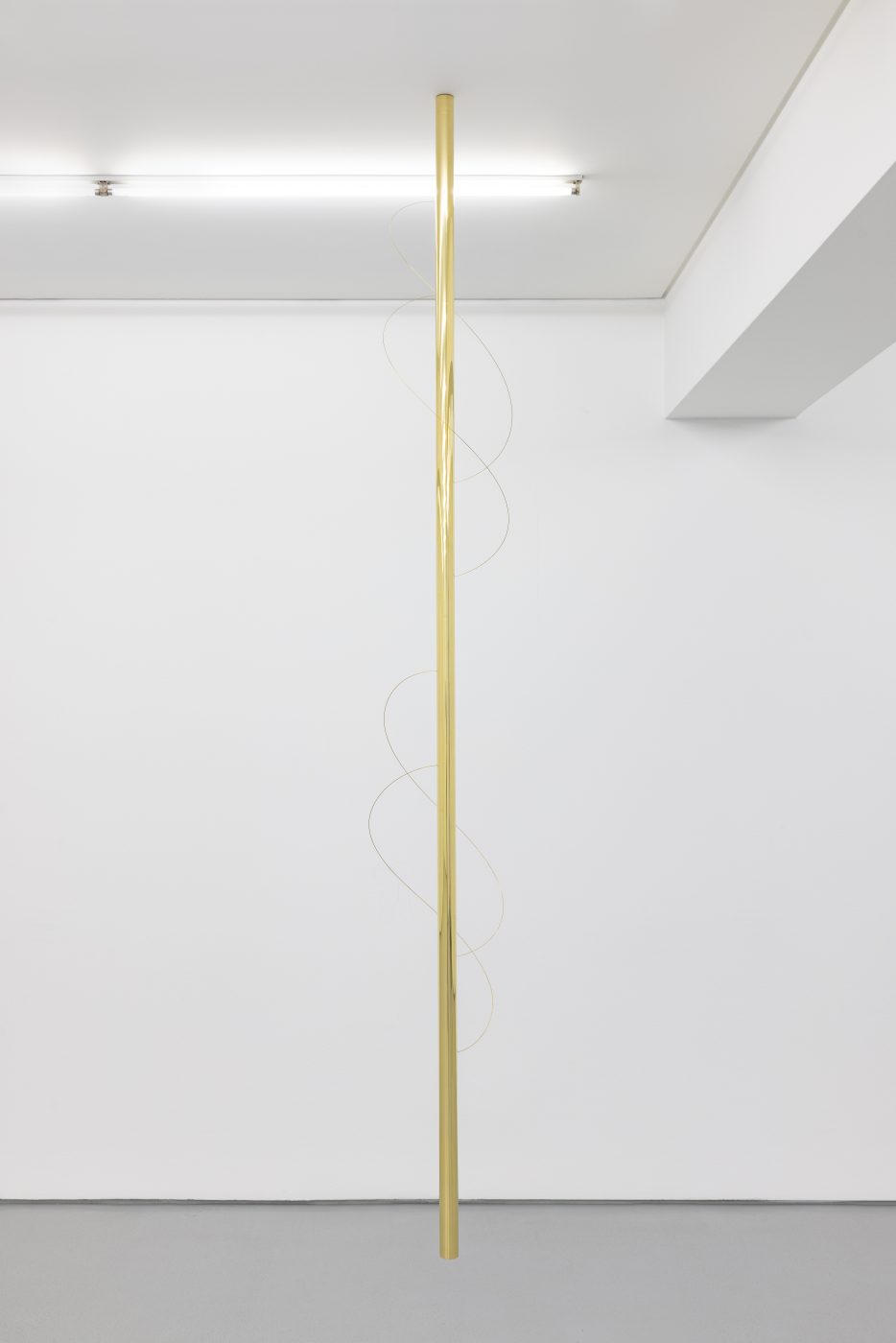

mas harmónio. um órgão composto por tiras ou palhetas metálicas finas, sem atenuação, nem surdina (talvez latão, bronze ou ouro?) que ressoam quando o ar passa por elas, forçando-as a vibrar, a pulsar e tremer de acordo com o fluxo de ar expelido pelo seu fole. o órgão de palhetas foi batizado de órgão-harmónio em 1842, quando ainda era vertical e acionado com pedal, mas ao chegar à Índia em 1875 perdeu o prefixo e o pedal para ser pousado no chão e bombeado à mão ao ritmo dos cânticos devotos sul-asiáticos, durante os quais instrumentistas, cantores e cantoras se sentam de pernas cruzadas, em estreita proximidade entre si e do chão, mesmo quando coberto por almofadas, tapetes, carpetes ou alcatifas. as linhas das suas canções interligadas em padrões de improvisação contínua em torno de diferentes cores entoacionais, inflexões menores e oscilações suaves, enraizadas no éter e na terra. Modal, não tonal,

Exhibition view: Joana Escoval, Tones of the Spine, 2025.
Enquire

Joana Escoval, armonia III, 2025. Brass, air. 220 x 57 x 130 cm. 2 elements 220 x 55 x 55 cm,155,5 x ø 3 cm. Unique
Enquire

Joana Escoval, armonia IV, 2025. Brass, air. 283 x 62 cm. Unique
Enquire

Joana Escoval, armonia IV (detail), 2025. Brass, air, . Unique
Enquire

Joana Escoval, armonia IV (detail), 2025. Brass, air. 283 x 62 cm. Unique
Enquire

Joana Escoval, armonia V, 2025. Brass, air. 211,5 x 30 cm. Unique
Enquire

Exhibition view: Joana Escoval, Tones of the Spine, 2025.
Enquire
but harmolodic. melody with one hand and wind with the other. like the pieces joana has arranged here, their elementality explicitly on display: sun, rain, wind, earth, fire, water, air. unnamed sensibilities, energetic charges that cohere into a temporary whole before disintegrating again. in another moment in time, she conjointly titled them after the armonia – from the greek άρμονία harmonia meaning connection, concord, arrangement, or proportion, deriving from the noun άρμοζ harmos (joint, door hinge) and the verb άρμοζω harmozo (join, connect, being in agreement but also adhere, unite, arrange). a synthesis of different parts forming a proportionate and concordant whole[1]. but like cosmic darkness, it is the discordant holes in the enveloping airflow between materials and elements that allow energy to ‘conduct (usher) itself through a series of self-transformations, which is not a sequential movement from one fixed point to another, but a tumbling of continuous variations with fuzzy borders’[2]. much like the creatures called harmoniums in kurt vonnegut’s book the sirens of titan: sentient creatures living in caves deep in the planet mercury which feed on the sonic vibrations arising from the tension between its perpetually white-hot, sunlit hemisphere and its dark-cold, penumbral one. as they ‘cling to the singing walls of their caves’, the harmoniums ‘eat the song of mercury’, their bodies so thin that these ‘life-giving vibrations can make all their cells tingle without intermediaries’ [3] . creatures that are entirely metabolic, not harmonic,
[1] Etymology of armonia found in etimo.it, http://etimo.it/?term=armonia. English translation by the author.
[2] Jane Bennett, Vibrant Matter: a political ecology of things (London, Durham: Duke University Press, 2010), 59.
[3] Kurt Vonnegut, The Sirens of Titan (New York: Dell, 1959; RosettaBooks, 2000), 131.
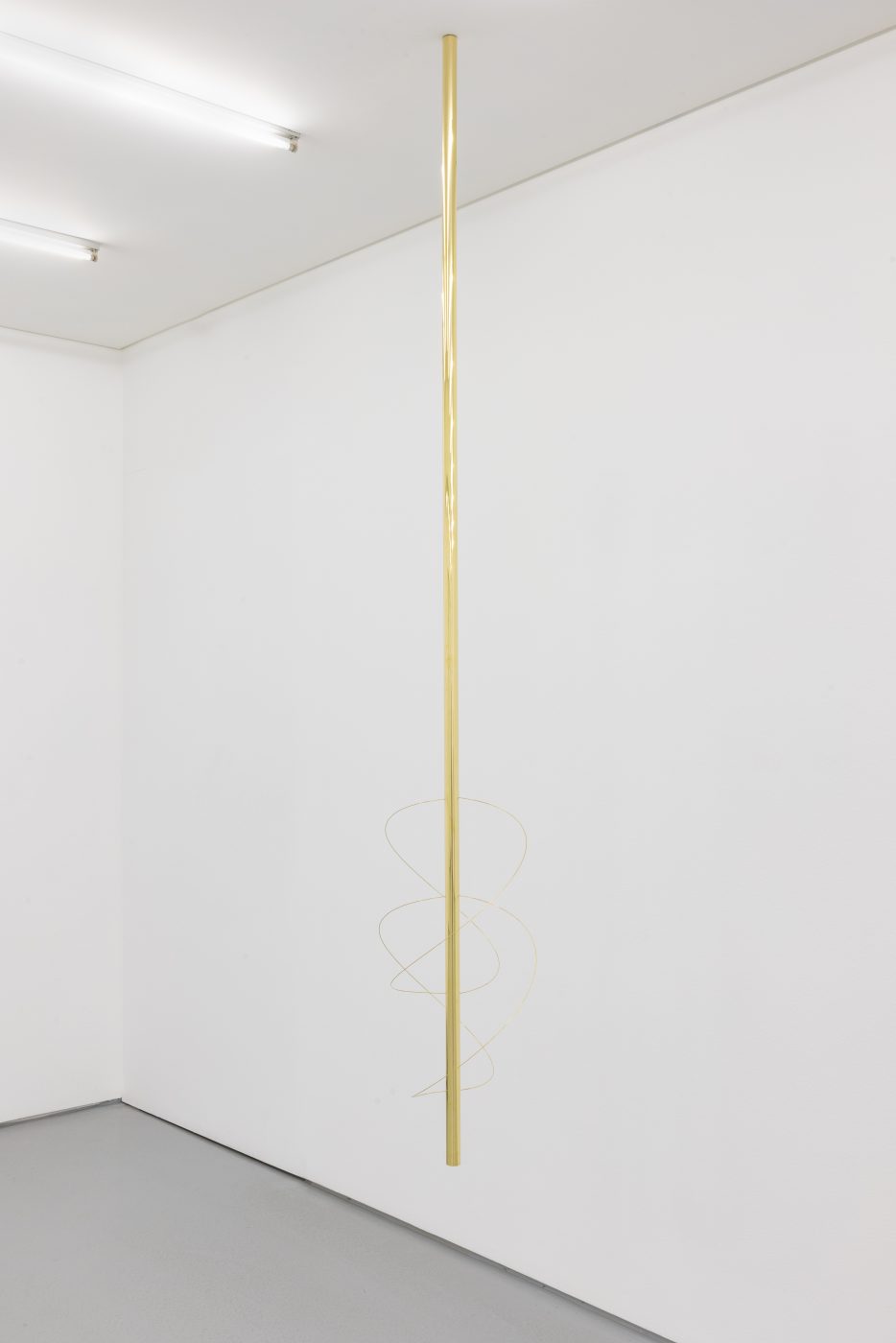

Joana Escoval, armonia VI, 2025. Brass, air. 283 x 62 cm. Unique
Enquire
mas harmoniosa. melodia com uma mão e vento com a outra. como as peças que joana aqui apresenta, a sua elementaridade tornada explícita: sol, chuva, vento, terra, fogo, água, ar. sensibilidades não nomeadas, cargas energéticas que se unem num todo temporário antes de se desintegrarem de novo. num outro momento, ela intitulou-os conjuntamente sob o termo italiano armonia– do grego άρμονία harmonia que significa conexão, concórdia, arranjo ou proporção, e deriva do substantivo άρμοζharmos (junta, dobradiça de porta) e do verbo άρμοζωharmozo (juntar, ligar, estar de acordo mas também aderir, unir, arranjar)[1] . uma síntese de diferentes partes formando um todo proporcional e concordante3. mas tal como a escuridão cósmica, são os buracos dissonantes no fluxo de ar, que envolve materiais e elementos, que permitem à energia “conduzir-se (se deixar levar) através de uma série de auto-transformações, que não são um movimento sequencial de um ponto fixo a outro, mas cambalhotas em variações contínuas com fronteiras difusas”[2]. tal como as criaturas chamadas harmoniums no livro de kurt vonnegut the sirens of titan: criaturas sentientes que vivem em cavernas nas profundezas do planeta mercúrio e se alimentam das vibrações sónicas resultantes da tensão perpétua entre o seu hemisfério branco-quente, iluminado pelo sol, e o seu hemisfério escuro-frio, penumbral. enquanto se “agarram às paredes cantantes das suas cavernas”, os harmónios “comem a canção de mercúrio”, os seus corpos tão finos que estas “vibrações vivificantes podem fazer vibrar todas as suas células, sem intermediação”[3]. Criaturas que são inteiramente metabólicas, não harmónicas,
[1] Etymology of armonia found in etimo.it, http://etimo.it/?term=armonia. English translation by the author.
[2] Jane Bennett, Vibrant Matter: a political ecology of things (London, Durham: Duke University Press, 2010), 59.
[3] Kurt Vonnegut, The Sirens of Titan (New York: Dell, 1959; RosettaBooks, 2000), 131.

Exhibition view: Joana Escoval, Tones of the Spine, 2025.
Enquire

Joana Escoval, armonia VII, 2025. Brass, air. 283 x 120 x 125 cm. 3 elements: 283 x ø 10 cm, 229 x ø 30,5 cm, 180 x ø 28 cm. Unique
Enquire

Joana Escoval, armonia VII (detail), 2025. Brass, air. 283 x 120 x 125 cm. 3 elements: 283 x ø 10 cm, 229 x ø 30,5 cm, 180 x ø 28 cm. Unique
Enquire

Exhibition view: Joana Escoval, Tones of the Spine, 2025.
Enquire
but in constant attunement to the slow song, tune, tone or drone that mercury ‘sings all the time’, verberating at the resonant frequency of the planet and its overtones. no thicker ‘than the skin of a toy balloon’, all continuous variations with fuzzy borders, akin to the metal conductors, organic resistors, mineral capacitors, and animal moults harmonising here in the gallery in the key of cosmic energy, for the time being. vonnegut concludes the description of the harmonia by saying they are only capable of transmitting and receiving ‘two possible messages. the first an automatic reply to the second, and the second an automatic reply to the first:
— here I am.
— so glad you are’.
Paris, September 2023-25
Nuno da Luz for Joana Escoval
mas em sintonia constante com a canção lenta, melodia, tom ou zumbido que mercúrio “canta o tempo todo”, vibrando na frequência de ressonância do planeta e os seus harmónicos. de espessura não superior à da “membrana de um balão insuflável”, todas elas variações contínuas com fronteiras difusas, semelhantes aos condutores metálicos, resistências orgânicas, condensadores minerais e mudas de pêlo animal que harmonizam aqui na galeria, na escala de energia cósmica, por agora. vonnegut conclui a descrição dos harmoniums dizendo que são apenas capazes de transmitir e receber “duas mensagens possíveis. a primeira uma resposta automática à segunda, e a segunda uma resposta automática à primeira:
– aqui estou eu.
– feliz que estás aqui”.
Paris, setembro 2023-25
Nuno da Luz para Joana Escoval

Exhibition view: Joana Escoval, Tones of the Spine, 2025.
Enquire
BIO
Joana Escoval is a multidisciplinary artist from Lisbon. Her practice circumscribes both aural and visual in the form of sculpture, installation, performance-promenade, video, painting and printed matter. The fluidity of elements and materials, carrying with them charges and vibrations from primary and transient states of matter, is at the heart of her research — not only as an expansion of environmental aspects but also as energetic systems of bodies. Exploring sound as a carrier, her work invites reflection on the connection to the unseen energy fields within new social practices.
A selection of her exhibitions and projects includes: I am Molten Matter (solo show) S.M.A.K. Museum, Ghent (2021); Nothing is Lost. Art and Matter in Transformation, curated by Anna Daneri and Lorenzo Giusti, GAMeC Museum, Bergamo (2021); Strange Attractor, curated by Margarida Mendes, Pavilhão Branco, Lisboa (2021); Mutações. The Last Poet (solo show), curated by Pedro Lapa, Museum Colecção Berardo, Lisbon (2020); We do not work alone (solo project), Fiorucci Art Trust, London (2019); 11a Biennal D’Art Leandre Cristòfol, curated by Julia Morandeira, Centre d’Art la Panera, Lleida (2019); De Collectie (1). Highlights for a Future, S.M.A.K., Ghent (2019); The sun lovers (solo show), Tenderpixel, London (2018); Transmissions from the Etherspace, curated by João Laia, La Casa Encendida, Madrid (2017); I will go where I don’t belong / Volcano Extravaganza, curated by Milovan Farronato and Camille Henrot, Fiorucci Art Trust, Stromboli (2016); I forgot to go to school yesterday (solo show), Kunsthalle Lissabon and Kunsthalle Tropical, Iceland (2016); Lichens Never Lie (solo show), La Criée Centre for Contemporary Art, Rennes (2016); The lynx knows no boundaries, Fondation d’Entreprise Ricard, Paris (2015); Europe, Europe, Astrup Fearnley Museet, Oslo (2014).
She won the BES Revelação Prize in 2012 (Serralves Museum) and was nominated for the EDP Foundation New Artists Prize in 2015, in Portugal. She received a fellowship from Calouste Gulbenkian Foundation and FLAD Foundation in 2013.
Escoval participated in art residencies, including the Fiorucci Art Trust Residency in Stromboli in 2015, and RU, in New York in 2013/14 and Halfhouse, Barcelona in 2011.
In collaboration with the artist Nuno da Luz, they released the album “Beasts of Gravity”, a double LP released by Vinyl Factory, London in 2019.
Her work is in public and private collections such as S.M.A.K. Collection (BE), Nicoletta Fiorucci Foundation (UK), FRAC Lorraine (FR), Fundació Sorigué (ES), Silvia Fiorucci Collection (MC), Portuguese State Collection (PT), MCAM (PT), Fundación Kablanc Otazu (ES), Lisbon City Collection (PT), EDP Foundation (PT), Colecção António Cachola – Museu de Arte Contemporânea de Elvas Colecção (PT), and Figueiredo Ribeiro – Quartel das Artes (PT).
Joana Escoval is a multidisciplinary artist from Lisbon. Her practice circumscribes both aural and visual in the form of sculpture, installation, performance-promenade, video, painting and printed matter. The fluidity of elements and materials, carrying with them charges and vibrations from primary and transient states of matter, is at the heart of her research — not only as an expansion of environmental aspects but also as energetic systems of bodies. Exploring sound as a carrier, her work invites reflection on the connection to the unseen energy fields within new social practices.
Uma seleção das suas exposições e projectos incluem: I am Molten Matter (exposição individual), Museu S.M.A.K., Ghent (2021); Nothing is Lost. Art and Matter in Transformation, curada por Anna Daneri e Lorenzo Giusti, Museu GAMeC, Bergamo (2021); Strange Attractor, curada por Margarida Mendes, Pavilhão Branco, Lisboa (2021); Mutações. The Last Poet (exposição individual), curada por Pedro Lapa, Museu Colecção Berardo, Lisboa (2020); We do not work alone (projeto individual), Fiorucci Art Trust HQ, Londres (2019); 11a Biennal D’Art Leandre Cristòfol, curada por Julia Morandeira, Centre d’Art la Panera, Lleida (2019); De Collectie (1). Highlights for a Future, Mueu S.M.A.K., Ghent (2019); The sun lovers (exposição individual), Tenderpixel, London (2018); Transmissions from the Etherspace, curada por João Laia, La Casa Encendida, Madrid (2017); I will go where I don’t belong / Volcano Extravaganza, curada por Milovan Farronato e Camille Henrot, Fiorucci Art Trust, Stromboli (2016); I forgot to go to school yesterday (exposição individual), Kunsthalle Lissabon and Kunsthalle Tropical, Iceland (2016); Lichens Never Lie (exposição individual), La Criée Centre for Contemporary Art, Rennes (2016); The lynx knows no boundaries, Fondation d’Entreprise Ricard, Paris (2015); Europe, Europe, Astrup Fearnley Museet, Oslo (2014).
Ganhou o Prémio BES Revelação em 2012 (Museu de Serralves) e foi nomeada para o Prémio de Novos Artistas da Fundação EDP em 2015, em Portugal. Escoval recebeu uma bolsa da Fundação Calouste Gulbenkian e da Fundação FLAD em 2013.
Entre outras residências, destaca-se a sua participação na Fiorucci Art Trust Residency em Stromboli (2015) e na RU em Nova Iorque (2013/14).
Em colaboração com o artista Nuno da Luz, editaram o álbum “Beasts of Gravity”, um duplo LP lançado pela Vinyl Factory, Londres em 2019.
O seu trabalho encontra-se em coleções públicas e privadas, tais como a S.M.A.K. Collection (BE), Nicoletta Fiorucci Foundation (UK), FRAC Lorraine (FR), Fundació Sorigué (ES), Coleção Silvia Fiorucci (MC), Coleção de Arte Contemporânea do Estado (PT), MCAM (PT), Fundación Kablanc Otazu (ES), Coleção da Cidade de Lisboa (PT), Fundação EDP (PT), Coleção António Cachola – Museu de Arte Contemporânea de Elvas (PT), e Figueiredo Ribeiro – Quartel das Artes (PT).
