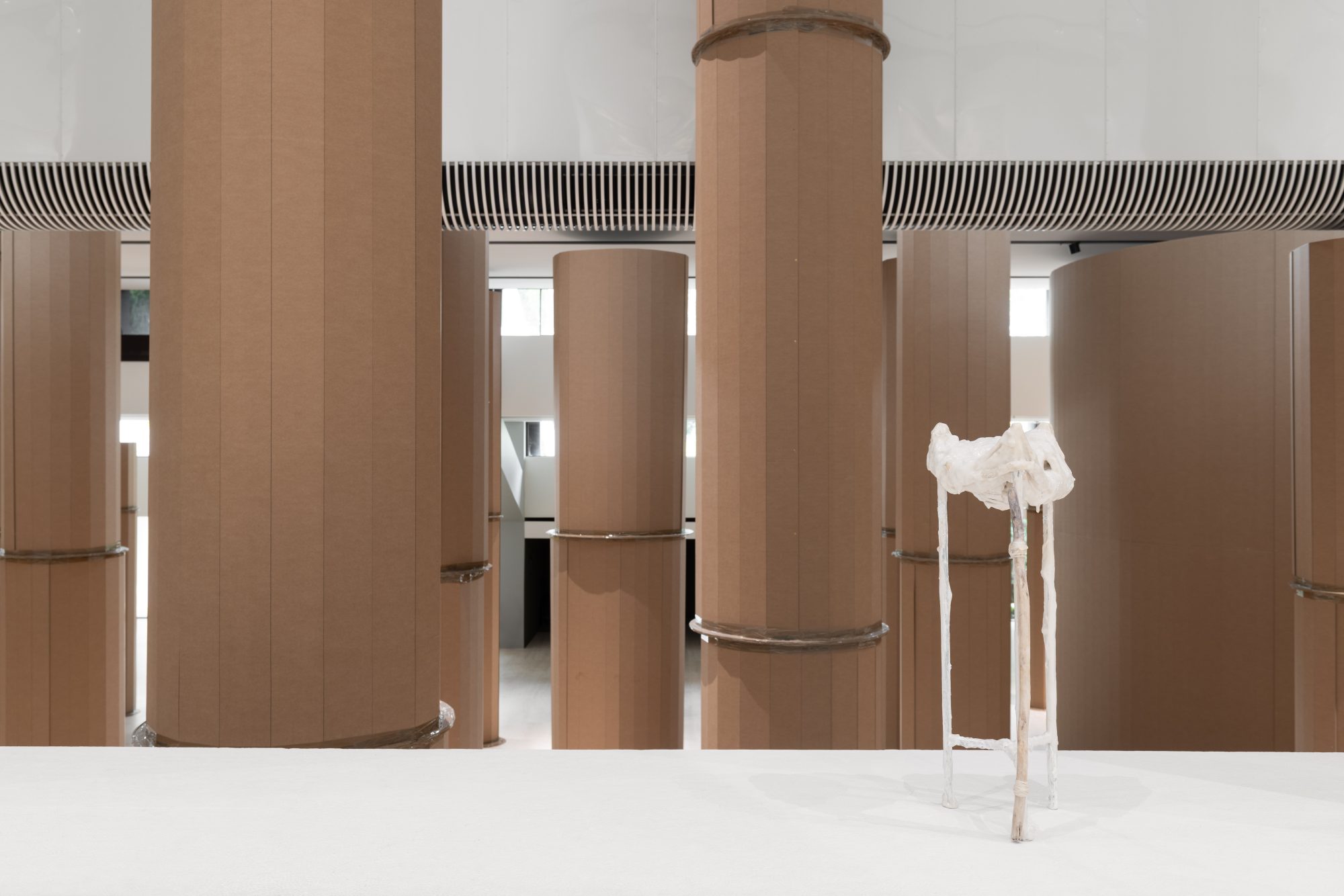
Carlos Bunga, Forest, 2025. Site specific installation for Centro de Arte Moderna Gulbenkian
Enquire
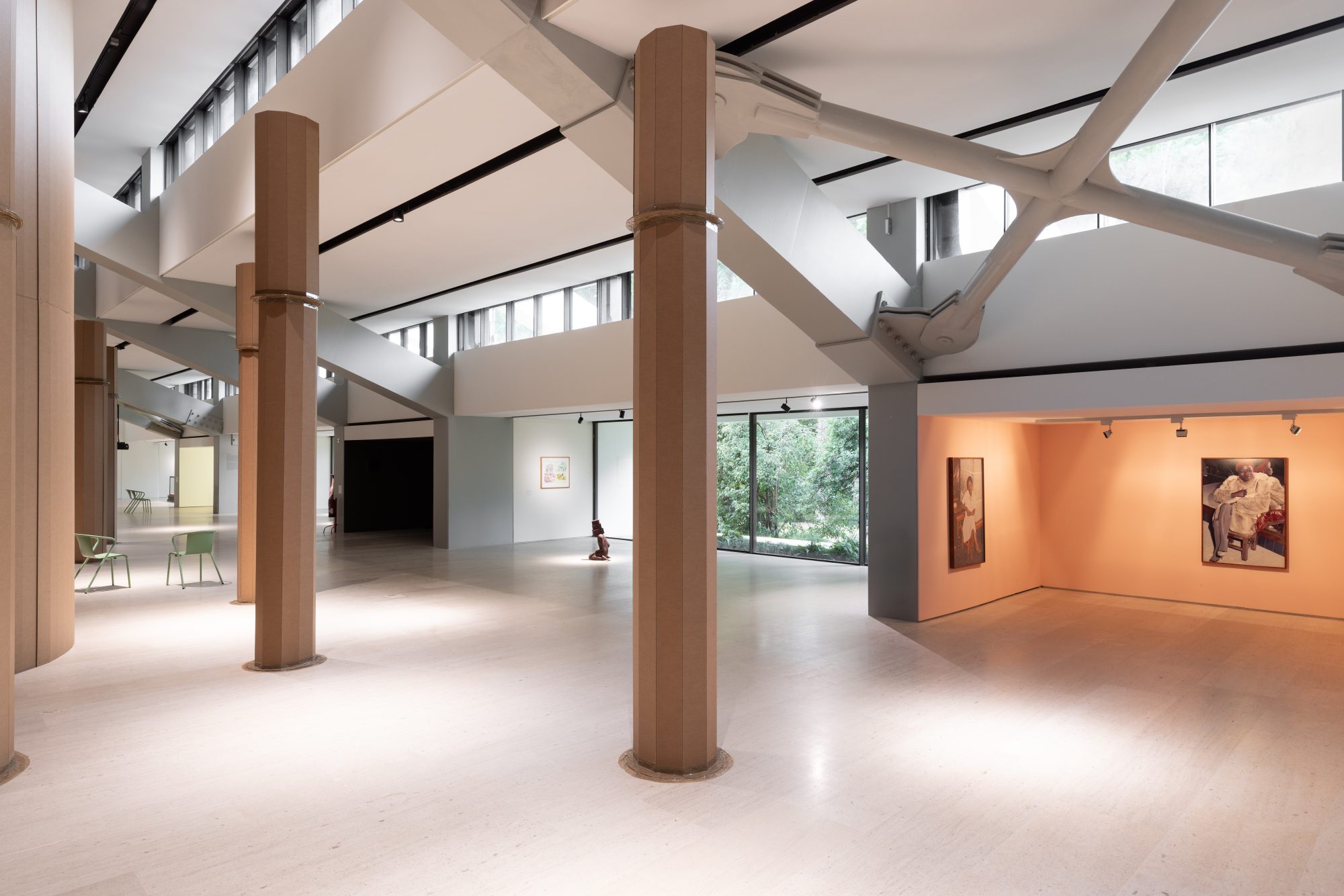
Carlos Bunga’s work is immediate, physically demanding, and responsive to its site, built from ordinary materials. For CAM’s Nave, he has engineered his largest installation yet, working from the outside in to join interior and exterior spaces. A terrain of cylindrical cardboard forms, taped into towering groupings, evokes both architectural columns and the soaring trunks of ancient trees. Arranged in shifting patterns, these structures create pathways and dead ends, giving the Nave a kinetic dimension that invites movement and encounter.
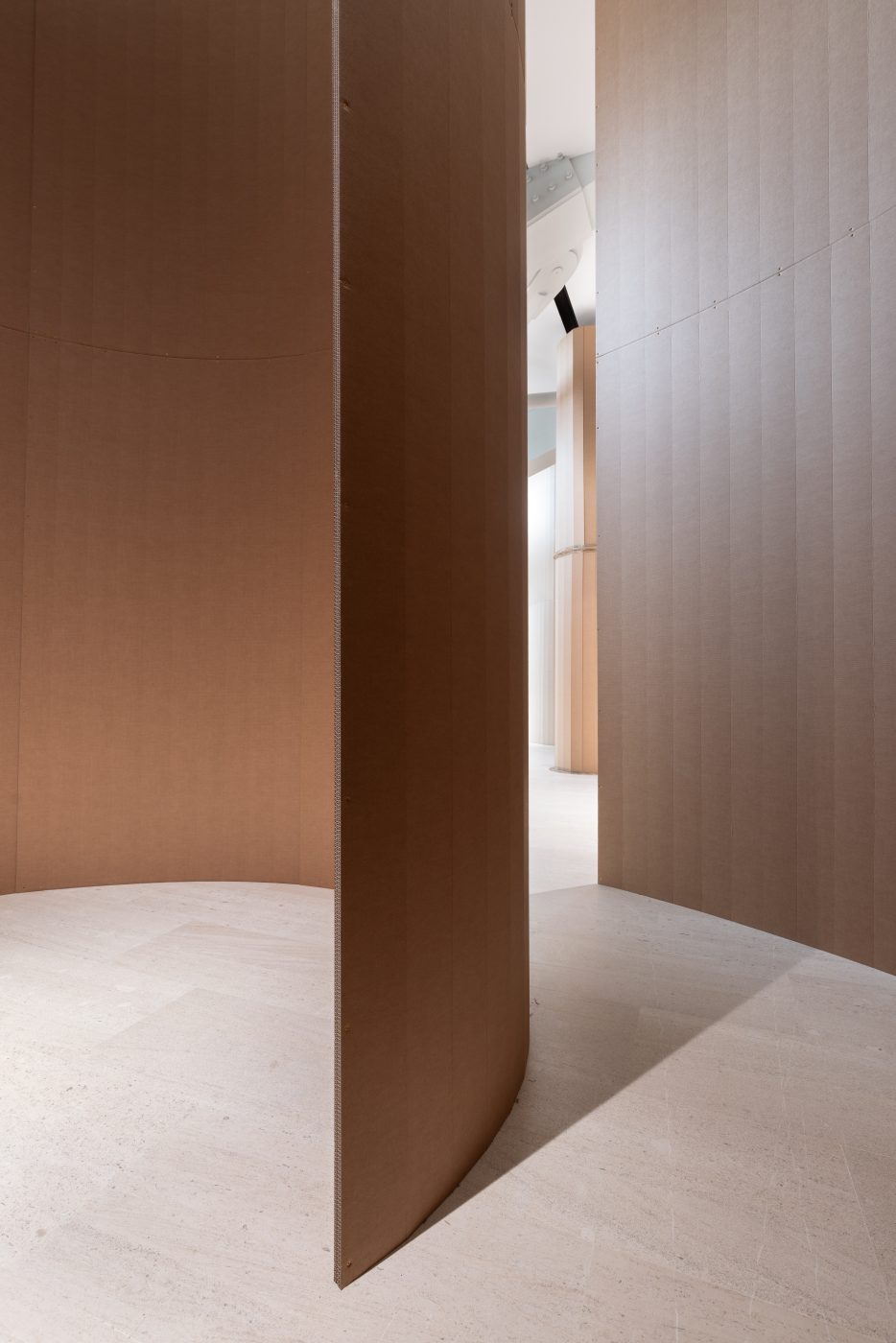

Carlos Bunga, Forest, 2025. Site-specific installation for Centro de Arte Moderna Gulbenkian
Enquire
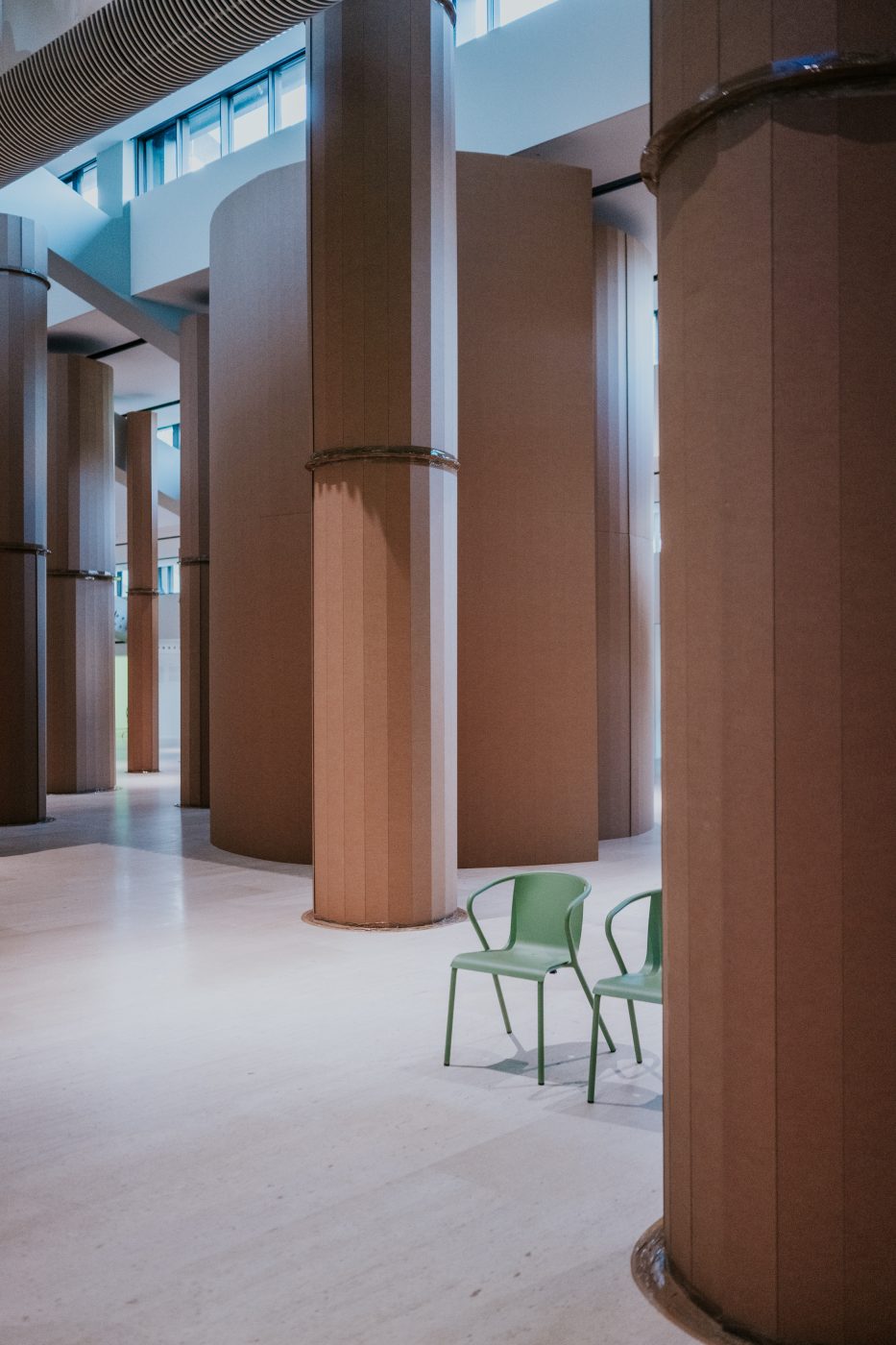
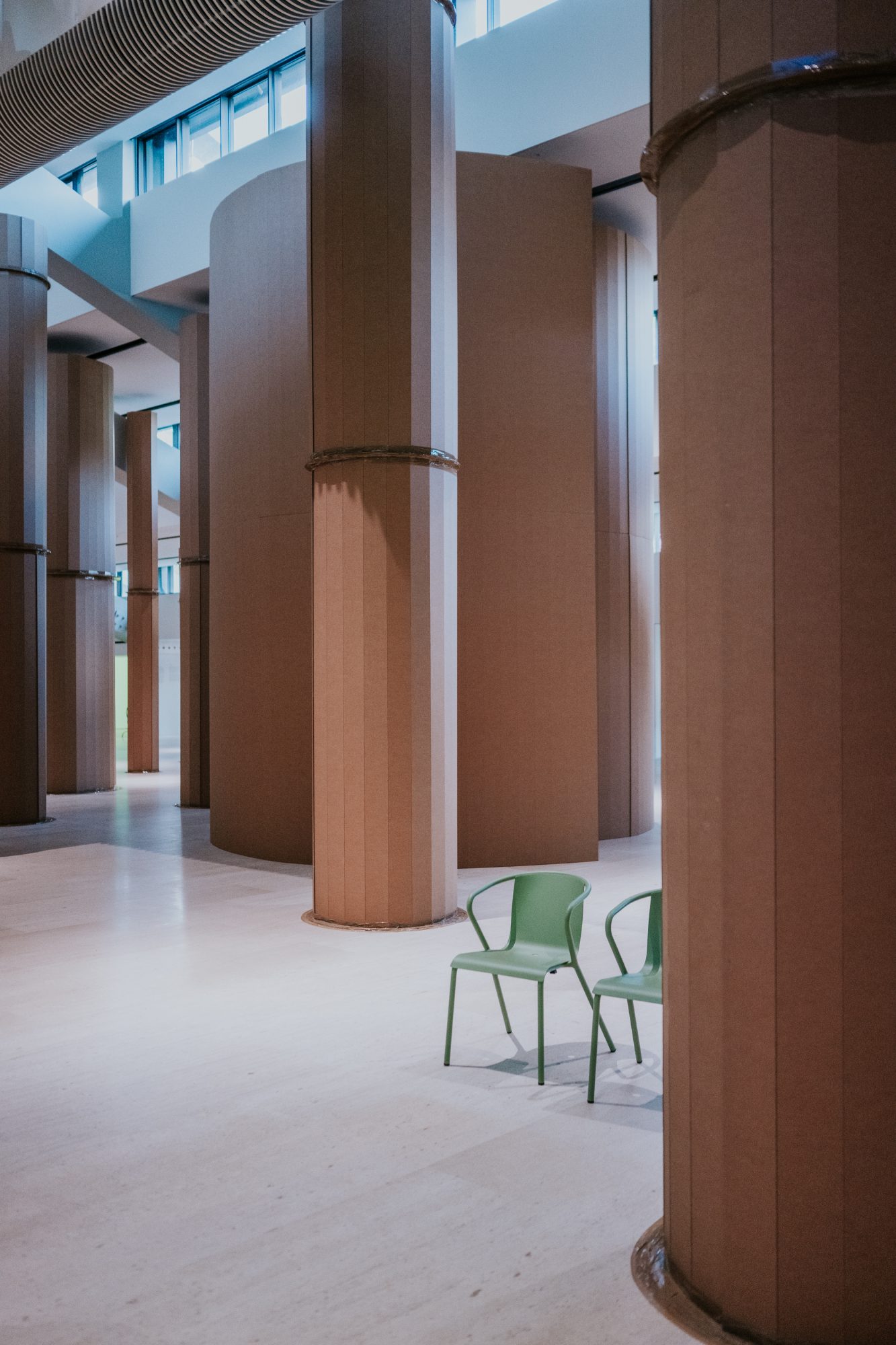
Carlos Bunga, Forest, 2025. Site-specific installation for Centro de Arte Moderna Gulbenkian
Enquire
Fisicamente exigente, o trabalho de Carlos Bunga caracteriza-se pelo seu imediatismo e reação ao local onde é construído com materiais banais. Para a Nave do CAM, Bunga projetou a sua maior instalação até à data, trabalhando de fora para dentro, para promover um encontro de espaço interior e exterior. Um cenário de formas cilíndricas de cartão, coladas e em grupos elevados como torres, evoca tanto colunas arquitetónicas como os troncos imponentes de árvores ancestrais. Dispostas em esquemas variáveis, estas estruturas criam caminhos e becos sem saída, conferindo à Nave uma dimensão cinética que convida ao movimento e ao encontro.
Their volume and curvature refer to the surrounding garden – an ‘urban forest’ – from its foliage to the pools that collect water and mirror the sky. For Bunga, the forest is a living network-human and nonhuman, visible and invisible, calming and disquieting – where things root, flourish, fall, and morph. Within it, visitors may also find a refuge: a place to pause and regain clarity. At some point, Bunga will cut into the installation, collapsing and recomposing it anew.
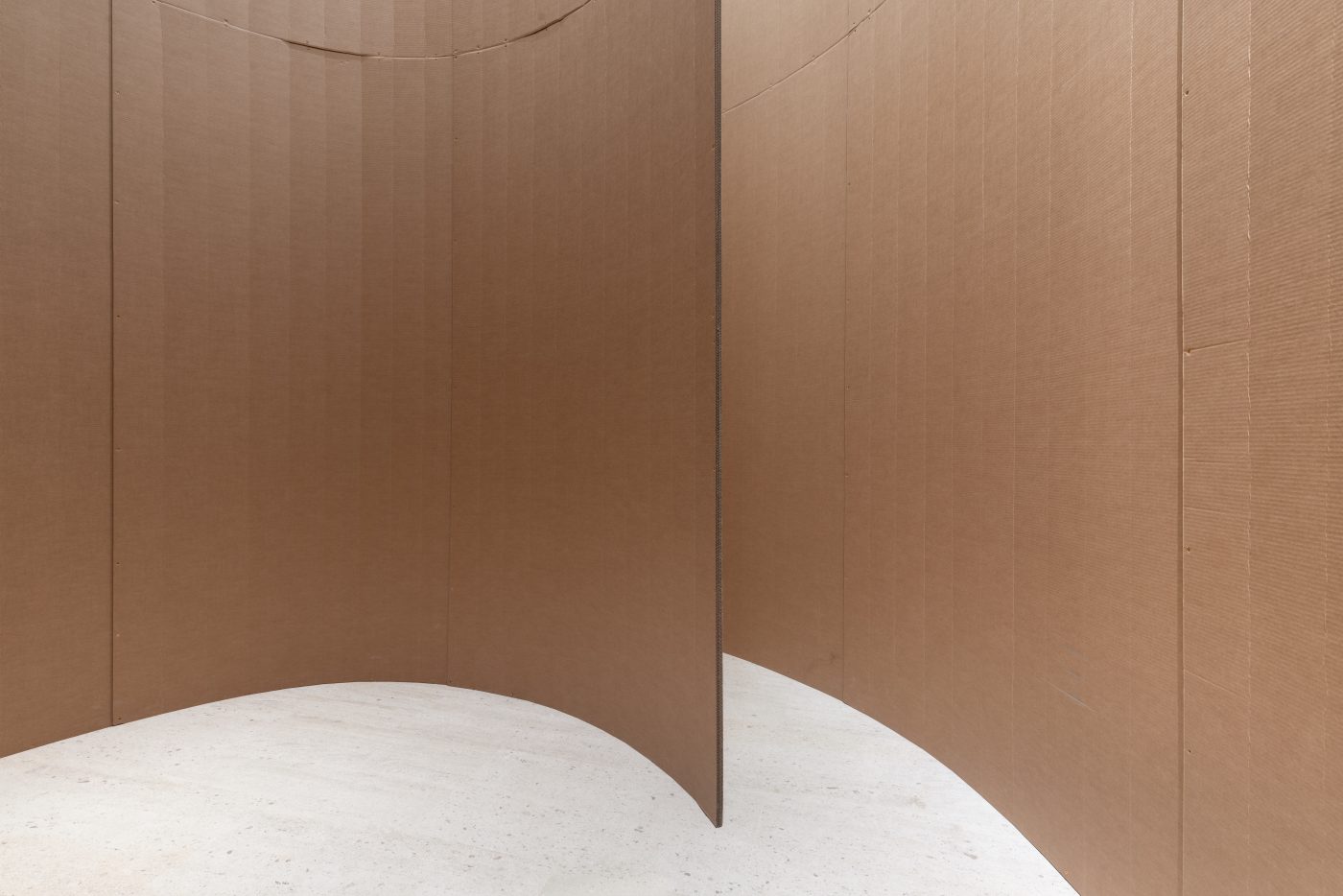
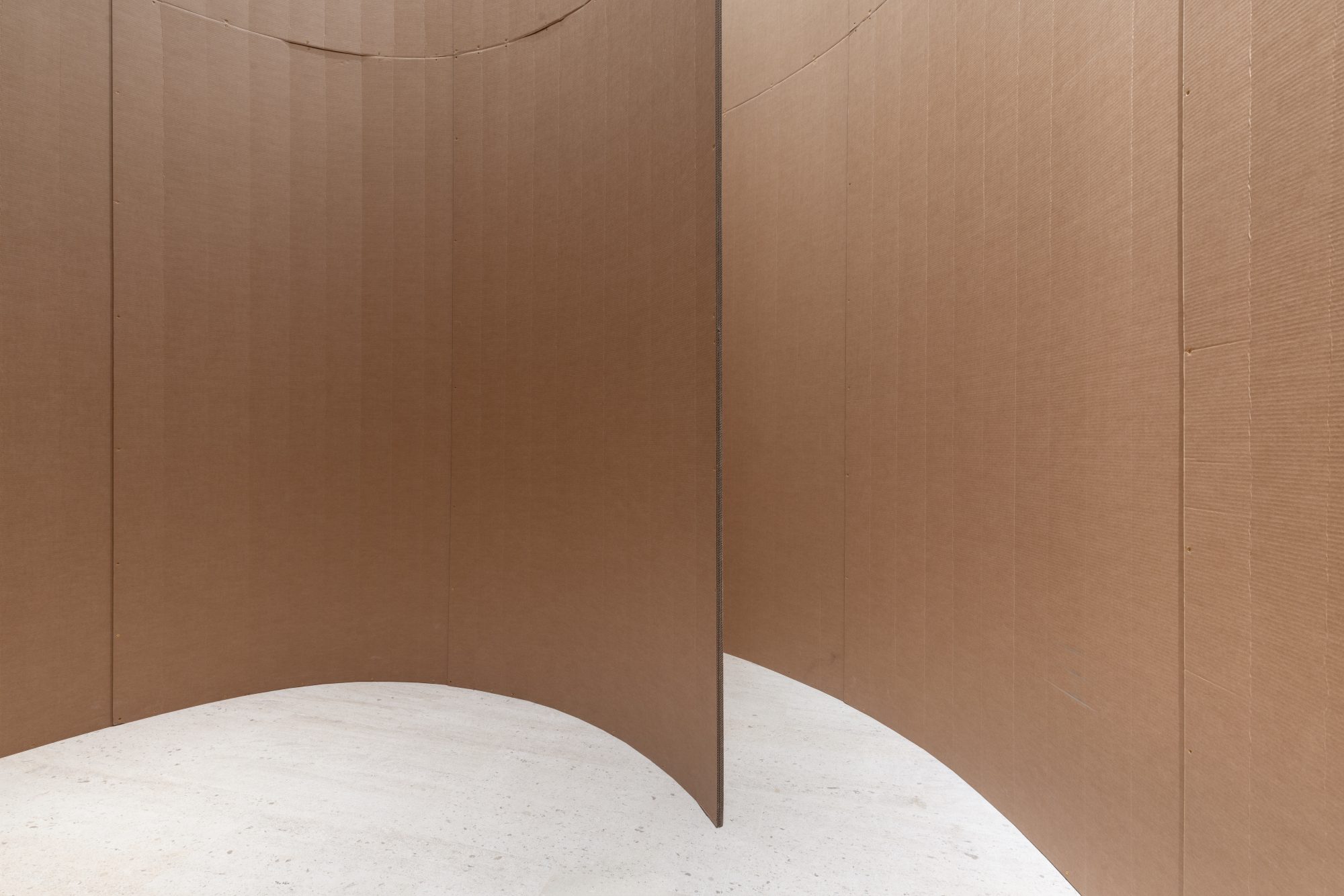
Carlos Bunga, Forest (detail), 2025. Site specific installation for Centro de Arte Moderna Gulbenkian
Enquire
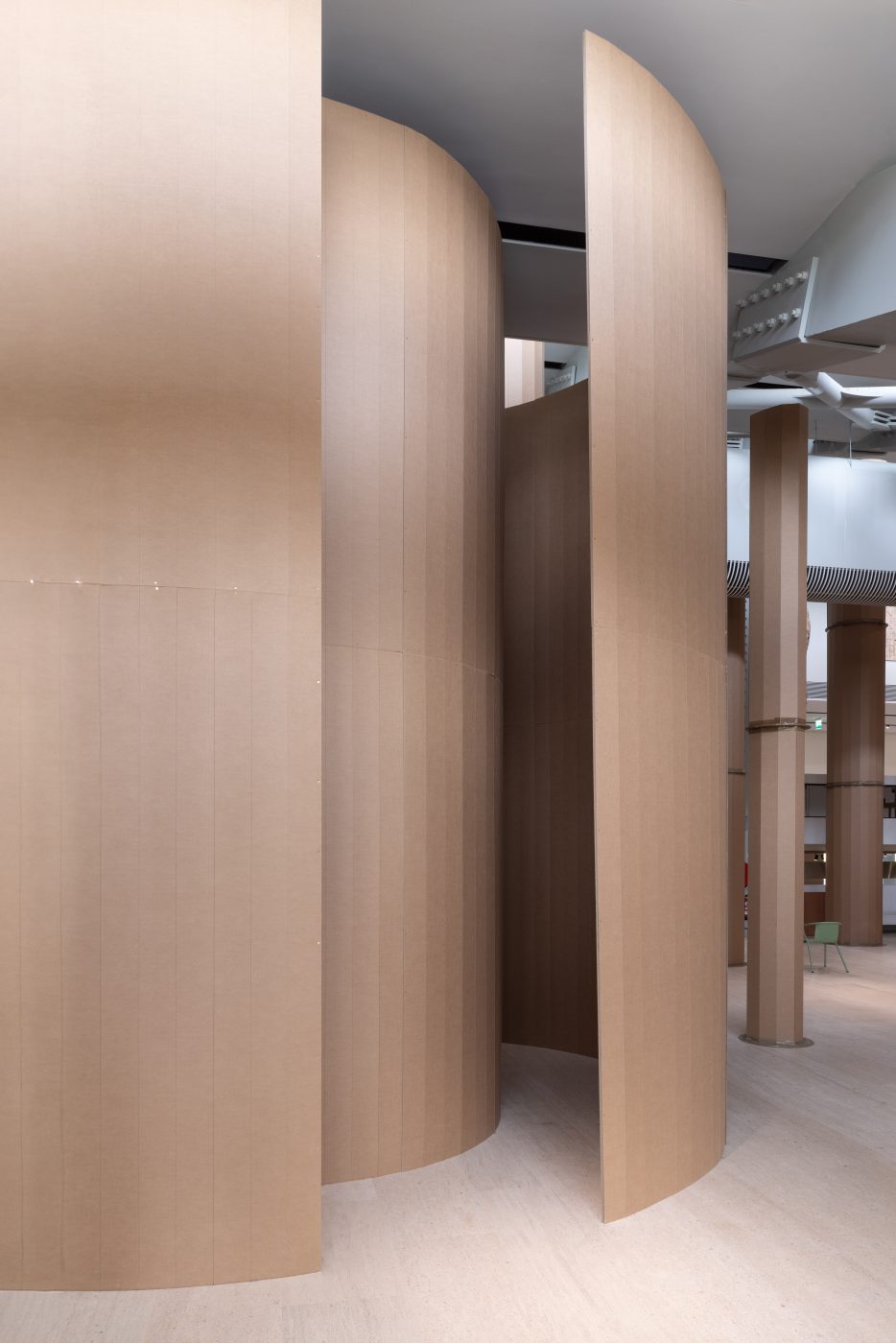
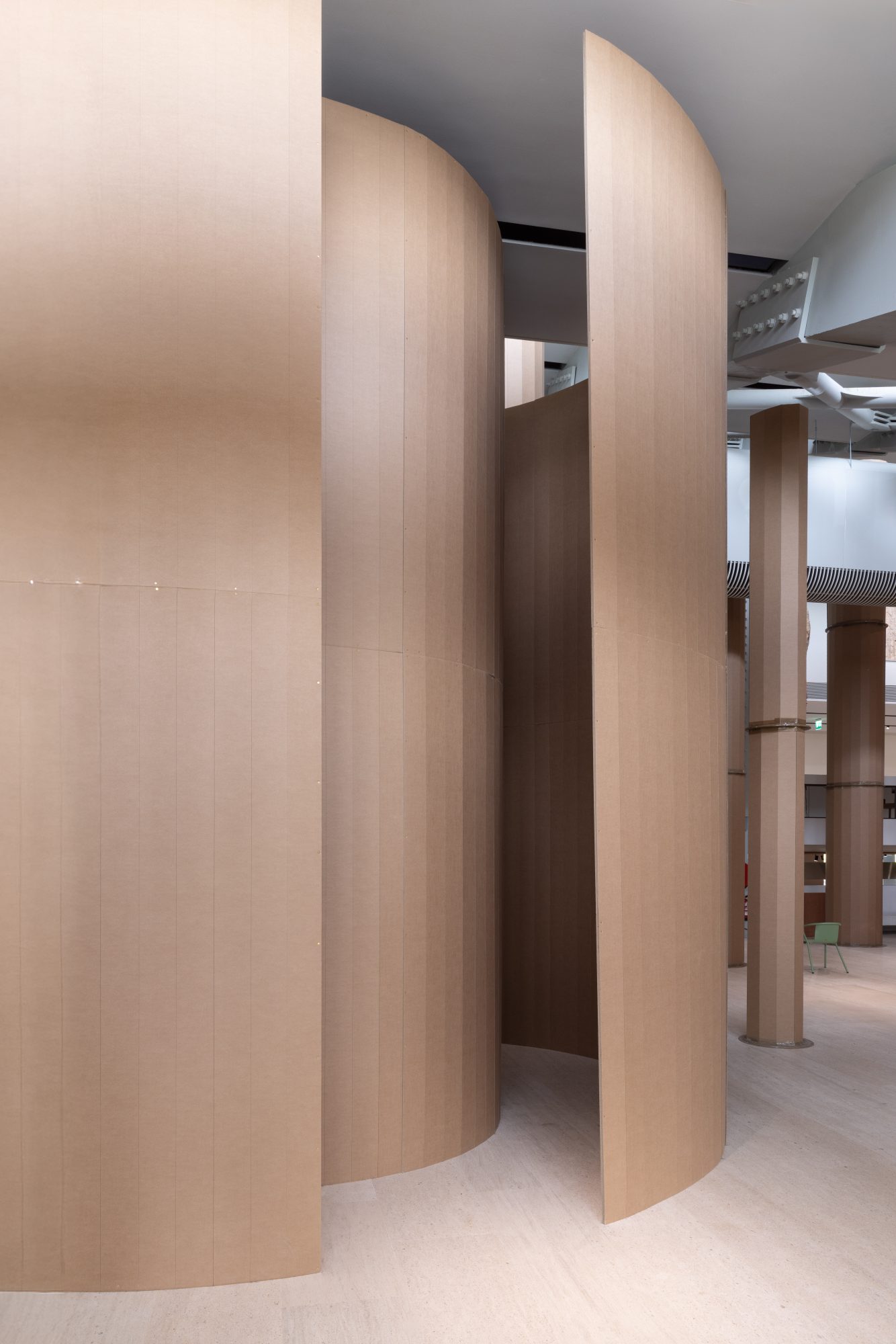
Carlos Bunga, Forest (detail), 2025. Site specific installation for Centro de Arte Moderna Gulbenkian
Enquire
O seu volume e a sua curvatura remetem para o jardim circundante – uma ‘floresta urbana’ -, com a sua folhagem e os seus lagos e charcos que recolhem água e refletem o céu. Para Bunga, o bosque é uma rede viva-humana e não-humana, visível e invisível, tranquilizador e inquietante – onde as coisas ganham raízes, florescem, murcham e se transformam. Dentro dele, os visitantes também poderão encontrar um refúgio: um local para fazer uma pausa e recuperar a clareza. Em determinado momento, Bunga irá intervir na instalação, cortando-a, fazendo-a desmoronar e reorganizando-a.
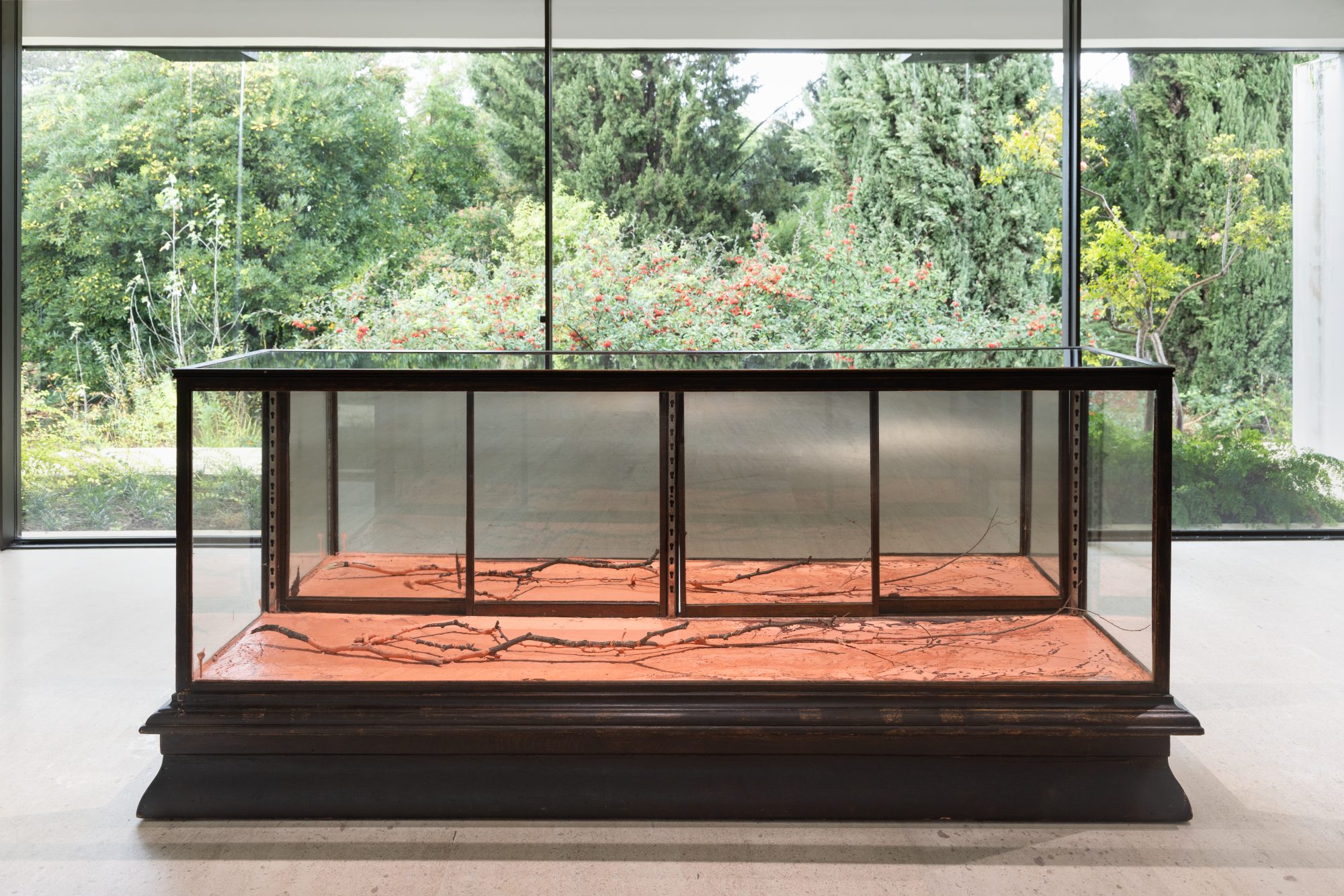
Carlos Bunga, Nature in a Vitrine, 2020. Latex, glue and branch in a vitrine. 104 x 236,5 x 66 cm
Enquire
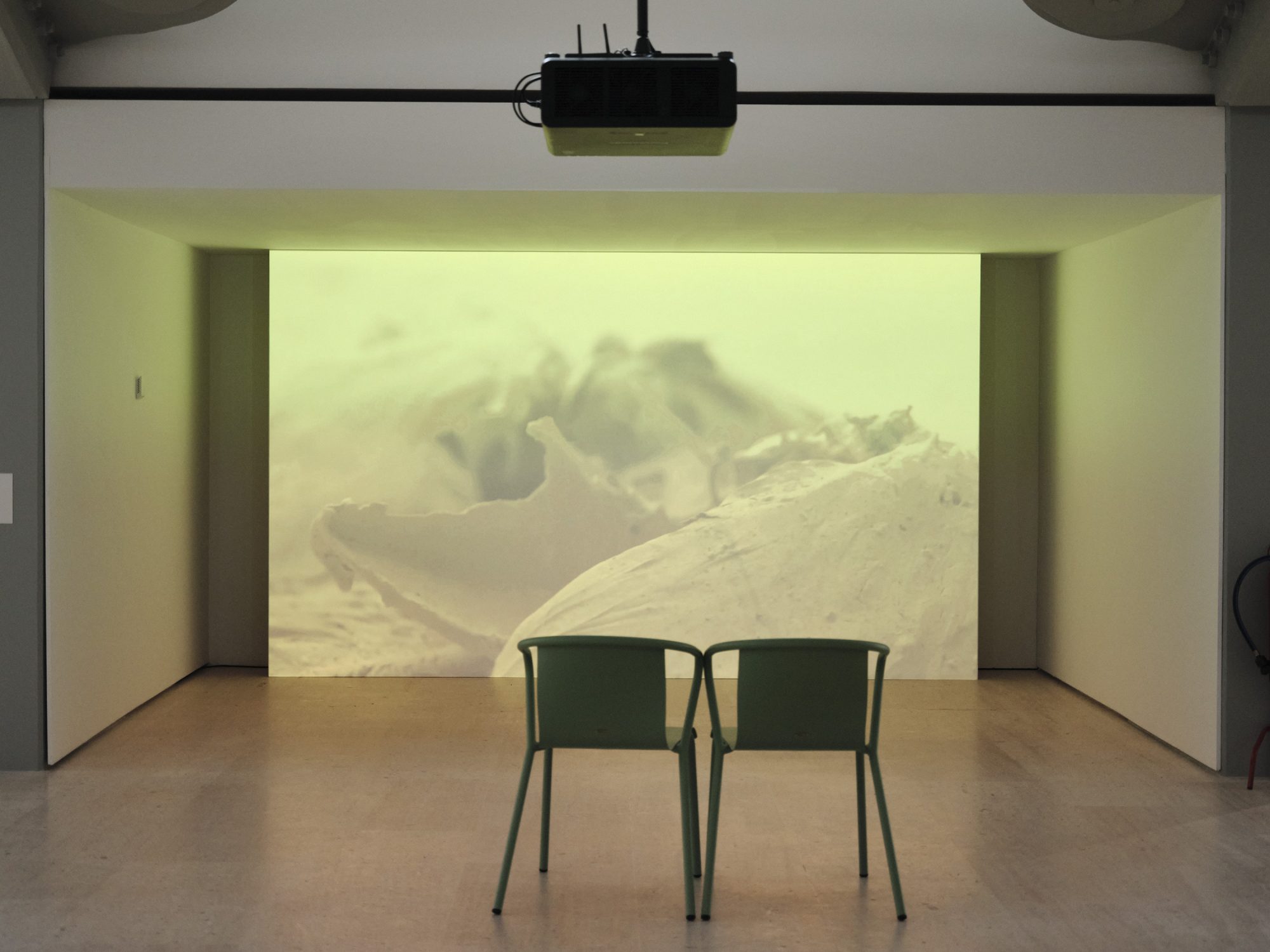
Carlos Bunga, La irrupción de lo impredecible (The Irruption of the Unpredictable), 2024-25. Single-channel, colour, silent, 10 min 28 s, loop.
Enquire

Carlos Bunga, La irrupción de lo impredecible (The Irruption of the Unpredictable), 2024-25. Single-channel, colour, silent, 10 min 28 s, loop.
Enquire
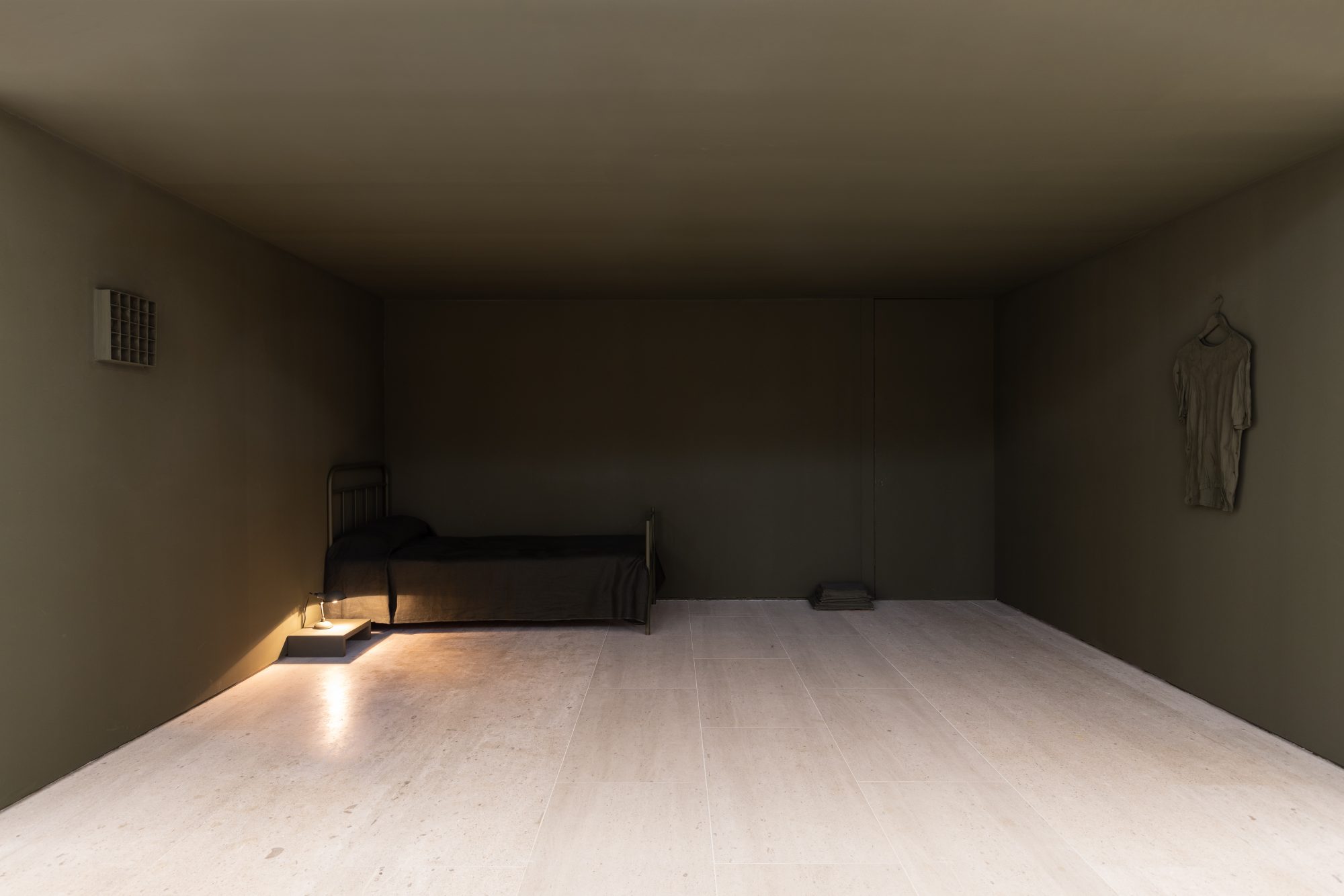
Carlos Bunga, The Place Where We Daily Abandon the World, 2021. Metal bed, mattress, pillow, fabric, lamp, bedside table, wall paint, painted cardboard structure, masking tape, glue paint-soaked t-shirt, hanger. Variable dimensions. Ed. 1
Enquire
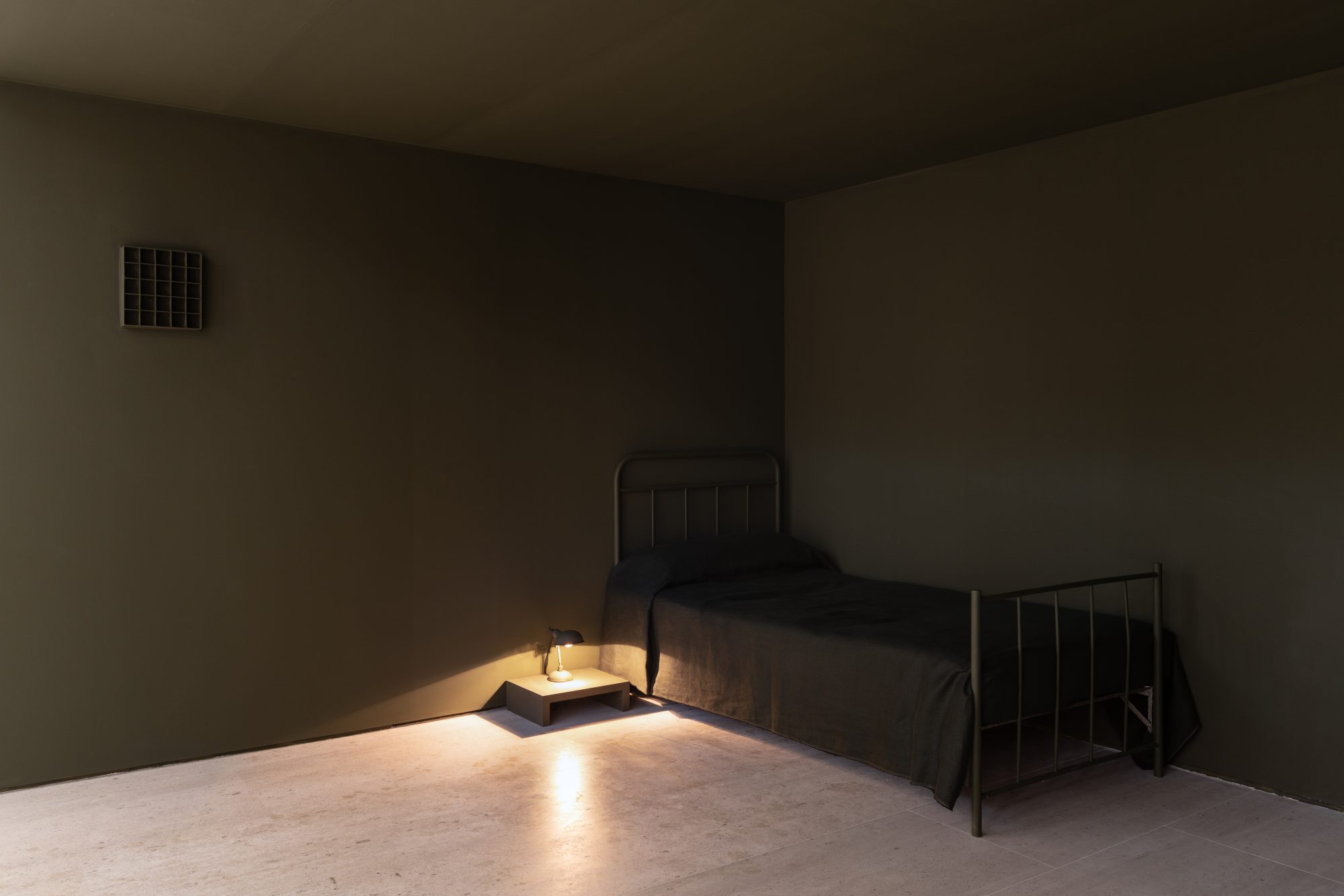
Carlos Bunga, The Place Where We Daily Abandon the World (detail), 2021. Metal bed, mattress, pillow, fabric, lamp, bedside table, wall paint, painted cardboard structure, masking tape, glue paint-soaked t-shirt, hanger. Variable dimensions. Ed. 1
Enquire
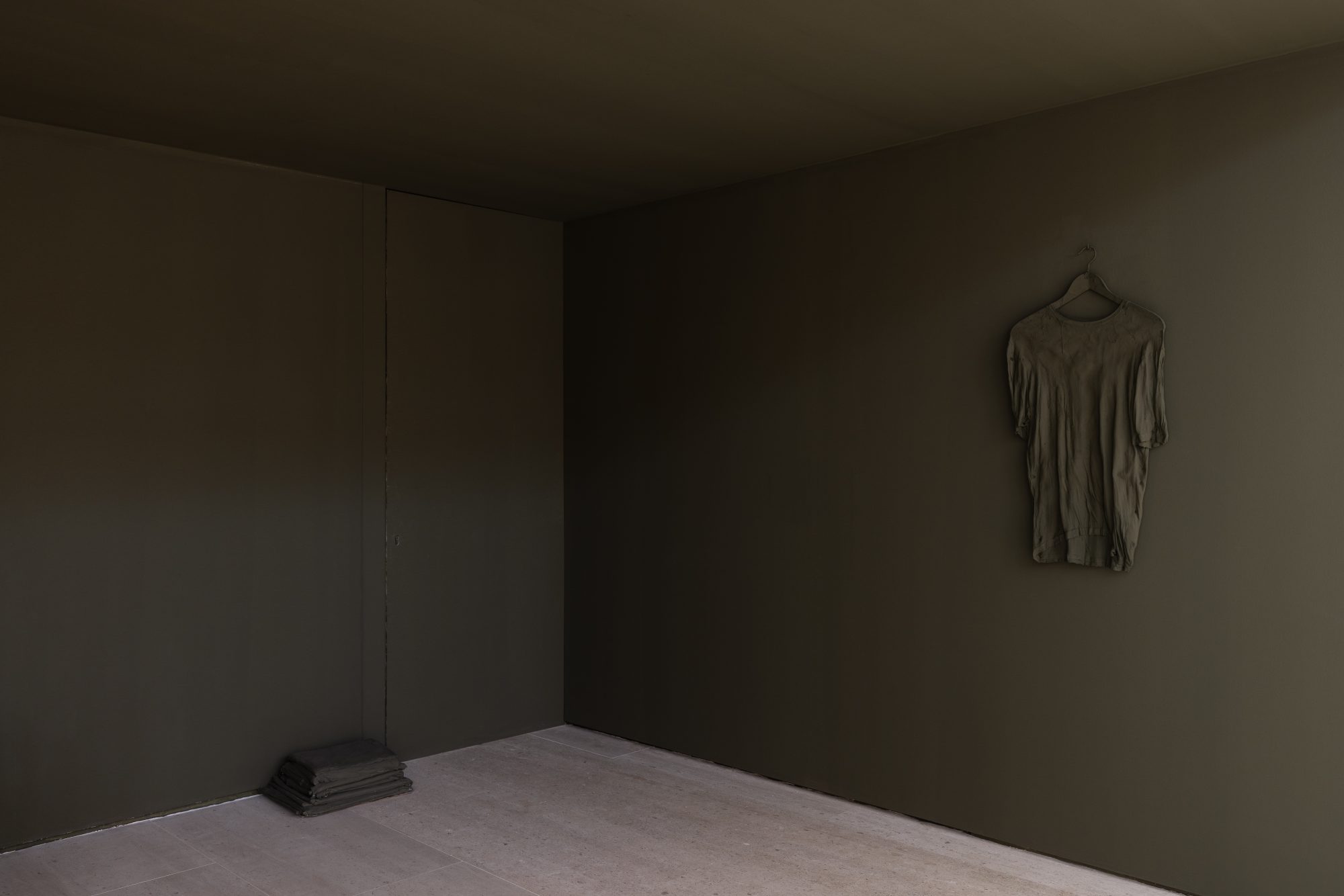
Carlos Bunga, The Place Where We Daily Abandon the World (detail), 2021. Metal bed, mattress, pillow, fabric, lamp, bedside table, wall paint, painted cardboard structure, masking tape, glue paint-soaked t-shirt, hanger. Variable dimensions. Ed. 1
Enquire
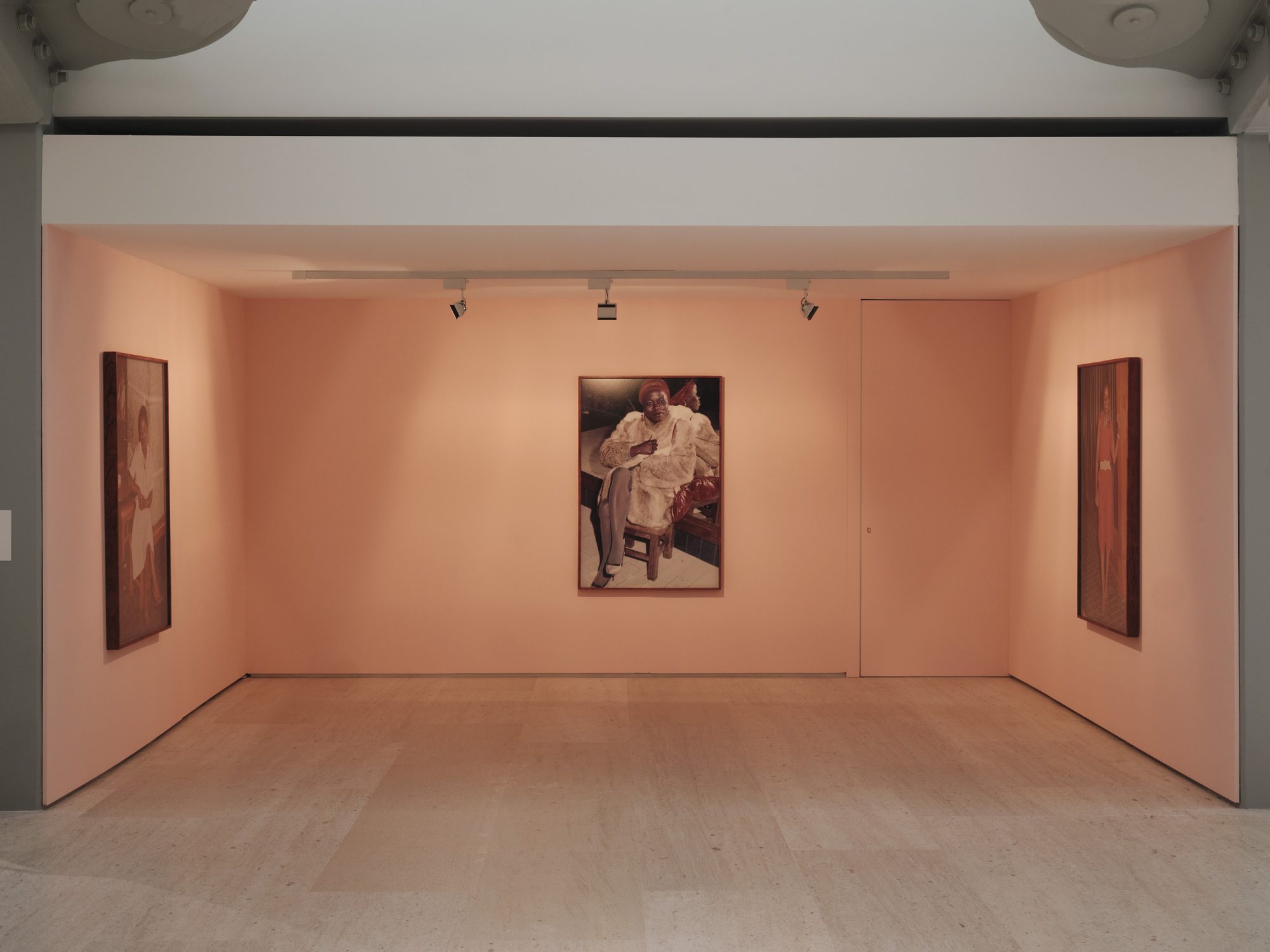
Carlos Bunga, Inhabit the Contradiction, Centro de Arte Moderna Gulbenkian, 2025-26. Exhibition view
Enquire
Motherhood
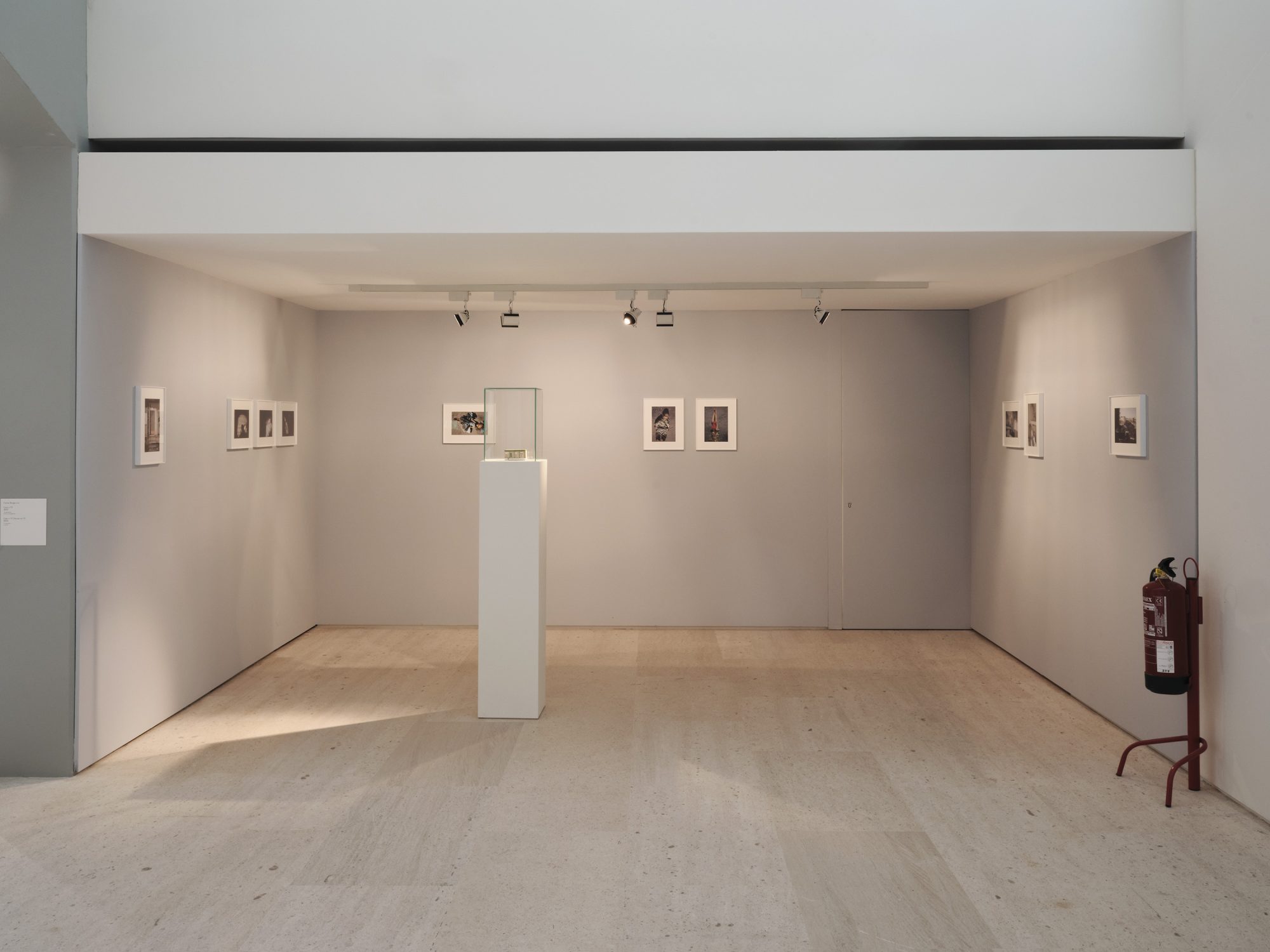
Taken in Lisbon’s Cais do Sodré district during the 1980s, these photographs show Carlos Bunga’s mother in the nightclubs where she worked and socialized. Once a portside zone of foreign traders, sailors, and sex workers, the neighbourhood was also becoming a gathering place for students and bohemians after the 1974 revolution, as Portugal transitioned toward democracy while reckoning with decolonization. Behind his mother’s glamour lay harsher realities. Fleeing Angola in 1975 with a young daughter and pregnant with Bunga, she arrived carrying little more than some clothes and photographs.
Maternidade
Captadas no Cais do Sodré, em Lisboa, nos anos 1980, estas fotografias mostram a mãe do artista nos clubes noturnos onde trabalhava e socializava. Outrora zona portuária povoada por negociantes estrangeiros, marinheiros e profissionais do sexo, após o 25 de Abril esta parte da cidade tornou-se também um ponto de encontro para estudantes e boémios, enquanto o país passava da ditadura para a democracia e lidava com as consequências da descolonização. Por trás do glamour desta figura materna, escondem-se duras realidades. Tendo fugido de Angola em 1975 com uma filha pequena e grávida de Bunga, chegou a Portugal com pouco mais do que alguma roupa e algumas fotografias.

Exhibition view: Carlos Bunga, Inhabit the Contradiction. Centro de Arte Moderna, Gulbenkian, 2025-26
Enquire
Unable to read or write, she relied on her body to provide for her family, yet carried herself unashamed. These photographs were taken amidst her reinvention against prejudices and taboos. Enlarged, they assert her radiance and truth—as an immigrant woman who resisted and protected her family against racism, classism, and misogyny. Beyond a personal nature, they move toward emblems of survival and becoming. She invites the viewer’s gaze but also meets it unflinchingly, compelling us to confront our own judgments-and question what we’ll do when faced with them ourselves.
Não sabendo ler nem escrever, dependia do corpo para sustentar a sua família, mas fazia-o sem qualquer vergonha. As fotografias são parte da sua reinvenção contra preconceitos e tabus. Ampliadas, mostram-na resplandecente na sua verdade – enquanto mulher imigrante que resistiu e protegeu a sua família do racismo, do classismo e da misoginia. Para além da sua natureza pessoal, as fotos constituem emblemas de sobrevivência e transformação. A figura convida o olhar do observador e encara-o sem vacilar, obrigando-nos a confrontar os nossos próprios juízos de valor e a questionar o que faremos se confrontados com eles.

Exhibition view: Carlos Bunga, Inhabit the Contradiction. Centro de Arte Moderna, Gulbenkian, 2025-26
Enquire

Exhibition view: Carlos Bunga, Inhabit the Contradiction. Centro de Arte Moderna, Gulbenkian, 2025-26
Enquire
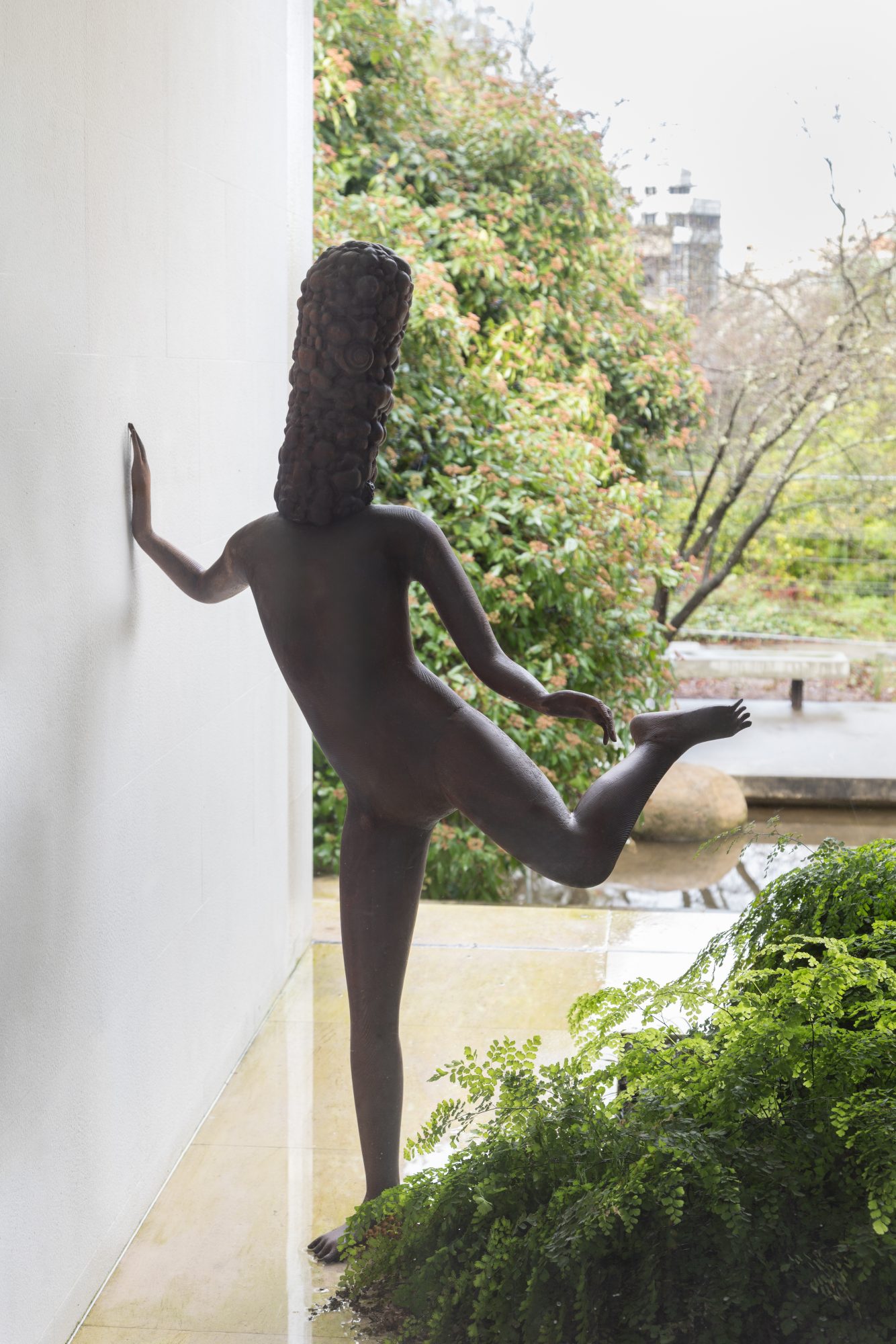
Carlos Bunga, Nómada. Caddis fly, 2025. Wood. 144,5 x 46,5 x 90,5 cm. Ed. 3
Enquire
Carlos Bunga’s Nomads traverse space and the boundaries of culture and identity. They are genderless, multiracial, and cross-species. Each carries a shelter as their head, constructions that are at once a burden and safe haven, raising questions about the weight of memory and fluctuations of home. Their bodies approximate the proportions of children, suspended in a moment of self-discovery and potential.

Carlos Bunga, Nómada. Vespeiro, 2025. Wood. 133,5 x 27,5 x 38 cm. Ed. 3
Enquire
Os Nómadas, de Carlos Bunga, atravessam o espaço e as fronteiras da cultura e da identidade. São multirraciais, interespécies e não têm género. Cada um carrega um abrigo como cabeça, construções que são ao mesmo tempo um fardo e um porto seguro, levantando questões sobre o peso da memória e as flutuações daquilo a que chamamos casa. Os seus corpos têm as dimensões aproximadas de crianças, suspensas num momento de autodescoberta e potencial.
This state of flux relates to Bunga’s own trajectory – from refugee to nomad – impacted by displacement and unstable housing. He invokes the figure of the child not only as a symbol of growth but as a way to recover a pre-rational space where play is primary and imagination unbounded. For this exhibition, Bunga presents a new series of Nomads made of wood, deepening the relationship between body, architecture, and nature in perpetual metamorphosis.

Carlos Bunga, Nómada. Askal (cão de rua), 2025. Wood. 46 x 71 x 30 cm. Ed. 3
Enquire

Carlos Bunga, Nómada, jugando a pensar, 2025. Wood. 71 x 45 x 51 cm. Ed. 3
Enquire
Este estado fluido relaciona-se com a trajetória do próprio artista – de refugiado a nómada -, marcada pelo deslocamento e pela instabilidade da habitação. Bunga evoca a figura da criança não só como símbolo de crescimento, mas também como forma de recuperar um espaço pré-racional, onde brincar é primordial e a imaginação não tem limites. Nesta exposição, Bunga apresenta uma nova série de Nómadas feitos em madeira, aprofundando assim a relação entre corpo, arquitetura e natureza em permanente metamorfose.

Carlos Bunga, Inhabit the Contradiction, Centro de Arte Moderna Gulbenkian, 2025-26. Exhibition view
Enquire
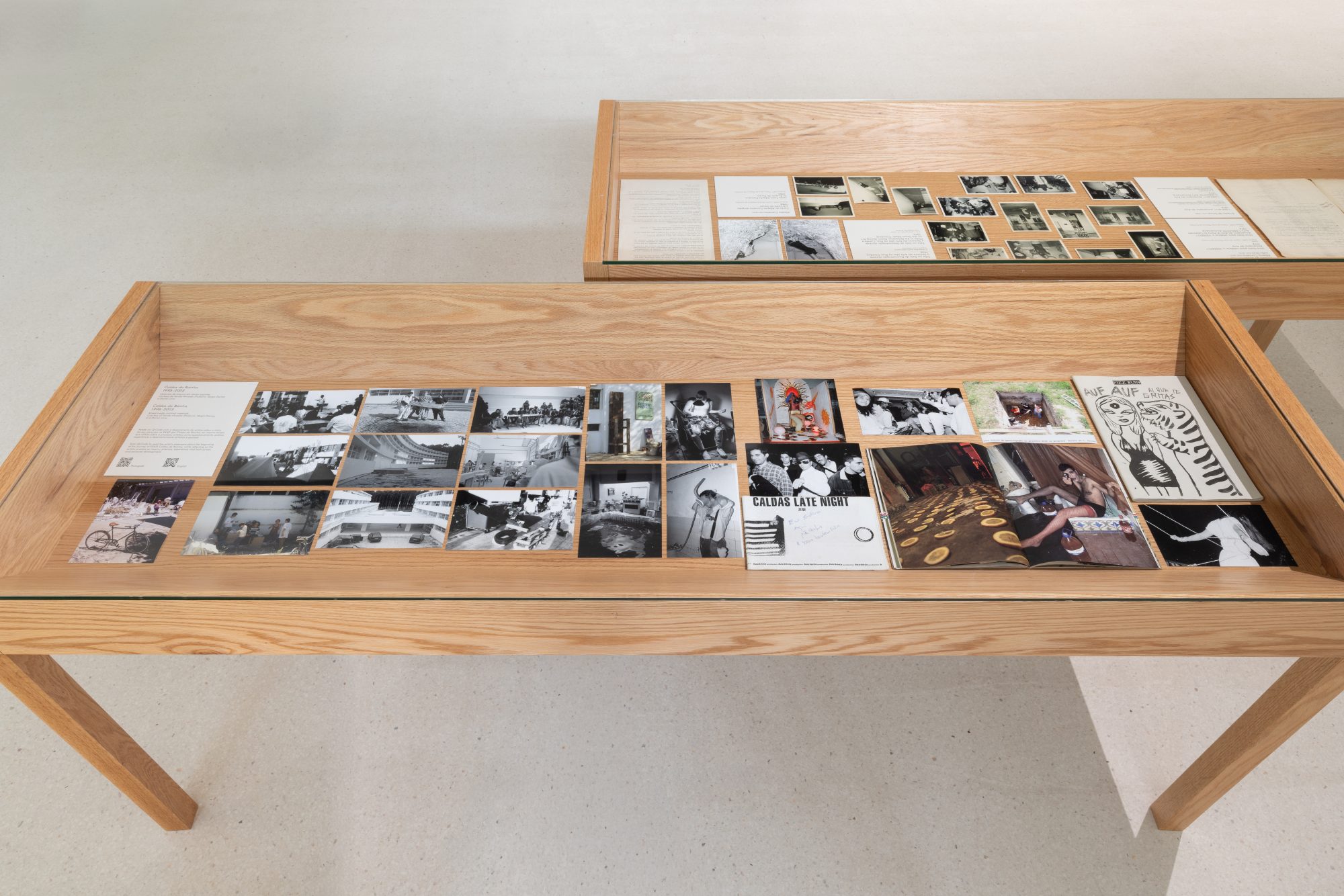
House No. 17 is connected to Carlos Bunga’s Model series, begun in 2002. Whereas his smaller cardboard constructions are ambiguous and formally loose, House No. 17 is a miniature, detailed, and crafted from a cereal box. The sculpture is modeled on one of the artist’s childhood homes in São Bartolomeu dos Galegos, just north of Lisbon. After years of living in converted institutions and religious centres for refugees, Bunga’s family relocated to this house, part of a social housing initiative built from prefabricated materials intended to last only a decade. In reality, families lived in them for nearly nineteen years, until their visibly degrading state led to demolition in 2002.
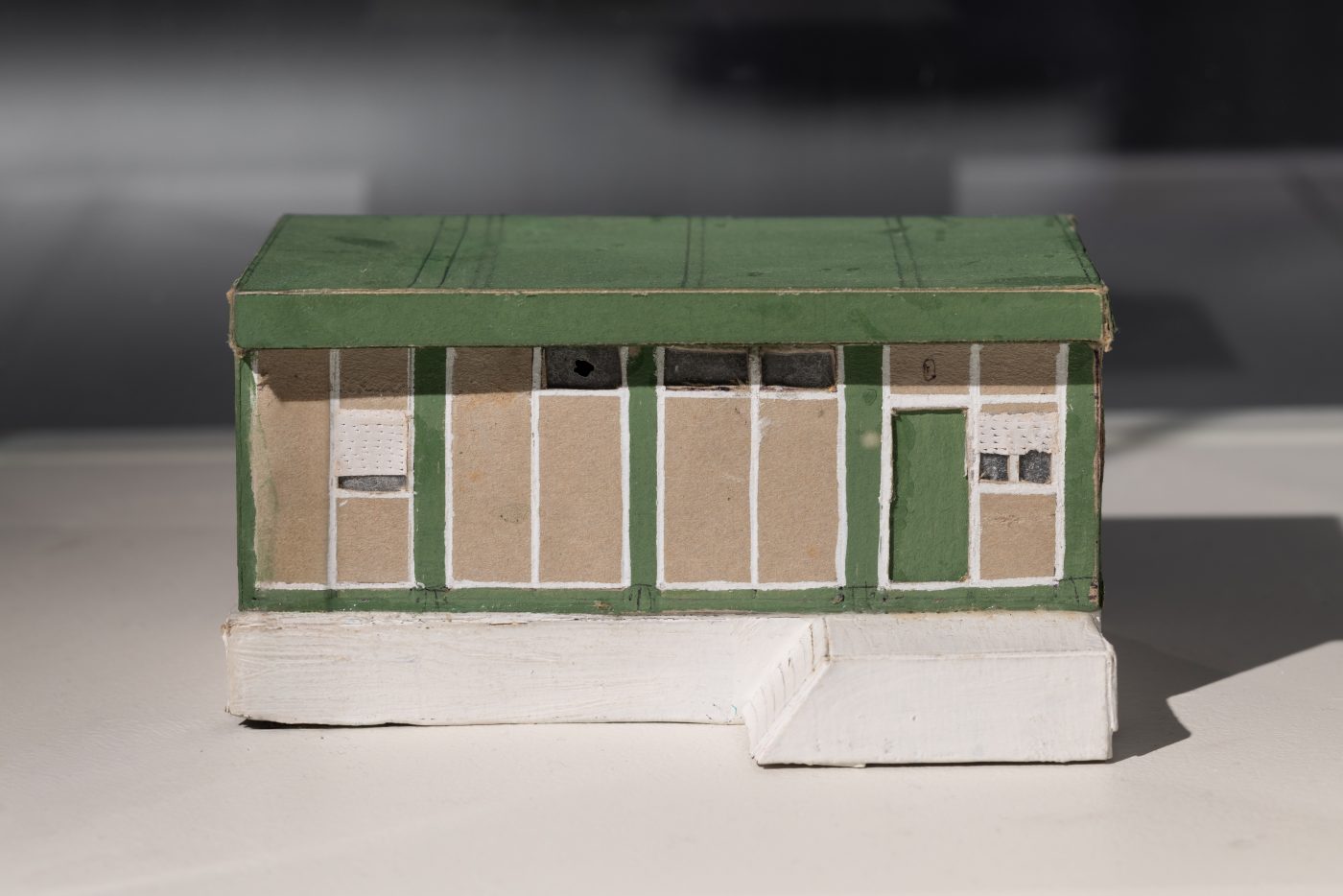
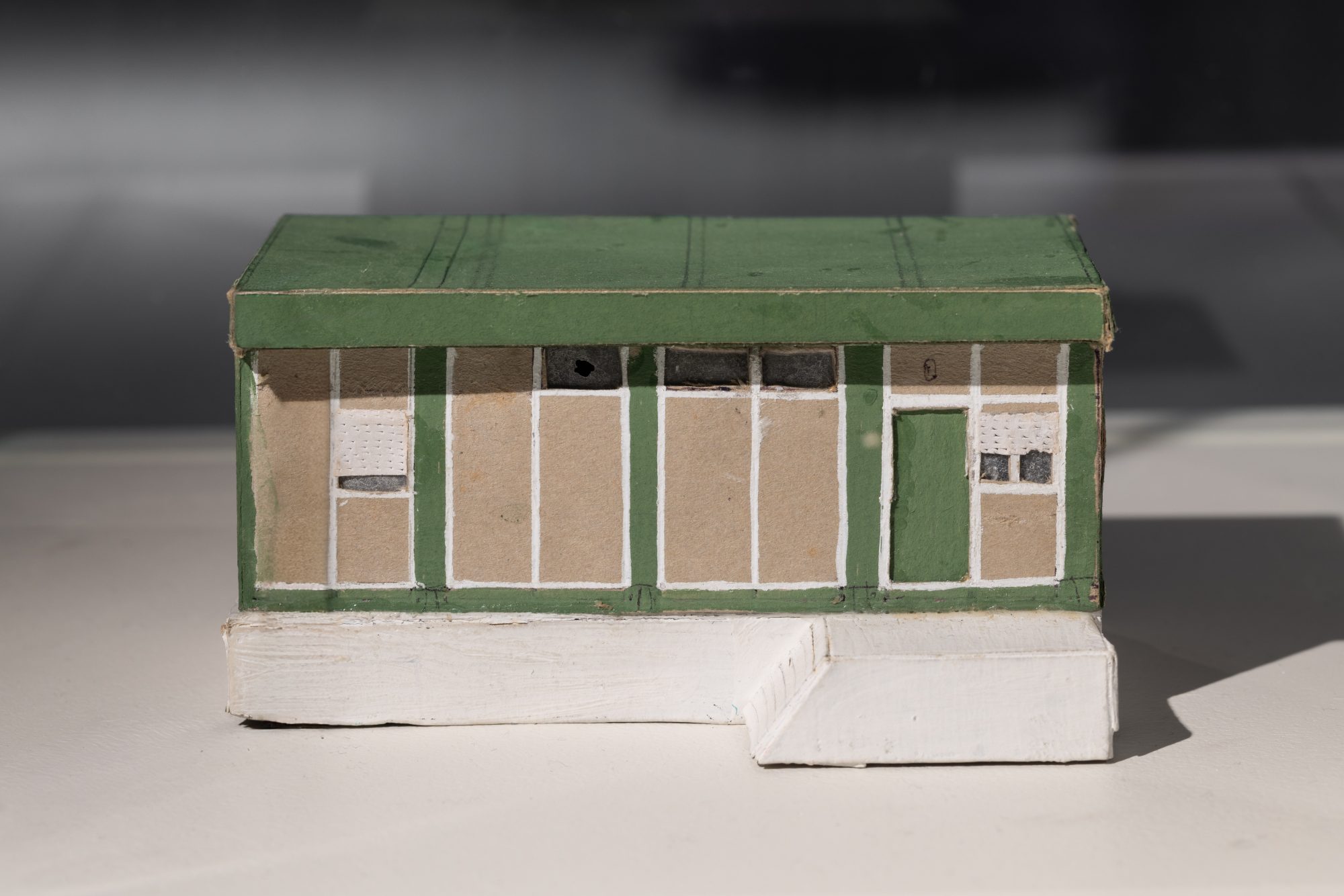
Casa n.017 é uma obra relacionada com a série de Carlos Bunga Modelos, iniciada em 2002. Enquanto as suas construções mais pequenas em cartão são ambíguas e formalmente vagas, Casa n.o17 é uma miniatura detalhada, feita a partir de uma caixa de cereais e inspirada numa das casas em que o artista viveu na infância, situada em São Bartolomeu dos Galegos, a norte de Lisboa. Depois de anos a viver em instituições convertidas e centros religiosos para refugiados, a família mudou-se para esta casa, parte de uma iniciativa de habitação social e construída com materiais prefabricados, concebida para durar apenas uma década. Na realidade, essas casas seriam habitadas durante quase dezanove anos, até o evidente estado de degradação ter forçado a sua demolição em 2002.

The model is paired with a sequence of never-before-seen photographs taken by the artist just before the demolition of his childhood home. Together they preserve a life on the brink of erasure: interiors and exteriors, objects and signs of habitation, the house’s final dismantling. They can also be interpreted as a kind of portrait of the artist’s mother. Within her rooms, religious icons resided with pin-ups and toy dolls, an assemblage of comforts and ideals that, even today, might be seen as contradictory. Their proximity, however, resists these distinctions. What is exalted and what is disparaged, what consoles and what provokes, coexisted within her and somewhere within each of us. This reality — ordinary yet profound — could have vanished with the rubble, but Bunga’s photographs withstand this possibility.
A maquete é acompanhada por uma sequência de fotografias que até agora nunca tinha sido exposta e que foi captada pelo artista pouco antes da demolição da casa onde cresceu. No seu conjunto, as imagens preservam uma vida prestes a ser apagada: interiores e exteriores, objetos e sinais da sua ocupação, e o desmantelar final da casa. As imagens também podem ser interpretadas como uma espécie de retrato da mãe do artista. Nos quartos, ícones religiosos coexistem com modelos e bonecas, uma mistura de objetos de conforto e de ideais que ainda hoje podem parecer contraditórios. A sua proximidade recusa, no entanto, estas distinções. O que é exaltado e o que é desconsiderado, o que consola e o que provoca coexistiam nela, tal como existem algures em cada um de nós. Esta realidade – comum mas profunda – poderia ter desaparecido nos escombros, mas sobrevive nas fotografias de Bunga.
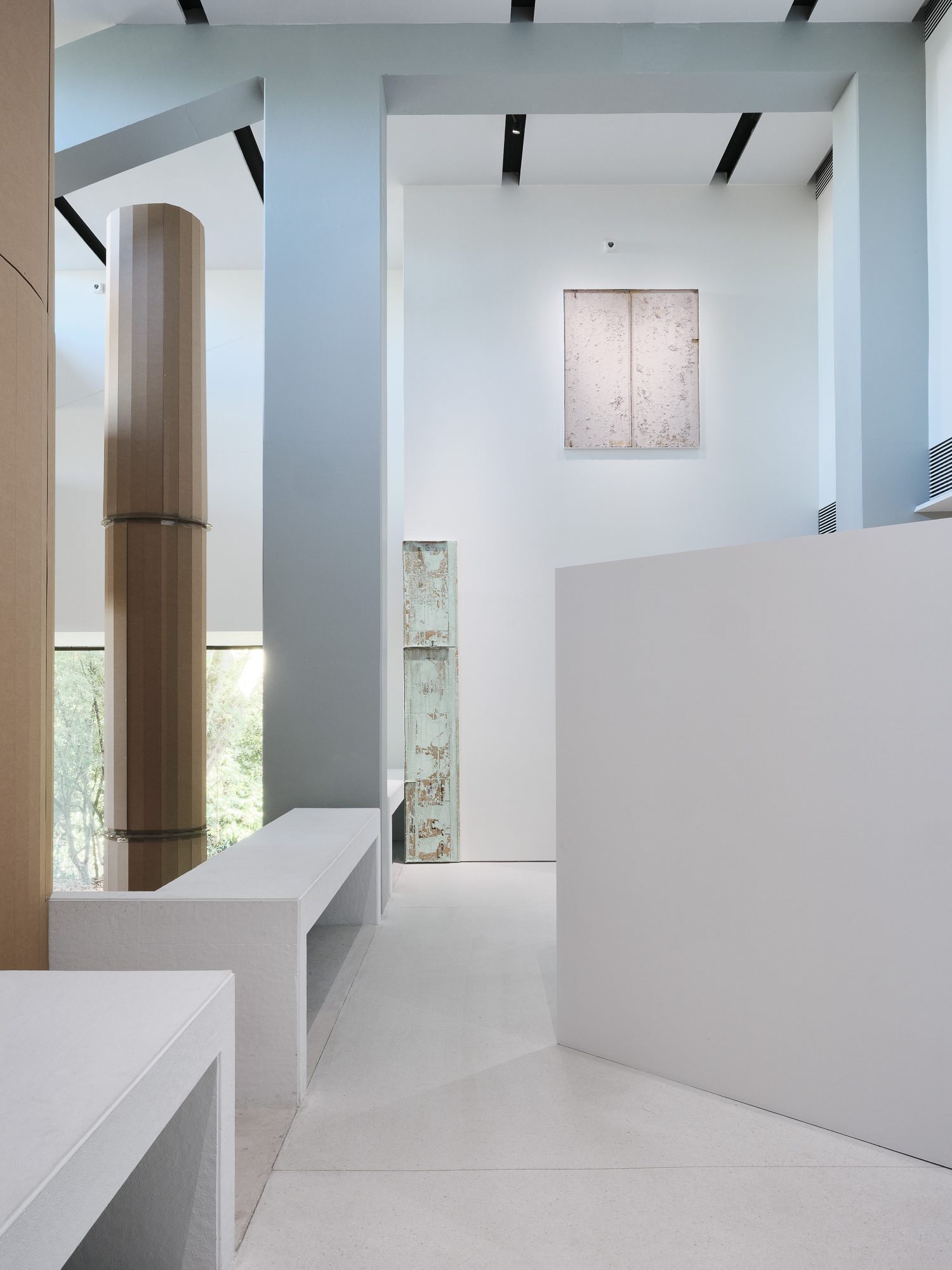
Exhibition view: Carlos Bunga, Inhabit the Contradiction. Centro de Arte Moderna, Gulbenkian, 2025-26
Enquire
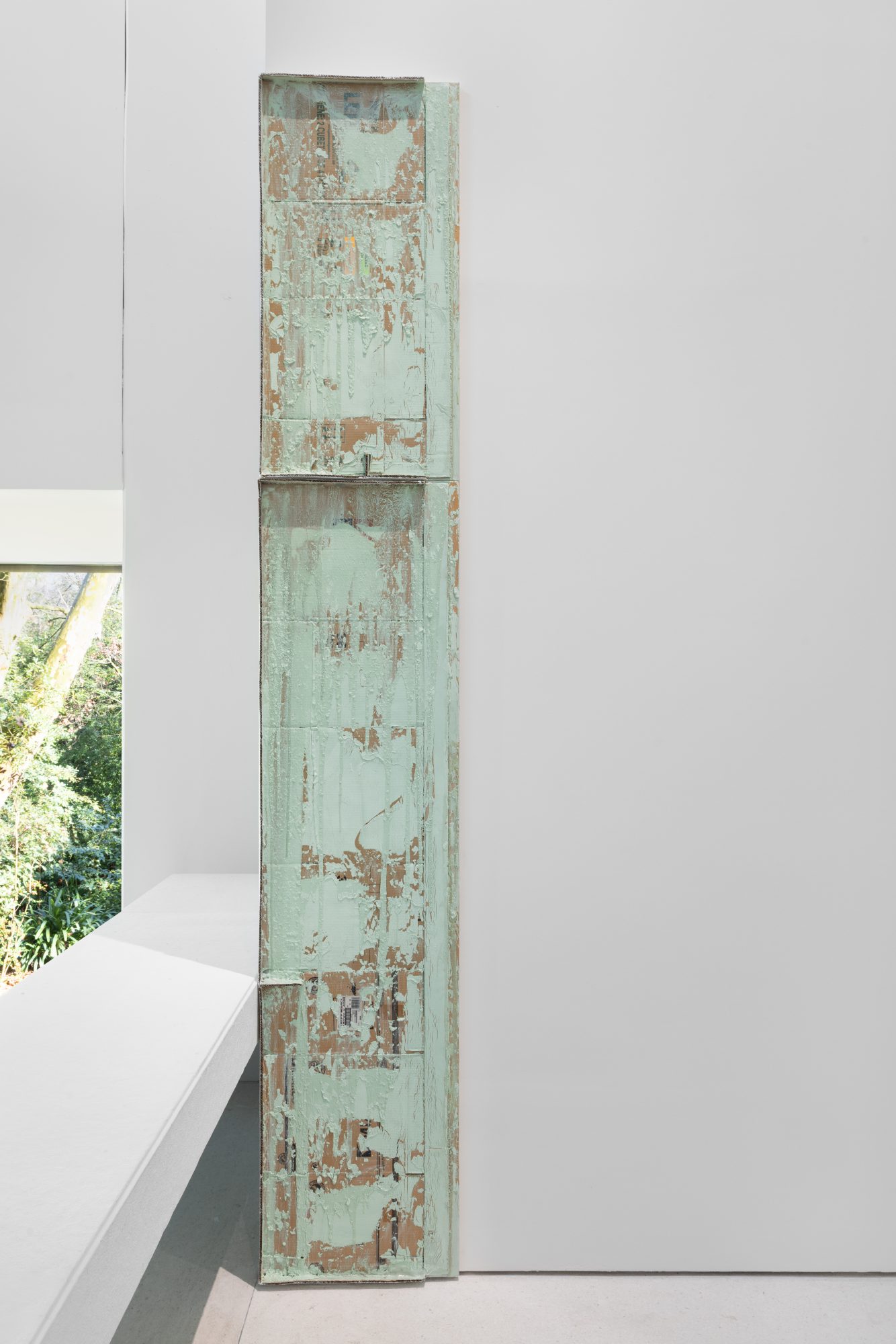
Carlos Bunga, Corner #2, 2018. Latex, glue, paper on wood. 260 x 60 x 10 cm
Enquire
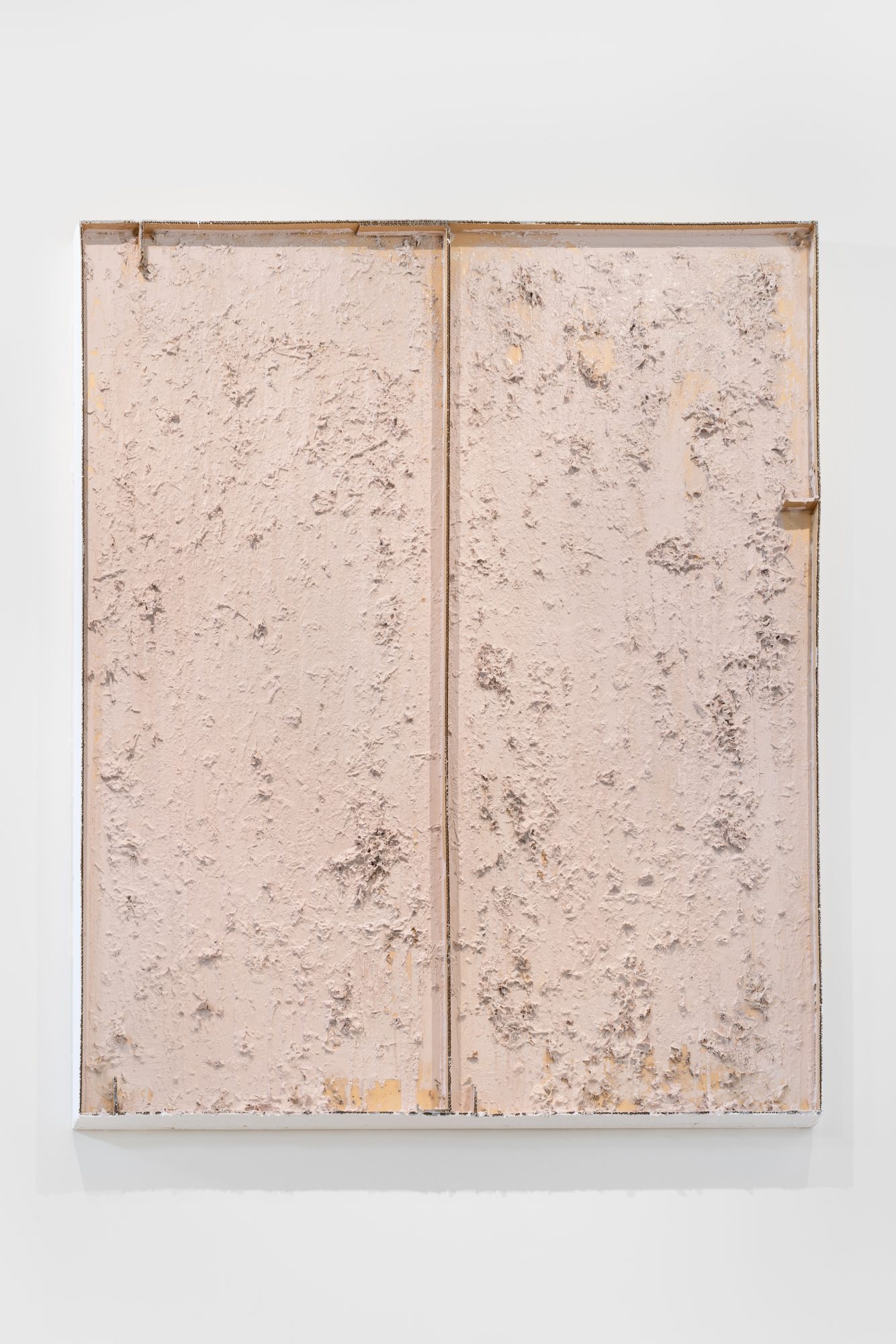
Carlos Bunga, Construcción pictórica vertical. Naturaleza #14, 2021. Plants, latex and glue on wood and cardboard. 180 x 150 x 6,5 cm
Enquire
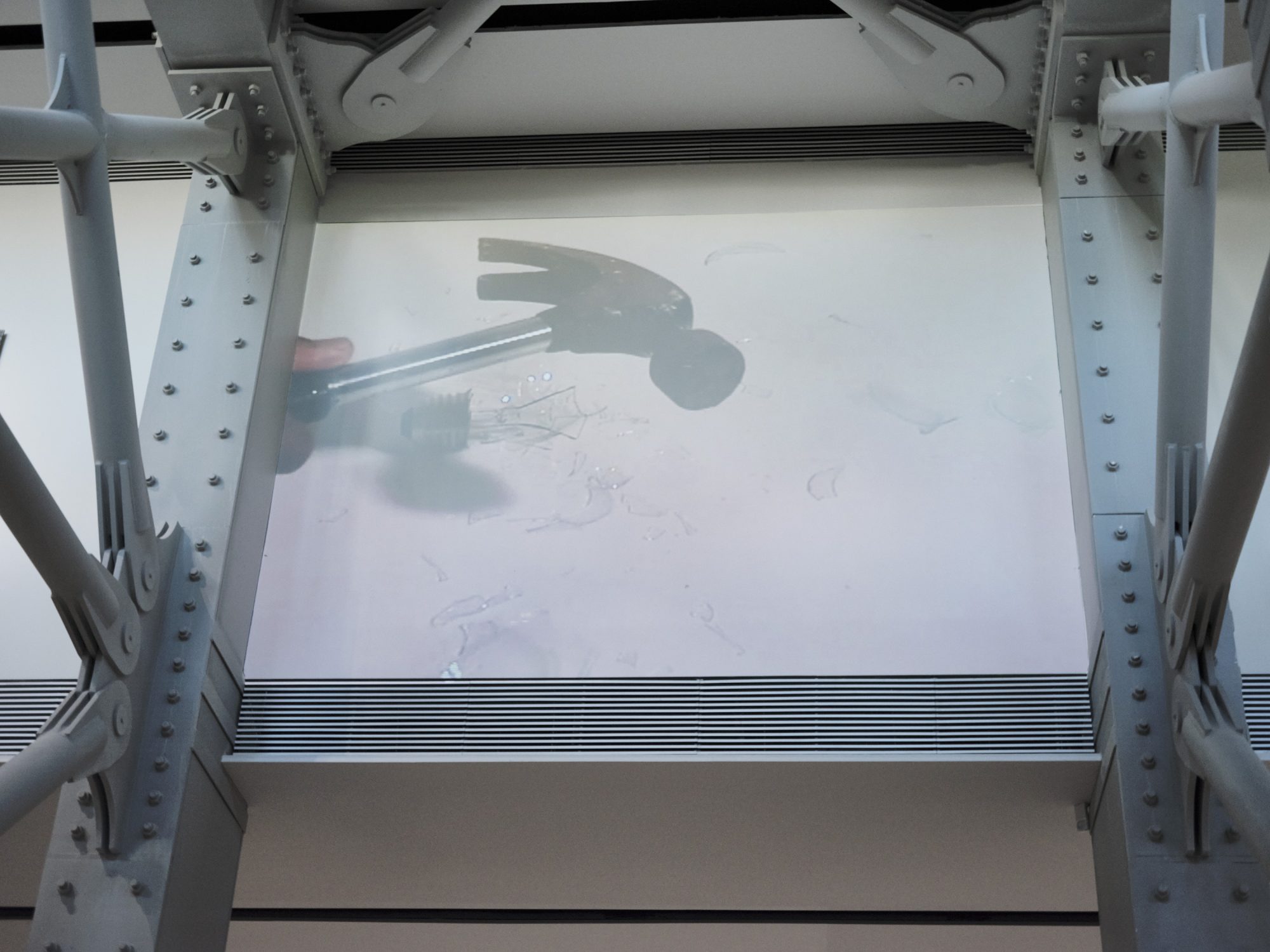
Carlos Bunga, Lamp, 2002. Single-channel, colour, sound, 1 min 34 s, loop. Variable dimensions. Ed. 5
Enquire
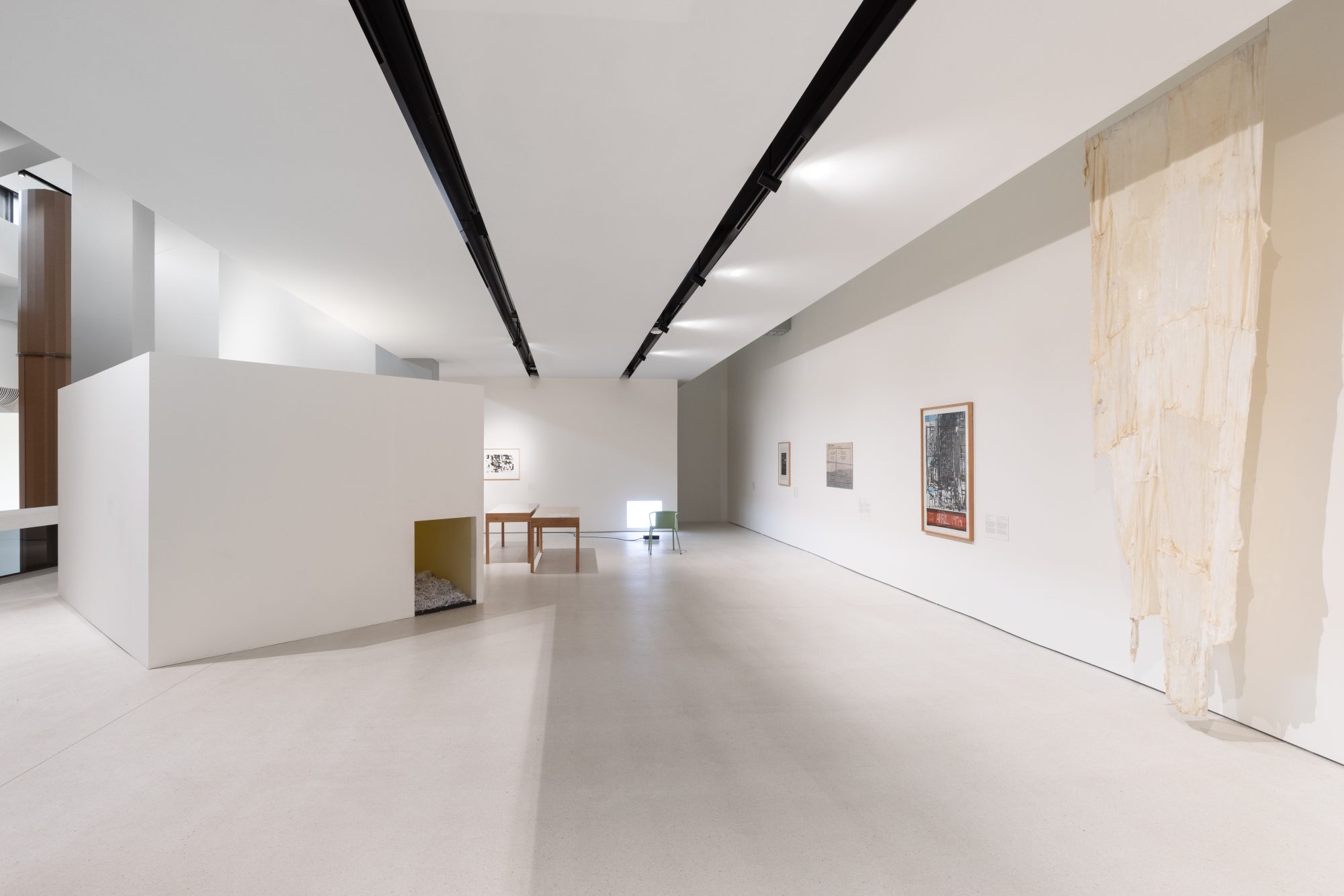
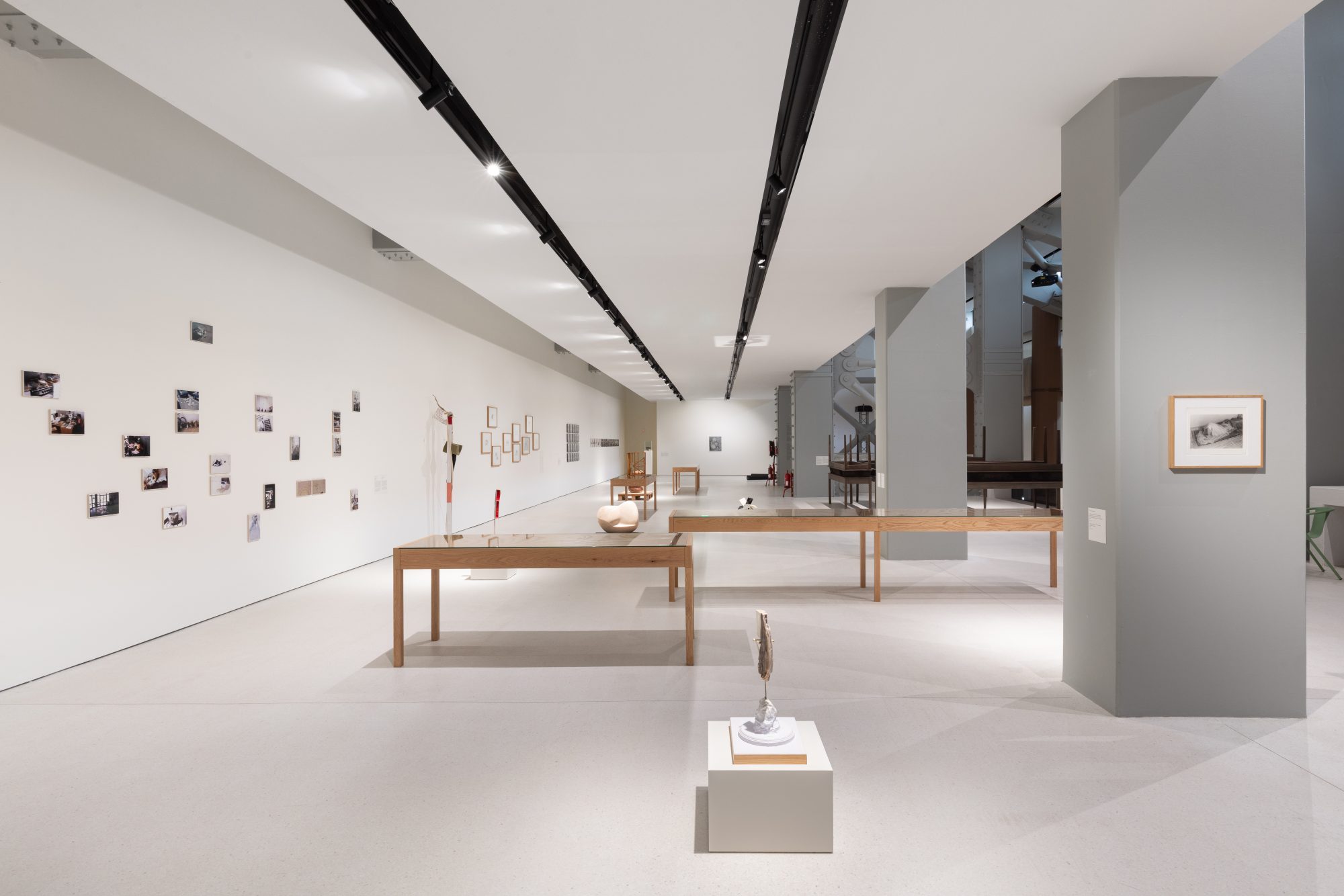
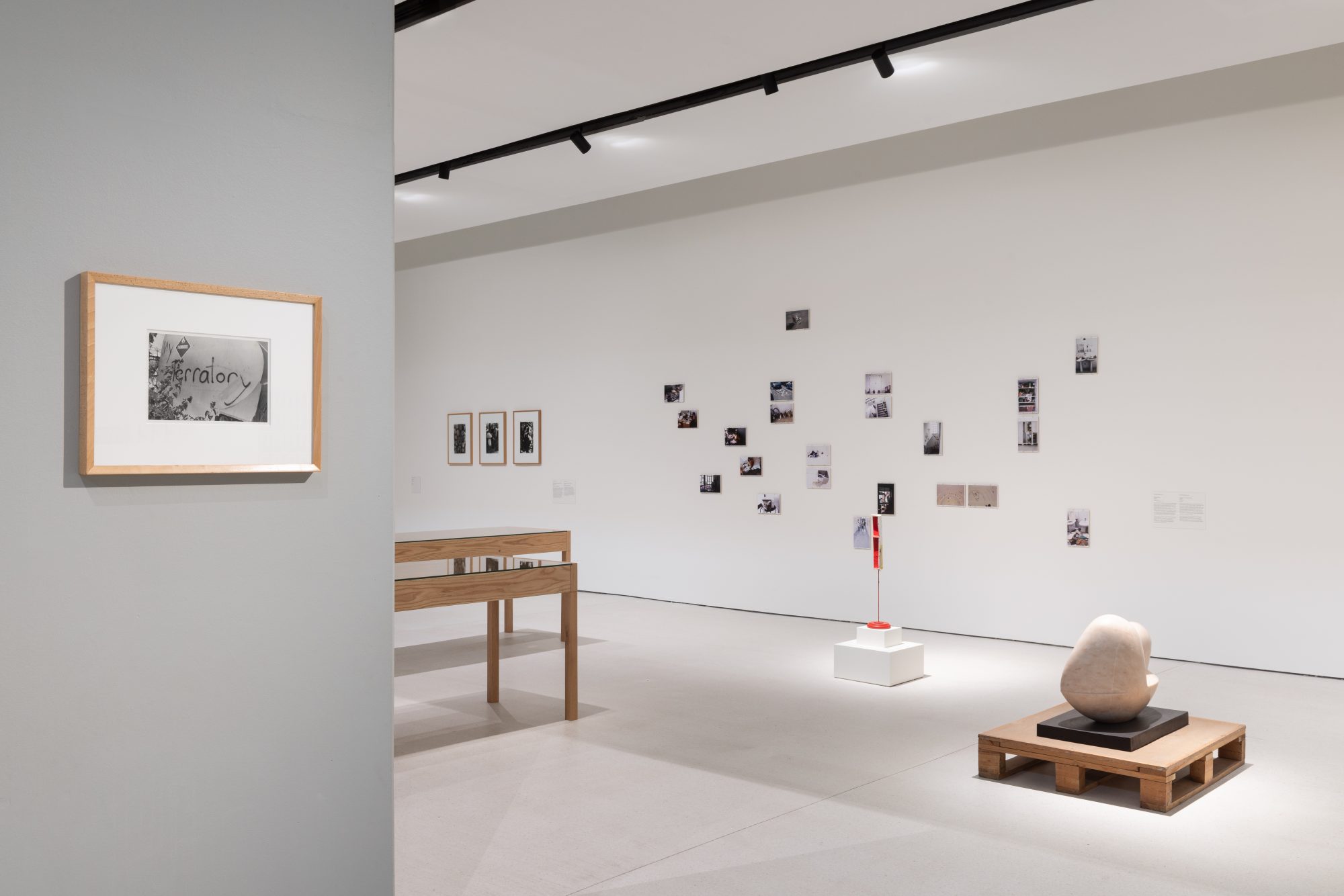
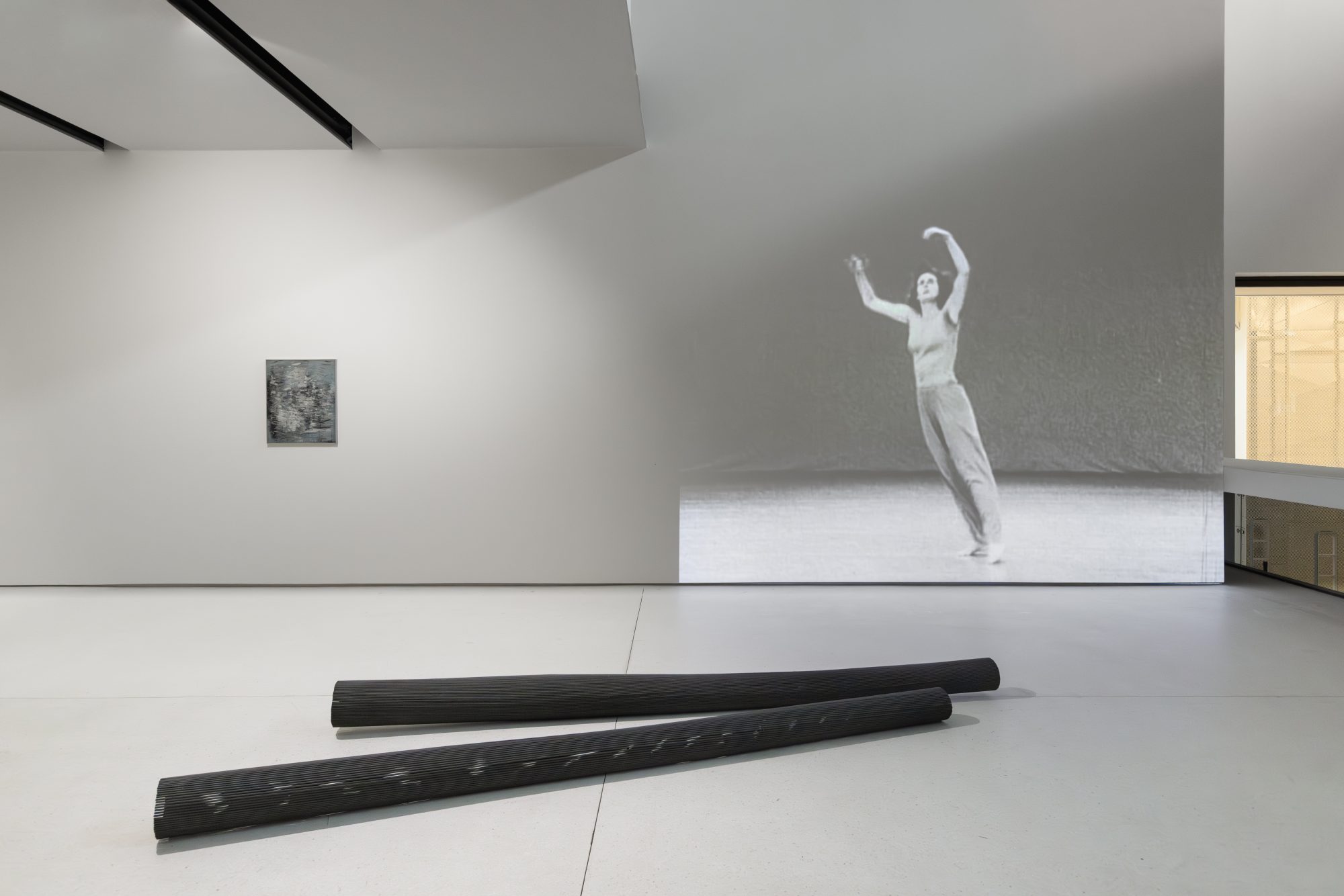
The invitation to explore the permanent Collection created a tension Carlos Bunga recognized as another fertile starting point. For more than two decades, he has questioned the authority of seemingly stable structures, drawing our attention instead to their fragility and mystery. What appears solid may, in fact, be provisional; and perhaps it is the nimble and adaptable that ultimately persists. Bunga gravitated toward works characterized by elusiveness and transience, among other aspects. Several are presented in relation to external loans and his rarely seen works that themselves hover between categories and states of being.
O convite para explorar a Coleção criou uma tensão que Carlos Bunga reconheceu como um outro ponto de partida fértil. Há mais de duas décadas que o artista questiona a autoridade de estruturas aparentemente estáveis e previsíveis, chamando ao invés a nossa atenção para a sua fragilidade e mistério. O que parece sólido poderá na verdade ser provisório; e talvez o que é flexível e adaptável seja afinal aquilo que perdura. Bunga foi atraído por obras caracterizadas pela sua natureza efémera e elusiva, entre outros aspetos. Várias delas são apresentadas em relação com empréstimos externos e obras do artista raramente expostas, que também elas oscilam entre categorias e estados.

Carlos Bunga, Skin Composition, 2018. Glue on cotton. 380 x 115 cm. Ed. 5
Enquire
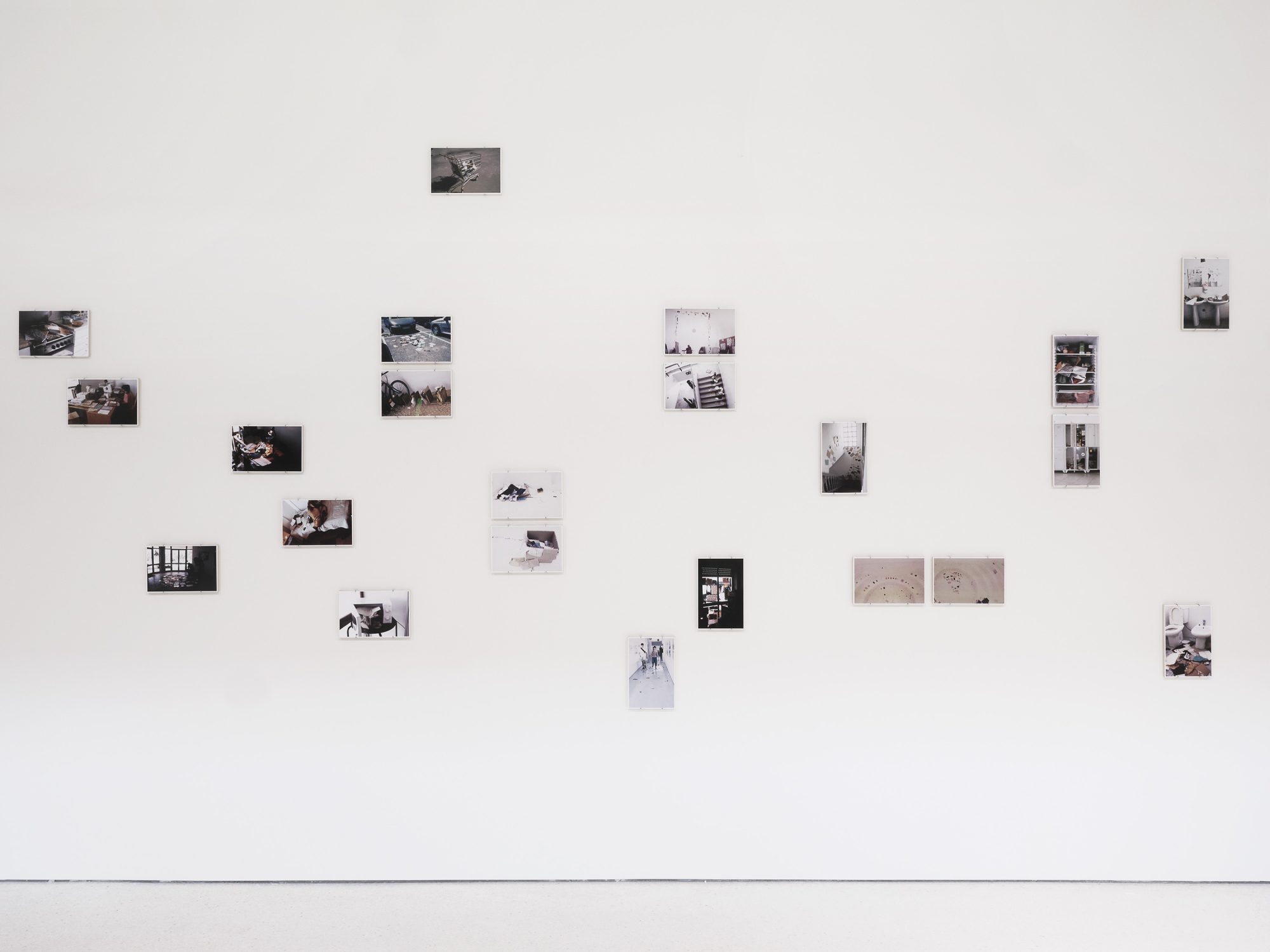
Carlos Bunga, Fragmentos, 2000. Chromogenic color print. 22 x (24 x 15,8 cm)
Enquire
While studying painting and growing dissatisfied with its conventions, Carlos Bunga began to experiment with found and discarded materials, which he cut and sutured with needle and thread. This simple and violent intervention left scars, testifying both to the action and to the impossibility of returning to their original form. He then placed the stitched objects in gaps and active sites such as a microwave, a stairwell, a shopping cart, or an office, among other areas, where they unsettled routines of use and movement.
Durante os seus estudos de pintura e crescentemente dececionado com as convenções deste meio, Carlos Bunga começou a fazer experiências com materiais encontrados e descartados, que cortava e cosia com agulha e linha. Esta intervenção simples mas violenta deixava cicatrizes, testemunhando a ação e a impossibilidade de retorno à forma original. A seguir, os objetos eram colocados em espaços vazios e locais movimentados, por exemplo, um micro-ondas, um carrinho de compras, uma escada ou um escritório, onde perturbavam as rotinas de uso e movimento.
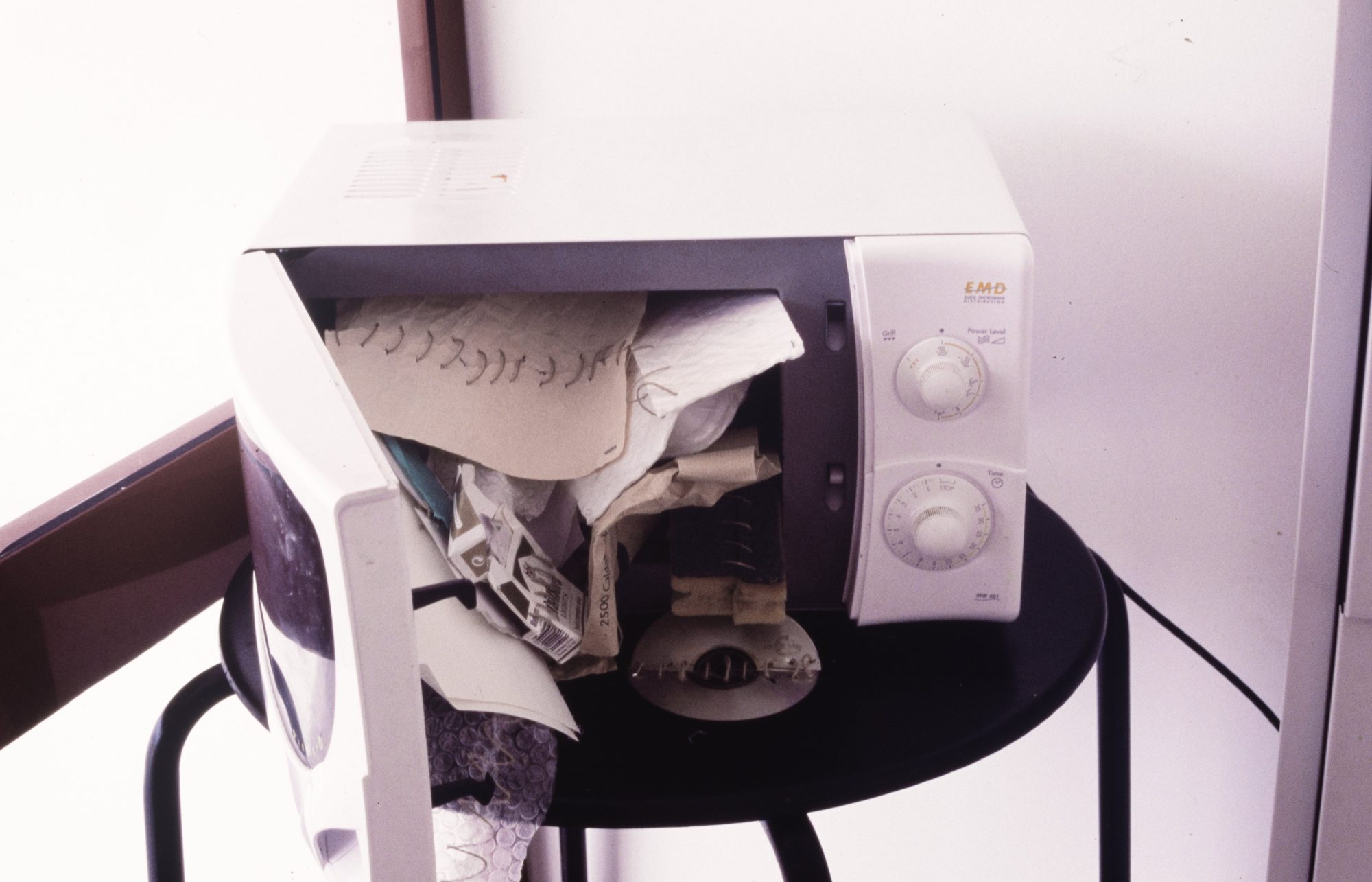
Carlos Bunga, Fragmentos (detail), 2000. Chromogenic color print. 22 x (24 x 15,8 cm)
Enquire
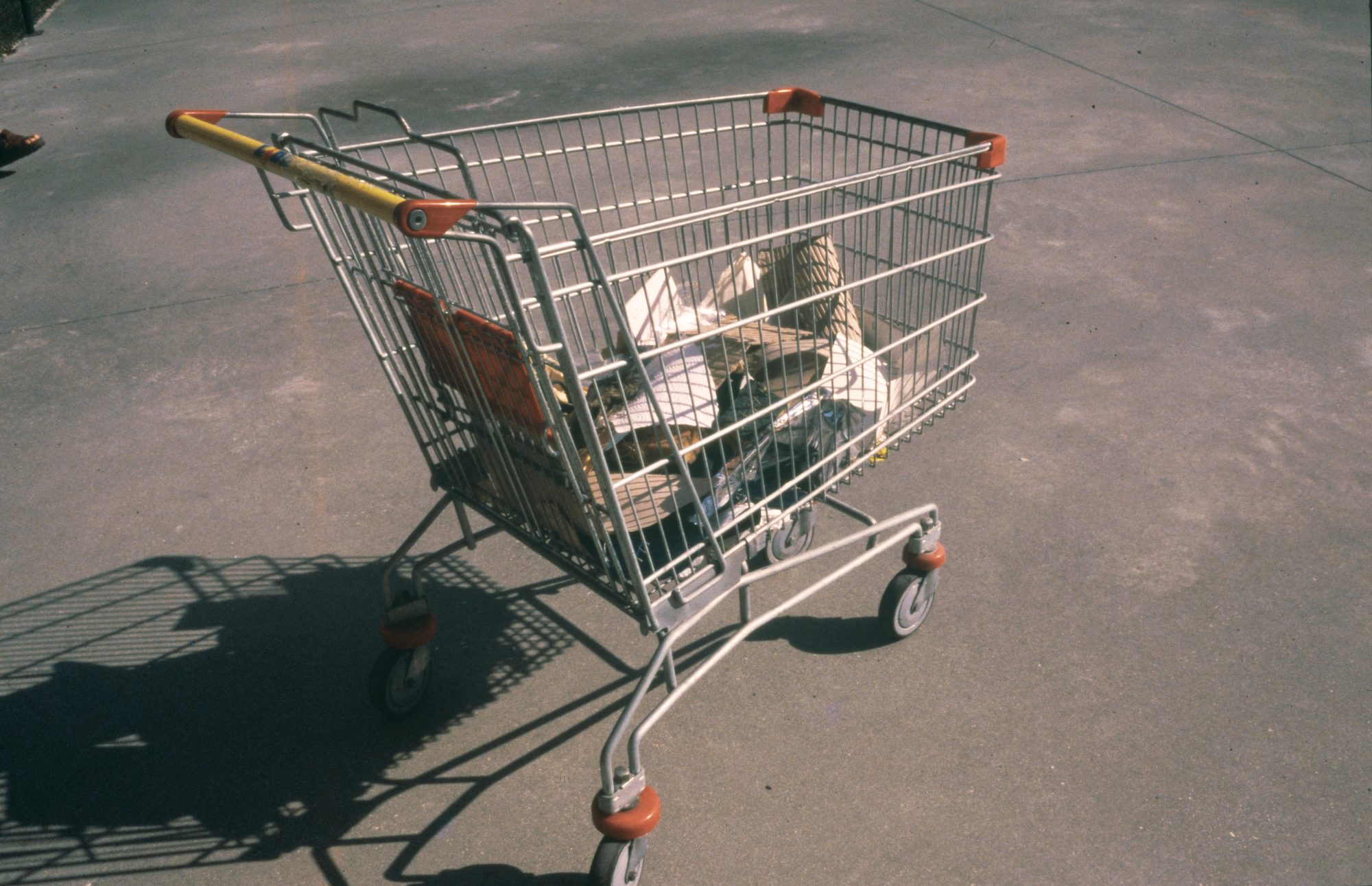
Carlos Bunga, Fragmentos (detail), 2000. Chromogenic color print. 22 x (24 x 15,8 cm)
Enquire
As Bunga recalls, ‘what emerged from this type of performance was the image of a living organism: exposed, resilient, always in motion’. Photographed then and presented here for the first time, the series affirms fragmentation ‘as both wound and vital condition’.
Como recorda o artista: «O que surgia deste tipo de performance era a imagem de um organismo vivo: exposto, resistente e sempre em movimento.»
Fotografada na altura e apresentada aqui pela primeira vez, a série confirma a fragmentação «como ferida e condição vital».
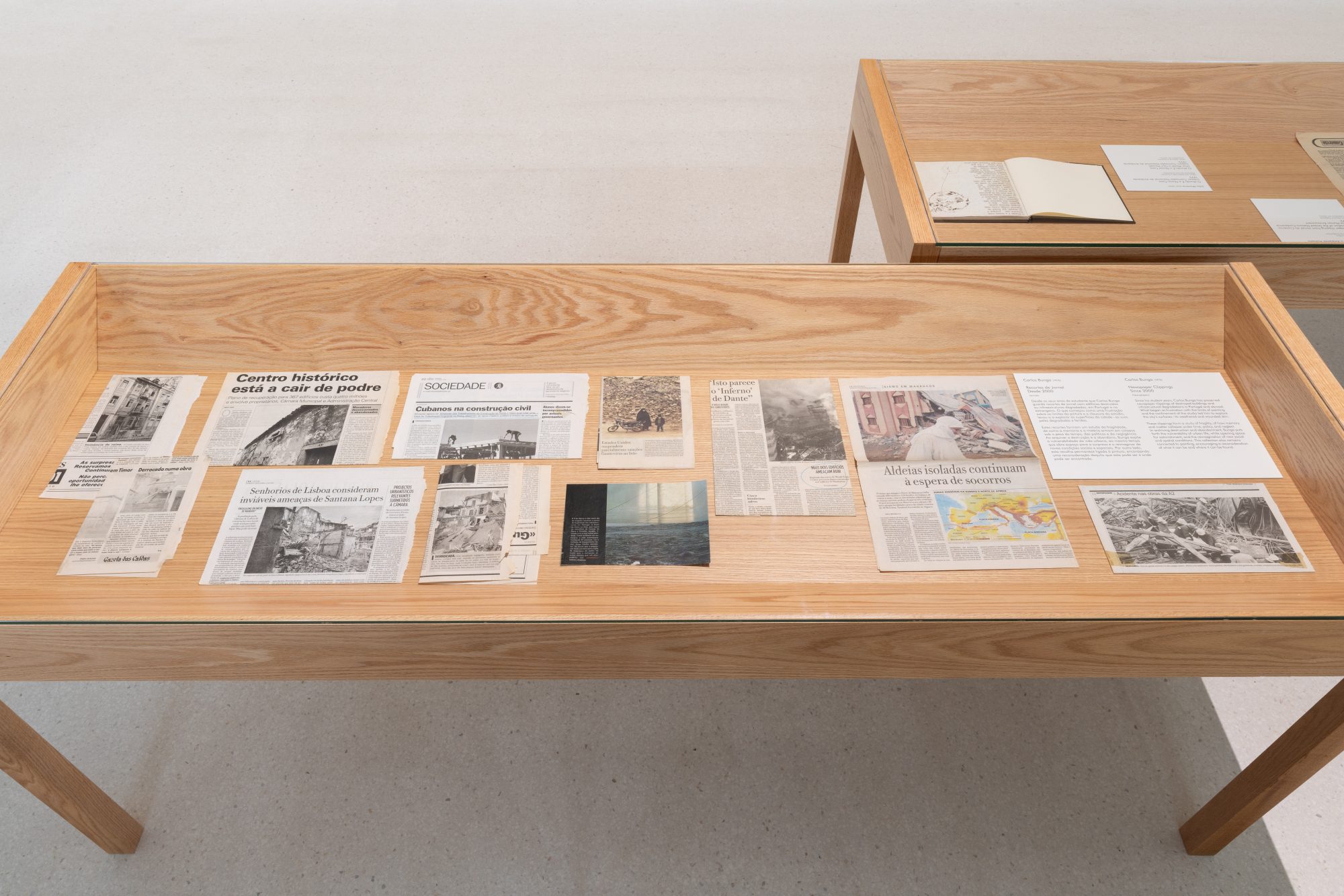
Since his student years, Carlos Bunga has preserved newspaper clippings of destroyed buildings and infrastructural degradations in Portugal and abroad. What began as frustration with the limits of painting and the confinement of the studio led him to explore the city’s surfaces – its weathered and wounded skin.
Desde os seus anos de estudante que Carlos Bunga guarda recortes de jornal com edifícios destruídos ou infraestruturas degradadas, em Portugal e no estrangeiro. O que começou como uma frustração sobre os limites da pintura e a clausura do estúdio, levou-o a explorar as superfícies da cidade – as suas peles degradadas e feridas.
These clippings form a study of fragility, of how memory and matter collapse under time, policy, and neglect.
In archiving destruction and abandonment, Bunga puts forth the vulnerability of urban life, while opening space for astonishment, and the reimagination of new social and spatial conditions. This collection also remains connected to painting, encouraging a reconsideration of what it can be and where it can be found.
Estes recortes formam um estudo da fragilidade, de como a memória e a matéria entram em colapso sob o peso do tempo, das políticas e da negligência. Ao arquivar a destruição e o abandono, Bunga expõe a vulnerabilidade da vida urbana, ao mesmo tempo que abre espaço para a surpresa e o reimaginar de novas condições sociais e espaciais. Por outro lado, esta recolha permanece ligada à pintura, encorajando uma reconsideração daquilo que esta pode ser e onde pode ser encontrada.
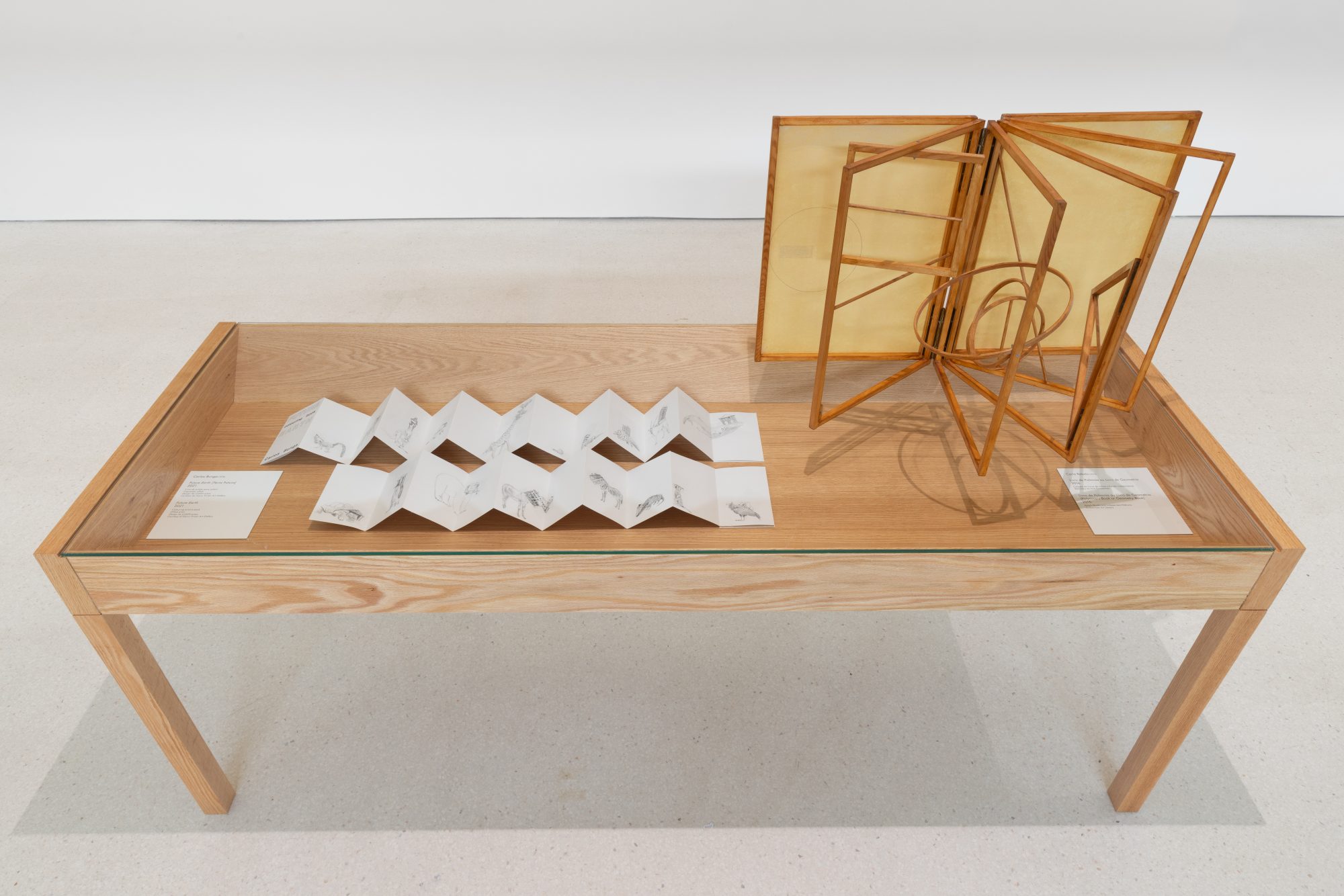
Exhibition view: Carlos Bunga, Inhabit the Contradiction. Centro de Arte Moderna, Gulbenkian, 2025-26
Enquire

Exhibition view: Carlos Bunga, Inhabit the Contradiction. Centro de Arte Moderna, Gulbenkian, 2025-26
Enquire
Through this active composition, a body in flux comes in and out of view: passing through cityscapes and landscapes, porous edges, memory and dream, heartbreak and exhilaration. What is gathered here resists conclusion, instead pointing to processes and open ends. At different moments works may relocate, disappear, or be newly introduced by the artist.
Através desta composição ativa, um corpo fluido entra e sai de cena, atravessando paisagens urbanas e rurais, fronteiras porosas, memória e sonho, sofrimento e euforia. O que vemos aqui reunido resiste à conclusão, em vez disso apontando para processos e finais em aberto. Em diferentes momentos da exposição, as obras poderão ser deslocadas, desaparecer ou surgir de novo pela mão do artista.
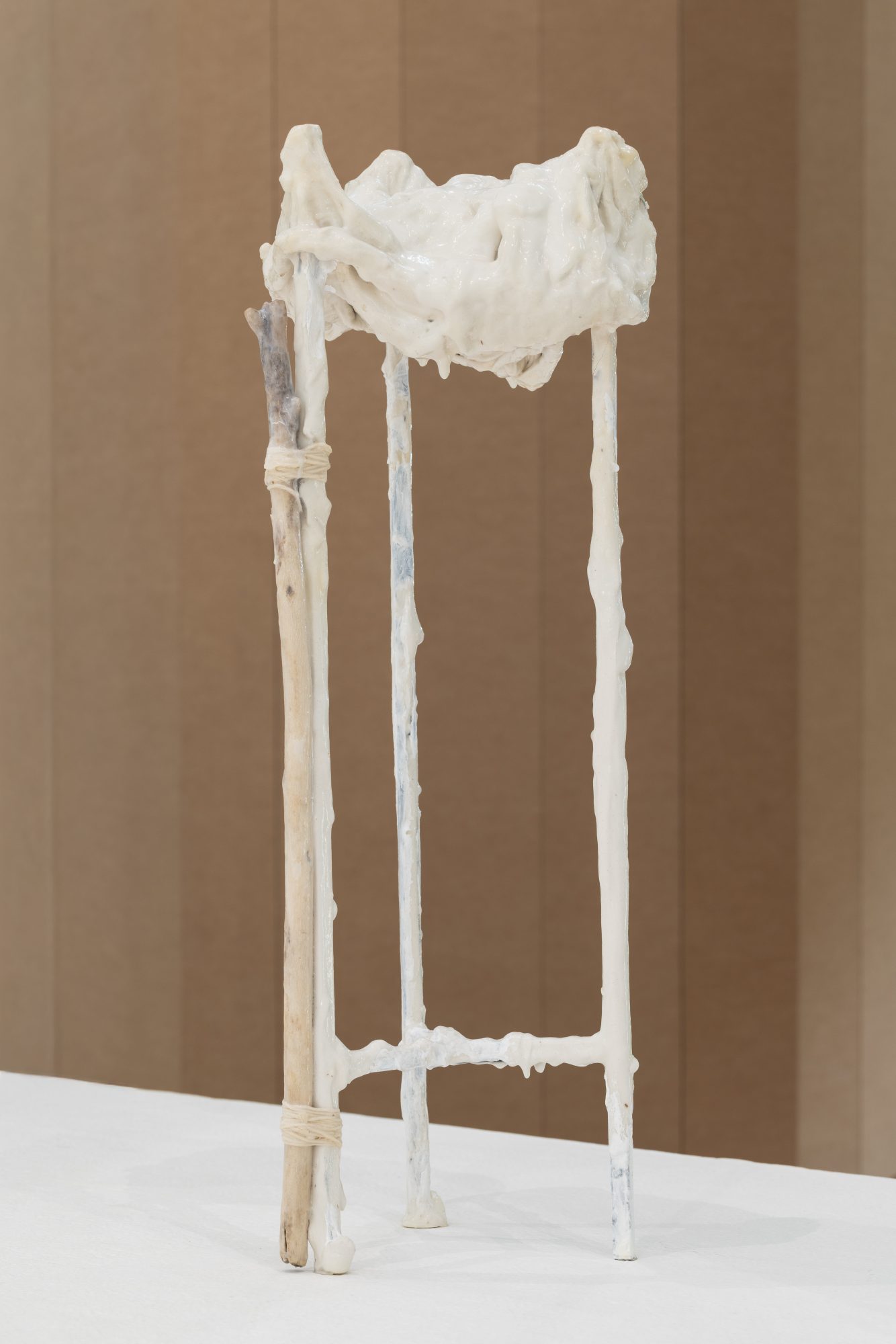
Carlos Bunga, UNTITLED #19 (in collaboration with Glynn Vivian Gallery Collection), 2021. Mixed media. 61 x 23 x 23 cm
Enquire

Carlos Bunga, Untitled #21 (in collaboration with Glynn Vivian Gallery Collection), 2021. Mixed media. 54 x 34,5 x 27 cm
Enquire

Carlos Bunga, Metamorphose, 2000. Inkjet print on paper. 20 x (26 x 32 cm). Ed. 5
Enquire

Exhibition view: Carlos Bunga, Inhabit the Contradiction. Centro de Arte Moderna, Gulbenkian, 2025-26
Enquire

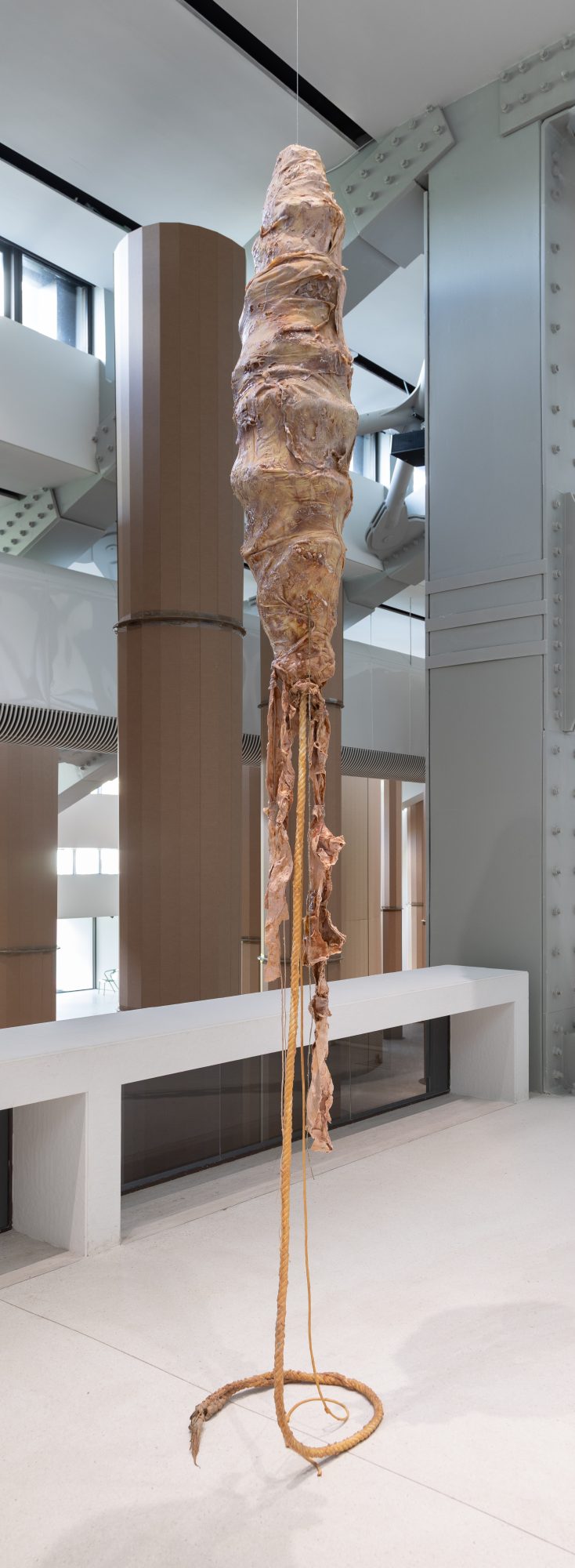
Carlos Bunga, Cocoon #9, Latex paint and glue on papier-mâché and wood. 140 x ø 60 cm
Enquire
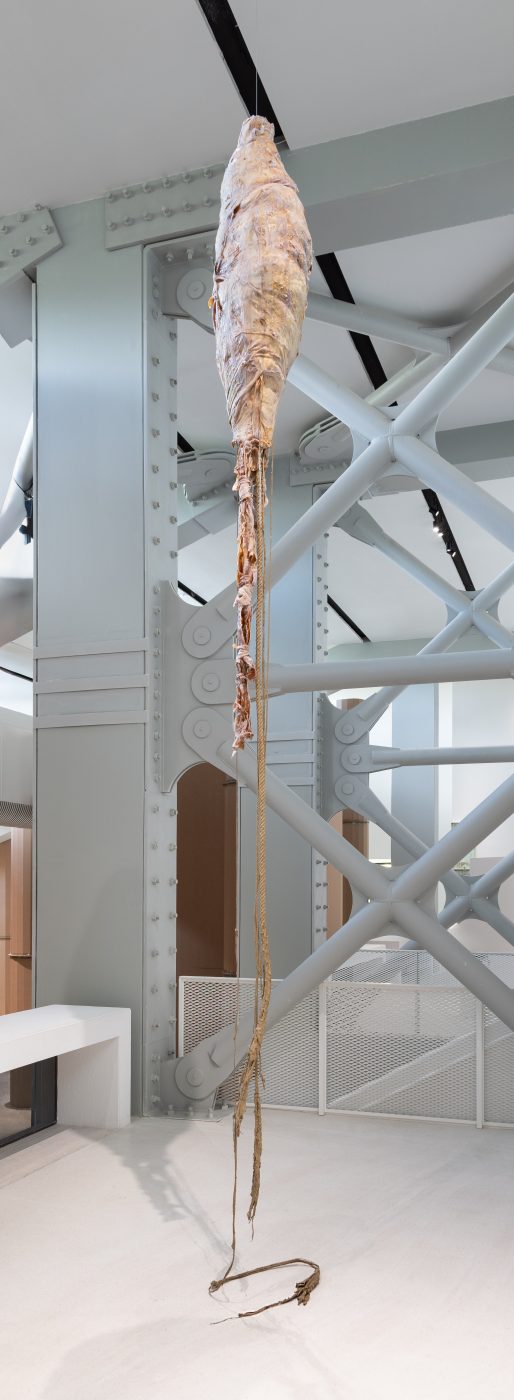
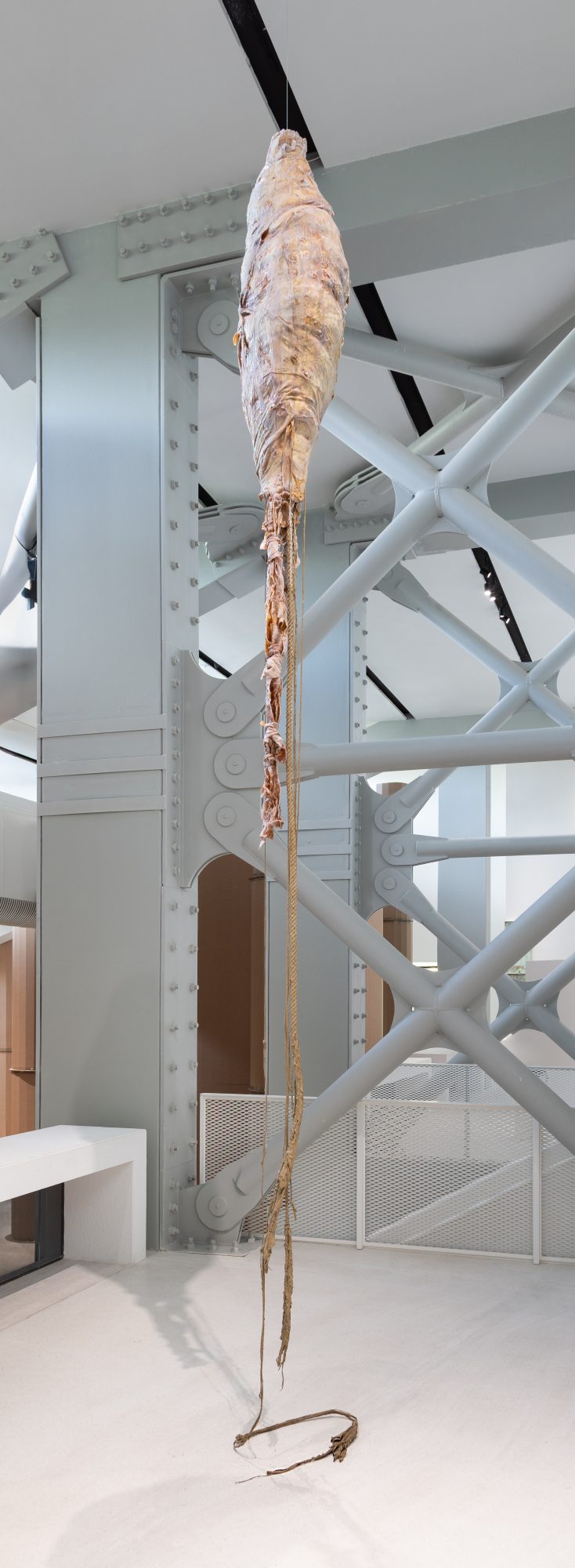
Carlos Bunga, Cocoon #7. Latex paint and glue on papier-mâché and wood. 140 x ø 50 cm
Enquire
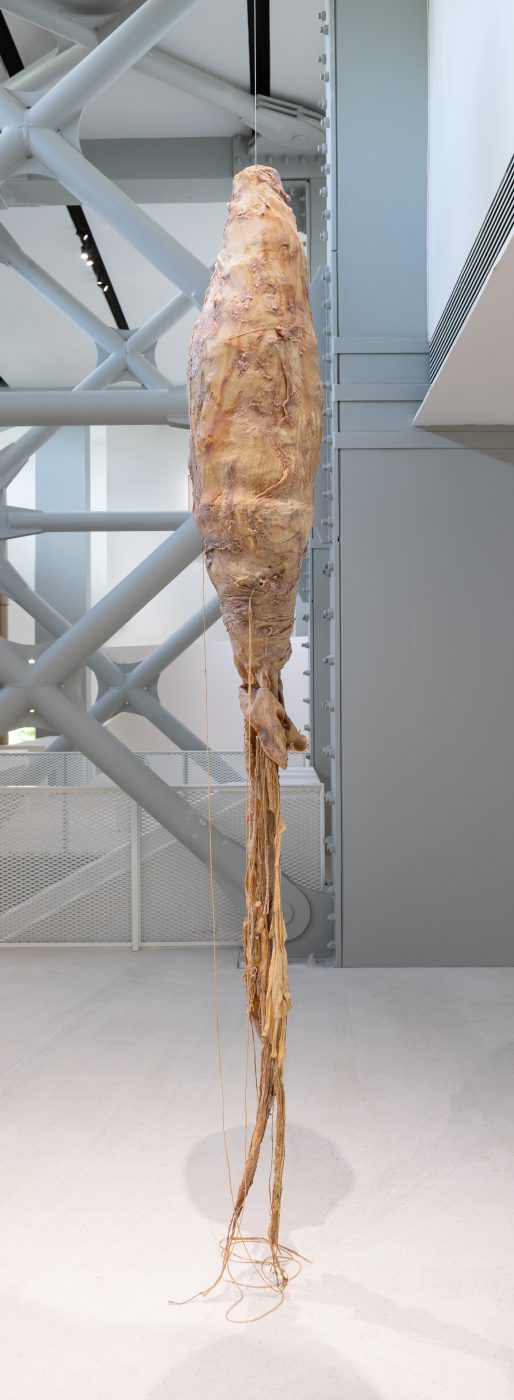
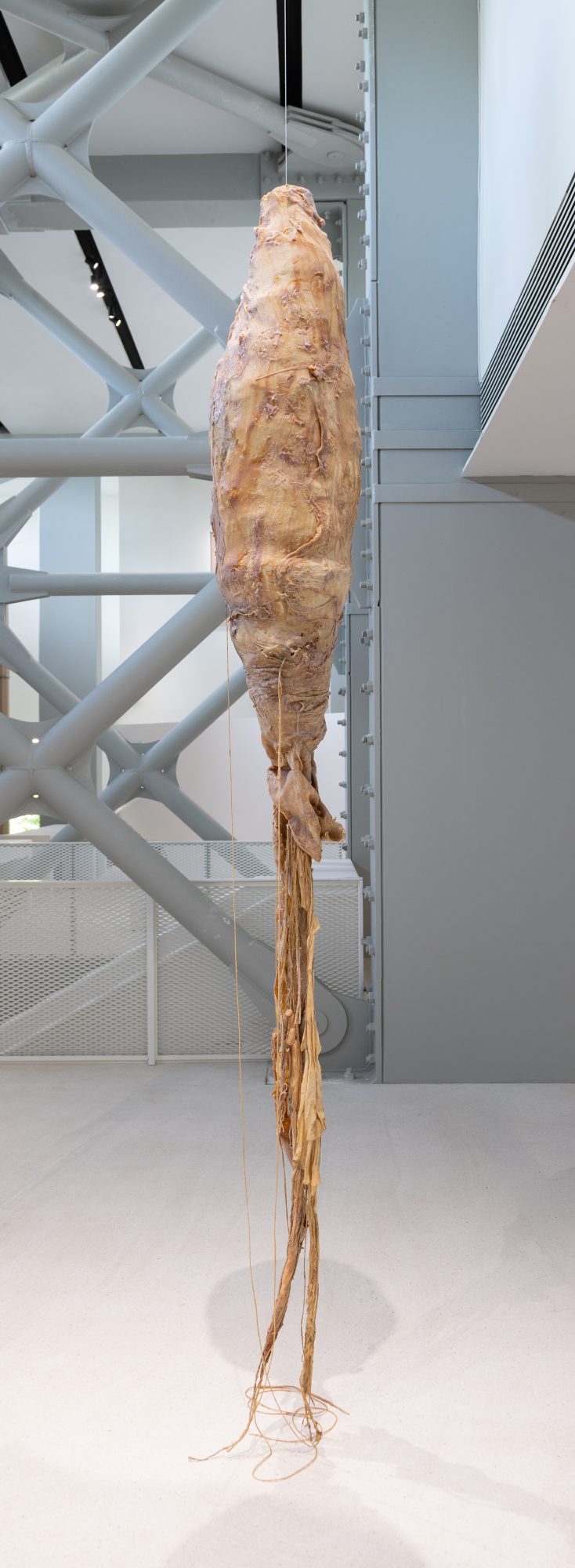
Carlos Bunga, Cocoon #7. Latex paint and glue on papier-mâché and wood. 140 x ø 0 cm
Enquire
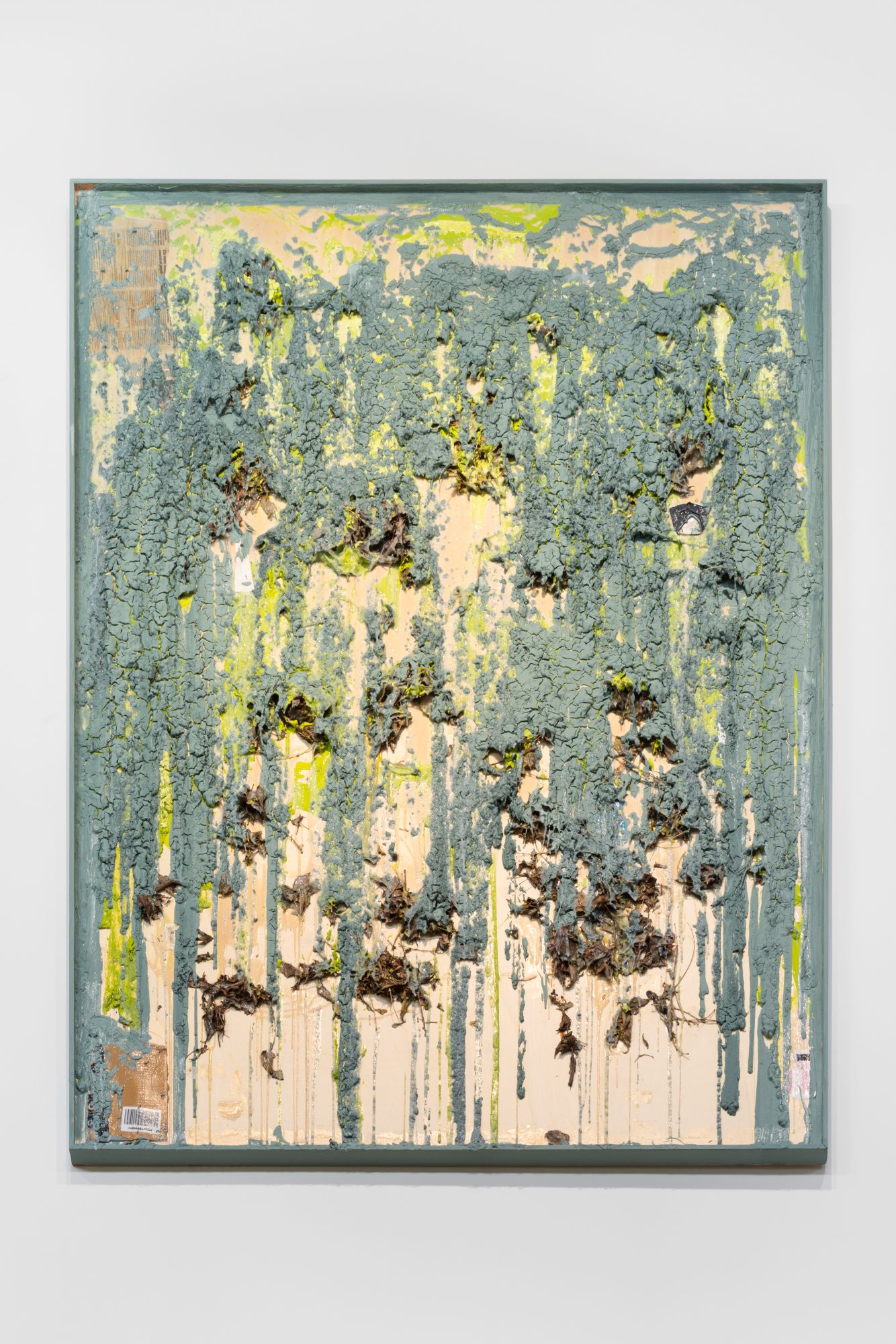
Carlos Bunga, Construcción pictórica. Naturaleza #12, 2021. Latex, glue, leaves, paper on wood. 200 x 150 x 8 cm
Enquire
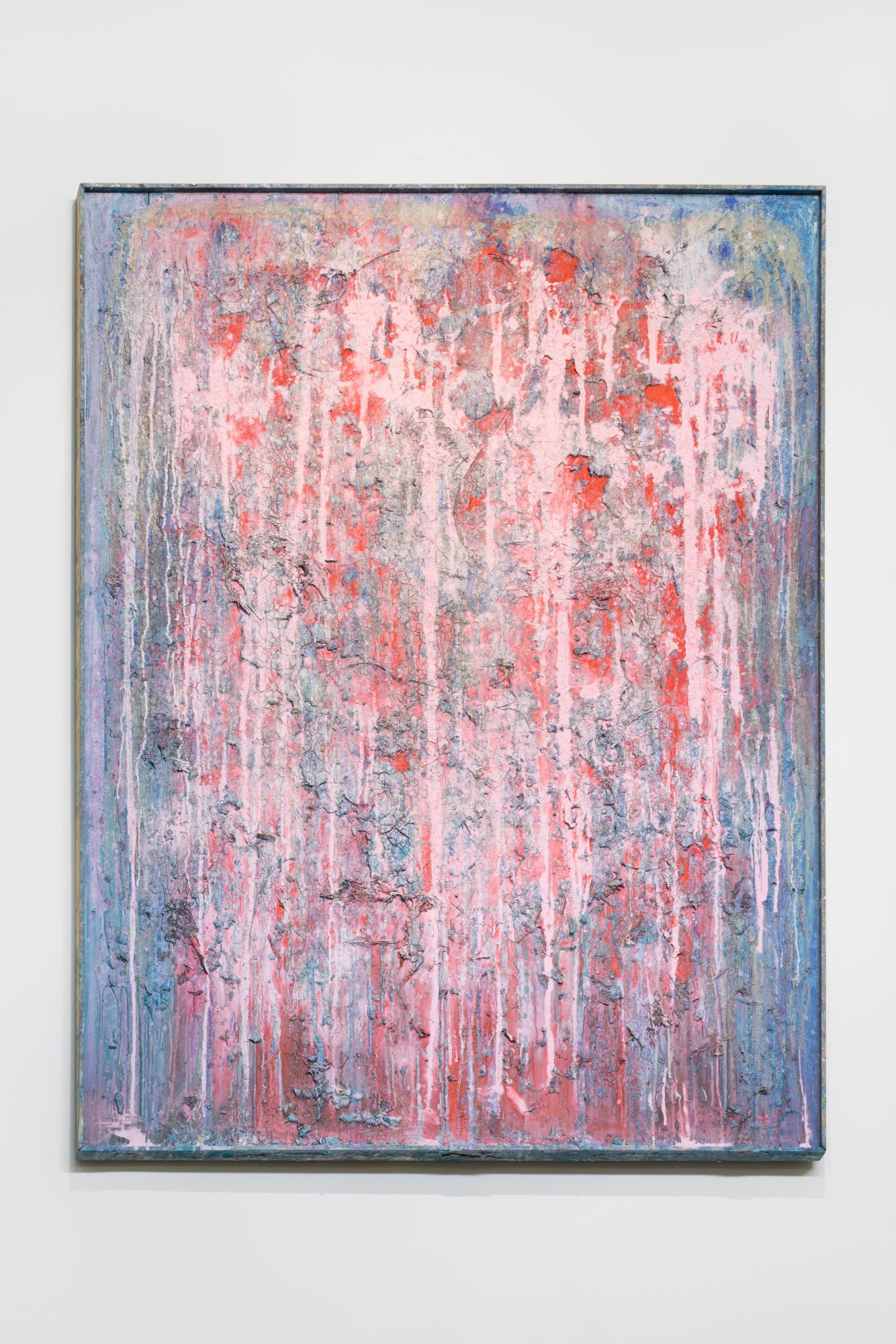
Carlos Bunga, Construcción pictórica, 2025. Latex paint, tempera, leaves, waste and glue on wood. 200 x 150 x 3 cm
Enquire

Exhibition view: Carlos Bunga, Inhabit the Contradiction. Centro de Arte Moderna Gulbenkian, 2025-26
Enquire
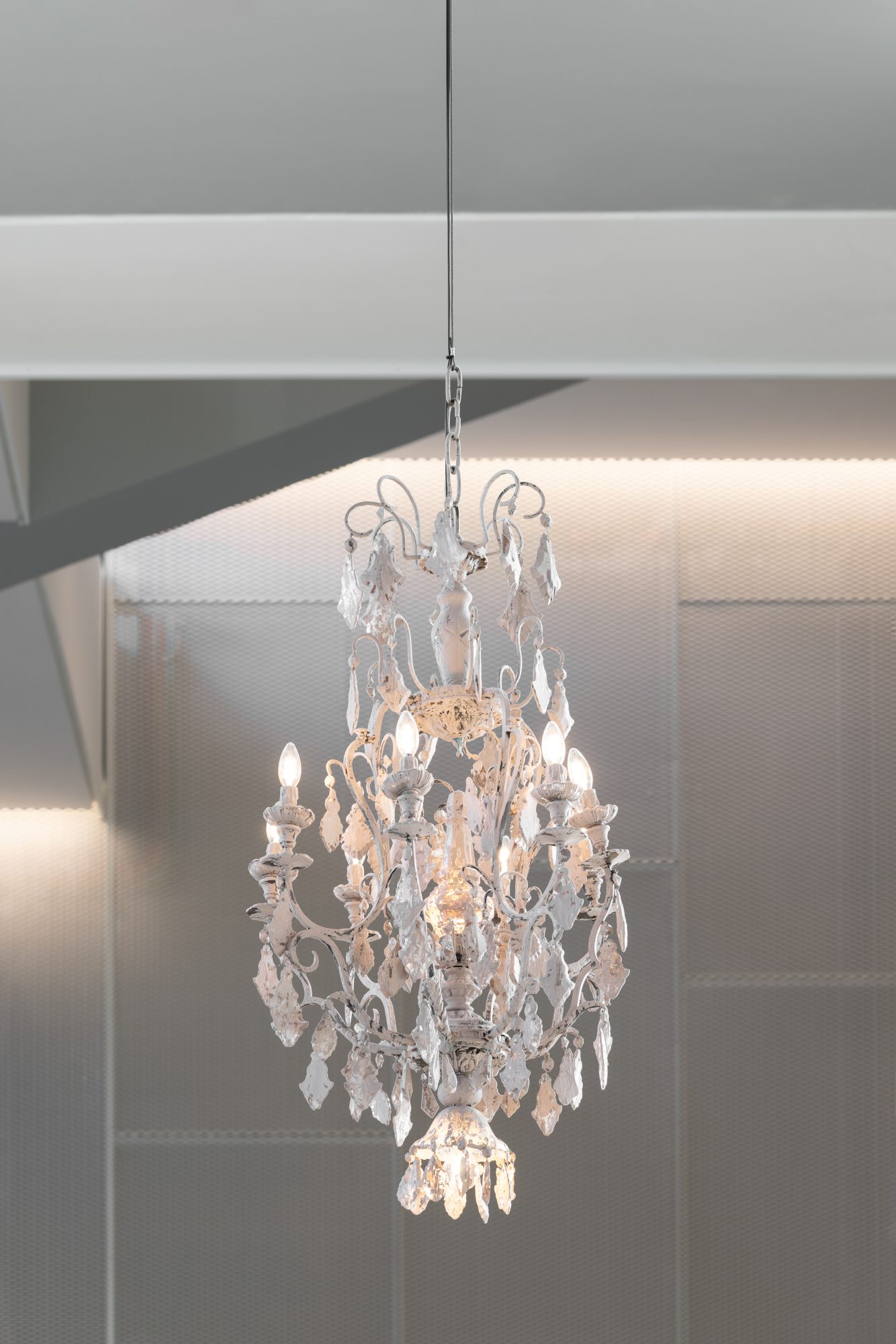
Carlos Bunga, Animism #22, 2025. Latex glue and paint on lamp. 140 x ø 70 cm
Enquire
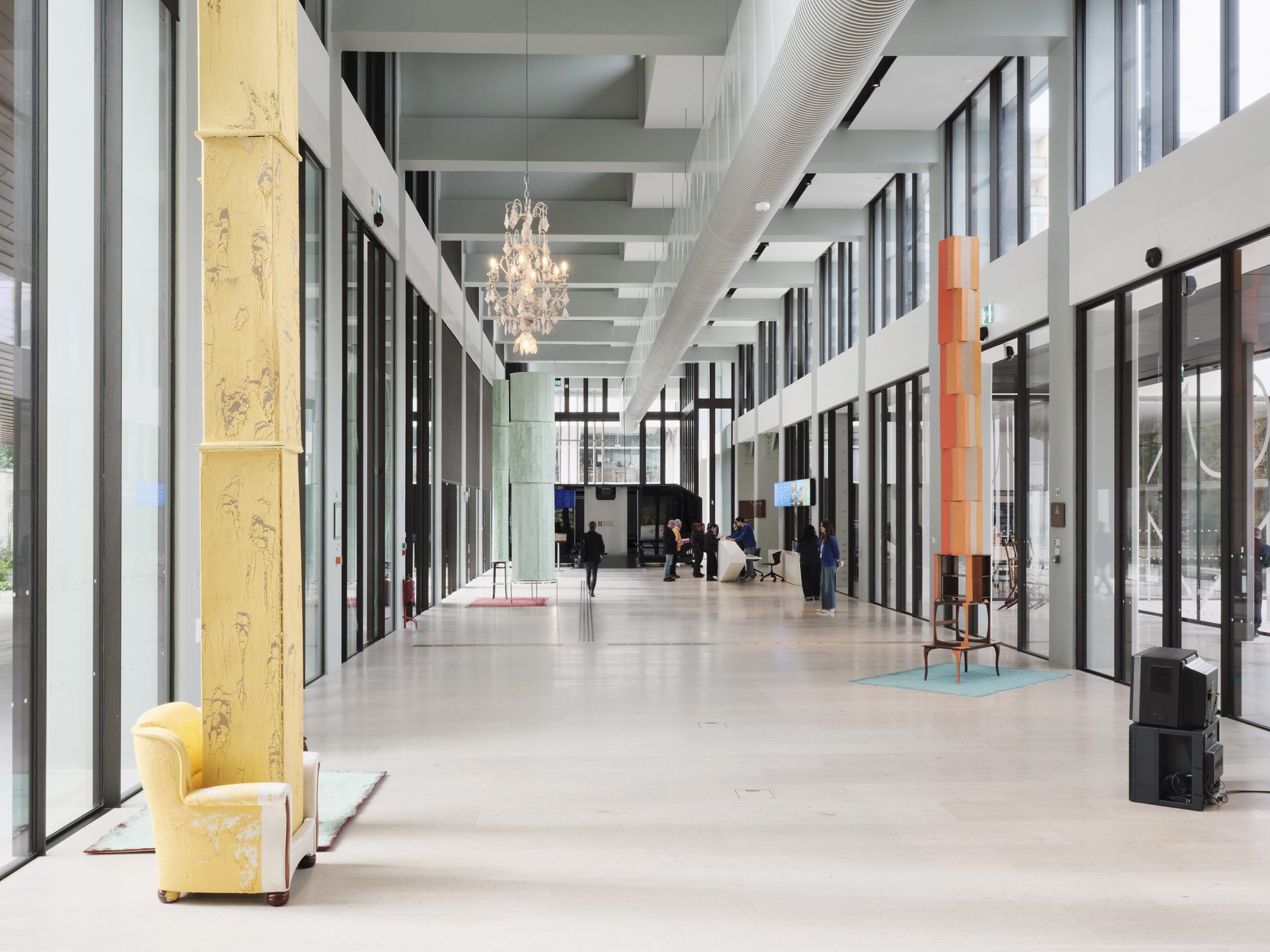
Exhibition view: Carlos Bunga, Inhabit the Contradiction. Centro de Arte Moderna Gulbenkian, 2025-26
Enquire

Exhibition view: Carlos Bunga, Inhabit the Contradiction. Centro de Arte Moderna Gulbenkian, 2025-26
Enquire
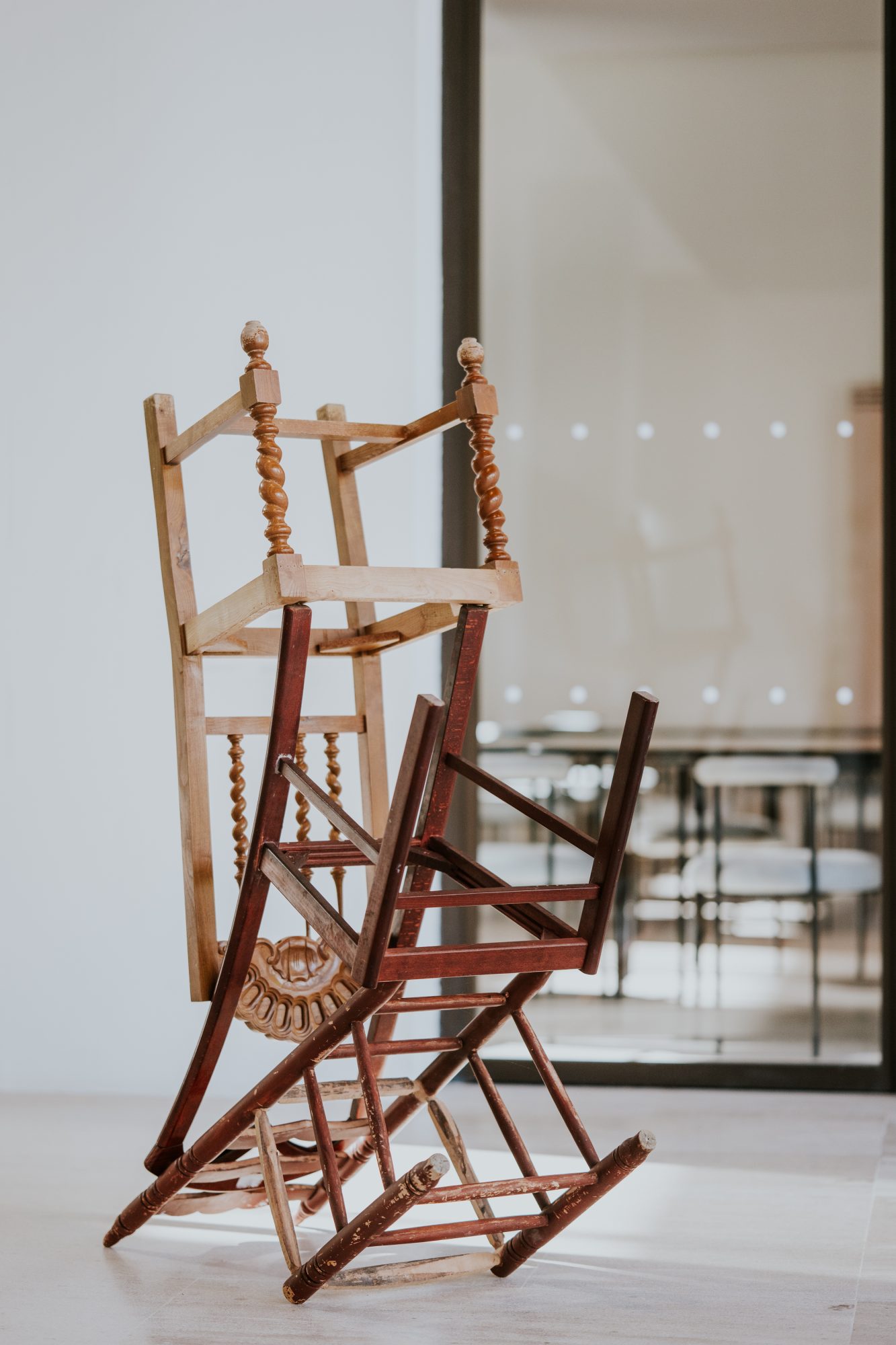
Carlos Bunga, Saltimbanqui #4, 2025. Chairs. 96 x 44 x 175 cm
Enquire

Carlos Bunga, Saltimbaqui #6, 2025. Ladder and sun lounger. 270 x 135 x 65 cm. Unique.
Enquire
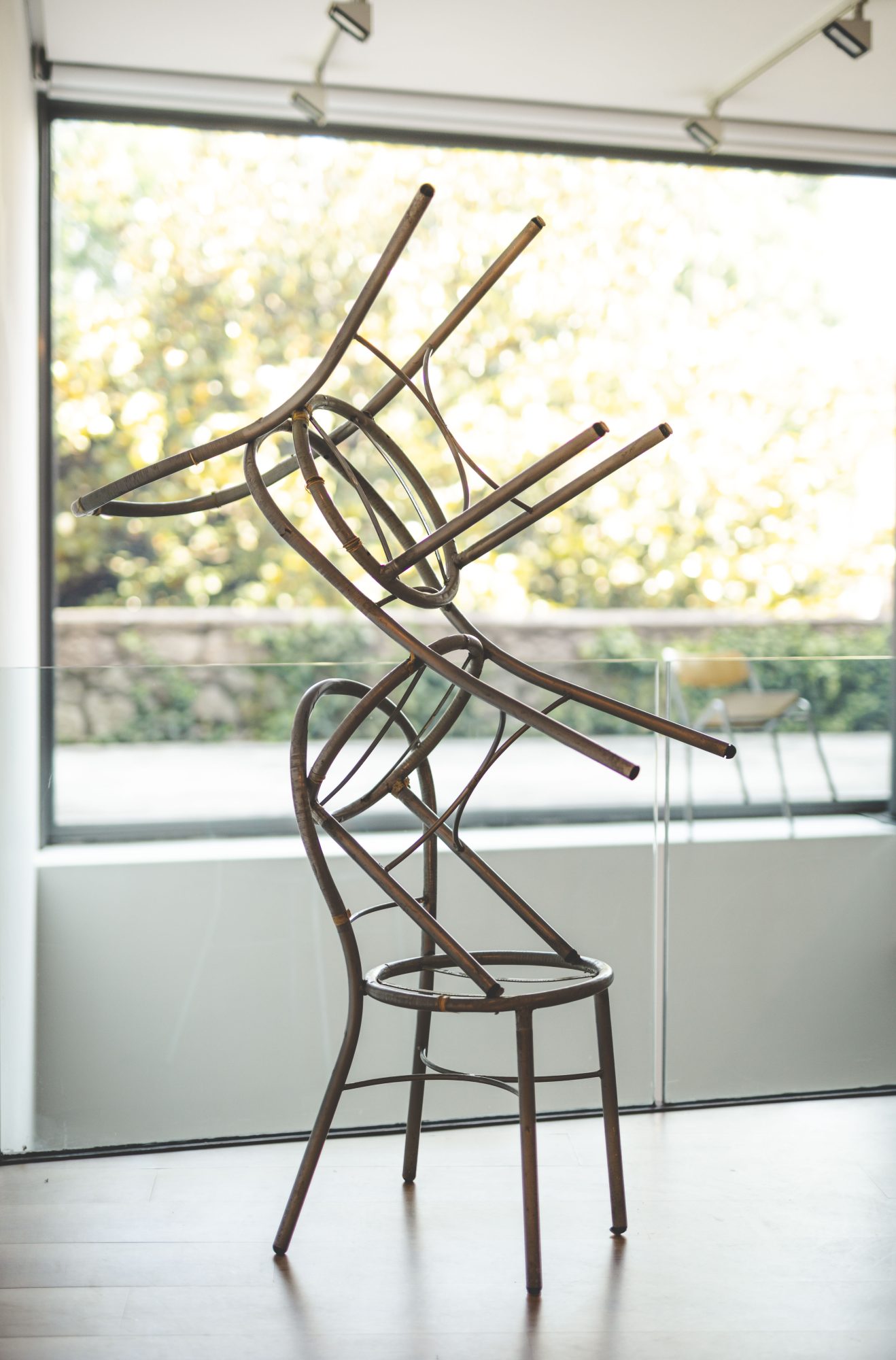
Carlos Bunga, Saltimbanqui #2, 2025. Chairs. 168 x 45 x 120 cm.
Enquire
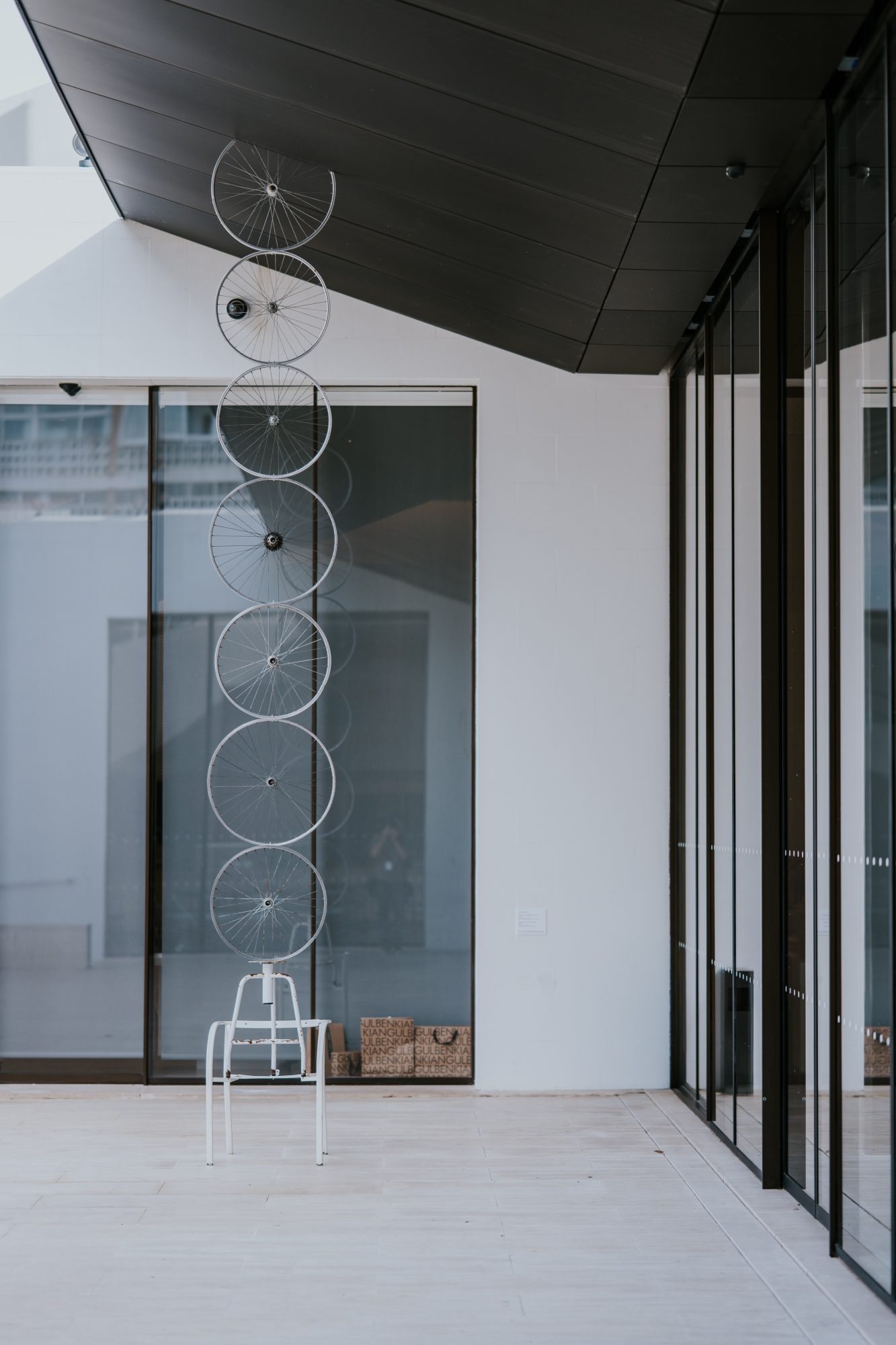
Carlos Bunga, Saltimbanqui #5, 2025. Chair, stool base and wheels. Minimum dimensions: 275 x 50 x 57 cm
Enquire

Carlos Bunga, Beijódromo, 2025. Iron. 175 x 21 cm.
Enquire
Part of Carlos Bunga’s practice involves reimagining found objects by physically altering them with paint, cardboard, and other materials. In the Calouste Gulbenkian Foundation’s South Garden, Bunga came upon this architectural vestige and has simply renamed it: Beijódromo. By doing so, he underscores how naming alone can redirect perception and meaning, shifting the site from an overlooked trace into a place of encounter and affection. The work highlights the kiss [beijo] as the symbol of connection, reaffirming bonds and countering the fragmentation of contemporary life.
Beijódromo, he notes, invites touch, mutual respect, and inclusion. Rather than a representation, it is a point where art and life converge, and where bodies openly embrace.
Durante os seus estudos de pintura e crescentemente dececionado com as convenções deste meio, Carlos Bunga começou a fazer experiências com materiais encontrados e descartados, que cortava e cosia com agulha e linha. Esta intervenção simples mas violenta deixava cicatrizes, testemunhando a ação e a impossibilidade de retorno à forma original. A seguir, os objetos eram colocados em espaços vazios e locais movimentados, por exemplo, um micro-ondas, um carrinho de compras, uma escada ou um escritório, onde perturbavam as rotinas de uso e movimento.
Como recorda o artista: «O que surgia deste tipo de performance era a imagem de um organismo vivo: exposto, resistente e sempre em movimento.»
Fotografada na altura e apresentada aqui pela primeira vez, a série confirma a fragmentação «como ferida e condição vital».
Carlos Bunga (b. 1976 Porto) attended the Escola Superior de Arte e Design in Caldas da Rainha, in Portugal. He currently lives and works near Barcelona.
He creates process-oriented works in various formats: sculptures, paintings, drawings, performances, video, and above all in situ installations, that refer to and intervene in their immediate architectural surroundings. While often using ordinary, unassuming materials such as packing cardboard and adhesive tape, Bunga’s work involves a highly developed degree of aesthetic care and delicacy, as well as a conceptual complexity derived from the inter-relationship between doing and undoing, between unmaking and remaking, between the micro and the macro, between investigation and conclusion.
Straddling the divide between sculpture and painting, Bunga’s deceptively delicate works are characterized by an intense study of the combination of color and materiality, while at the same time emphasize the performative aspect of the creative act. Bunga’s works on paper, which are closely related to his sculptures and installations, often involve overlays, whether of compositional elements in the paintings or sheets of translucent paper in the drawings. The analytic/descriptive result, like a photographic double-exposure, mimics the dual experience of memory and imagination underlying the sculpture.
Carlos Bunga has had solo shows at Centro de Arte Moderna (CAM), Gulbenkian Foundation (2025), The New Art Gallery Walsall (2024), Museo Helga de Alvear, Cáceres (2024), Sarasota Art Museum, Florida (2023), Bombas Gens, Valencia (2023), Palacio de Cristal – Museo Nacional Centro de Arte Reina Sofía, Madrid (2022); Secession, Wien (2021); Whitechapel Gallery, London (2020); MOCA – Museum of Contemporary Art, Toronto (2020); Centro Internacional das Artes José de Guimarães (2019); MAAT – Museu de Arte, Arquitectura e Tecnologia, Lisbon (2019); Fundação Carmona e Costa, Lisbon (2019); Museum of Contemporary Art Detroit (2018); MACBA – Museu d’Art Contemporani de Barcelona (2015); Museo de la Universidad Nacional de Colombia (Bogota, 2015); Museum Haus Konstruktiv, Zurich (2015): Museo Amparo, Puebla, México (2014); MUAC – Museo Universitario de Arte Contemporáneo, Mexico D.F. (2013); Pinacoteca do Estado de São Paulo (2012); Fundação Serralves, Oporto (2012); Hammer Museum, Los Angeles (2011); Miami Art Museum (2009) and MARCO – Museo de Arte Contemporánea de Vigo (2009).
Bunga participated in the 35th Bienal de São Paulo (2023), the Chicago Architecture Biennial (2015), the 29th Bienal de São Paulo (2010), the Trienal de Arquitectura de Lisboa (2010), the 14th Biennale Internazionale di Scultura di Carrara (2010) and Manifesta 5, San Sebastian (2004). Bunga was awarded the International Art Prize at Grand Rapids, Michigan (2013) and was short-listed for Artes Mundi 6 Prize, Cardiff (2015). His work is included in important collections such as The Museum of Modern Art (New York), Fundação Serralves (Oporto), Hammer Museum (Los Angeles), Patricia Phelps de Cisneros Collection (New York), Pinacoteca do Estado de São Paulo, Museum Haus Konstruktiv (Zurich), Pérez Art Museum (Miami), Museum of Contemporary Art Detroit, Museo Calouste Gulbenkian (Lisbon) or Museu d’Art Contemporani de Barcelona (MACBA), among others.
Carlos Bunga (Porto, 1976) frequentou a Escola Superior de Arte e Design em Caldas da Rainha, Portugal. Atualmente vive e trabalha perto de Barcelona.
As suas obras, orientadas para o processo, são criadas em vários formatos: esculturas, pinturas, desenhos, performances, vídeo, e, principalmente, instalações in situ, que se referem e intervêm na sua envolvente arquitectónica imediata. Embora utilizando frequentemente materiais simples e despretensiosos, tais como cartão de embalagem e fita adesiva, o trabalho de Bunga envolve um grau altamente desenvolvido de preocupação estética e delicadeza, bem como uma complexidade conceptual derivada da inter-relação entre fazer e desfazer, entre não fazer e refazer, entre o micro e o macro, entre investigação e conclusão.
Ultrapassando a divisão entre escultura e pintura, os trabalhos enganosamente delicados de Bunga caracterizam-se por um estudo intenso da combinação da cor e da materialidade, ao mesmo tempo que enfatizam o aspecto performativo do acto criativo. As obras de Bunga sobre papel, que estão intimamente relacionadas com as suas esculturas e instalações, envolvem frequentemente sobreposições, quer de elementos de composição nas pinturas, quer de folhas de papel translúcido nos desenhos. O resultado analítico/descritivo, como uma dupla exposição fotográfica, imita a dupla experiência da memória e da imaginação subjacente à escultura.
Carlos Bunga expôs individualmente no Centro de Arte Moderna (CAM) da Fundação Gulbenkian, The New Art Gallery Walsall (2024), Museo Helga de Alvear, Cáceres (2024), Sarasota Art Museum, Florida (2023), Bombas Gens, Valência (2023), Palácio de Cristal – Museo Nacional Centro de Arte Reina Sofía, Madrid (2022); Secession, Viena (2021); Whitechapel Gallery, Londres (2020); MOCA – Museu de Arte Contemporânea, Toronto (2020); Centro Internacional das Artes José de Guimarães (2019); MAAT – Museu de Arte, Arquitectura e Tecnologia, Lisboa (2019); Fundação Carmona e Costa, Lisboa (2019); Museu de Arte Contemporânea de Detroit (2018); MACBA – Museu d’Art Contemporani de Barcelona (2015); Museo de la Universidad Nacional de Colombia (Bogotá, 2015); Museum Haus Konstruktiv, Zurique (2015); Museo Amparo, Puebla, México (2014); MUAC – Museo Universitario de Arte Contemporáneo, México D. F. (2013); Pinacoteca do Estado de São Paulo (2012); Fundação Serralves, Porto (2012); Hammer Museum, Los Angeles (2011); Miami Art Museum (2009) e MARCO – Museo de Arte Contemporánea de Vigo (2009), entre outros.
Bunga, foi artista convidado da 35ª Bienal de São Paulo, na Bienal de Arquitectura de Chicago (2015), na 29ª Bienal de São Paulo (2010), Trienal de Arquitectura de Lisboa (2010), 14ª Bienal Internazionale di Scultura di Carrara (2010) e Manifesta 5, San Sebastian (2004). Bunga recebeu o Prémio Internacional de Arte em Grand Rapids, Michigan (2013) e foi pré-seleccionado para o Prémio Artes Mundi 6, Cardiff (2015).
A sua obra está incluída em importantes colecções tais como The Museum of Modern Art (Nova Iorque), Fundação Serralves (Porto), Hammer Museum (Los Angeles), Patricia Phelps de Cisneros Collection (Nova Iorque), Pinacoteca do Estado de São Paulo, Museu Haus Konstruktiv (Zurique), Pérez Art Museum (Miami), Museu de Arte Contemporânea de Detroit, Museu Calouste Gulbenkian (Lisboa) ou Museu d’Art Contemporani de Barcelona (MACBA), entre outros.