
Exhibition view: Ana Vieira. El hogar y la huida (Ana Vieira. The Home and the Escape), Es Baluard Museu d’Art Contemporani de Palma, Palma de Mallorca, Spain, 21.02.20-30.08.20 © of the works of art, Ana Vieira State, 2020 © of the photograph, Es Baluard Museu, 2020. Photographer: David Bonet
Enquire
A female silhouette searches for it self in the mirror; a silhouette in profile, centred and geometric, made of remnants, tissue paper and fragments in various shades of blue. A blue that will continue to appear in the different media which Ana Vieira (Coimbra, 1940 – Lisbon, 2016) had gone on to explore.
Uma silhueta feminina procura-se no espelho; uma silhueta de perfil, centrada e geométrica, feita de restos, papel de seda e fragmentos em vários tons de azul. Um azul que continuará a aparecer nos diferentes meios que Ana Vieira (Coimbra, 1940 – Lisboa, 2016) passou a explorar.
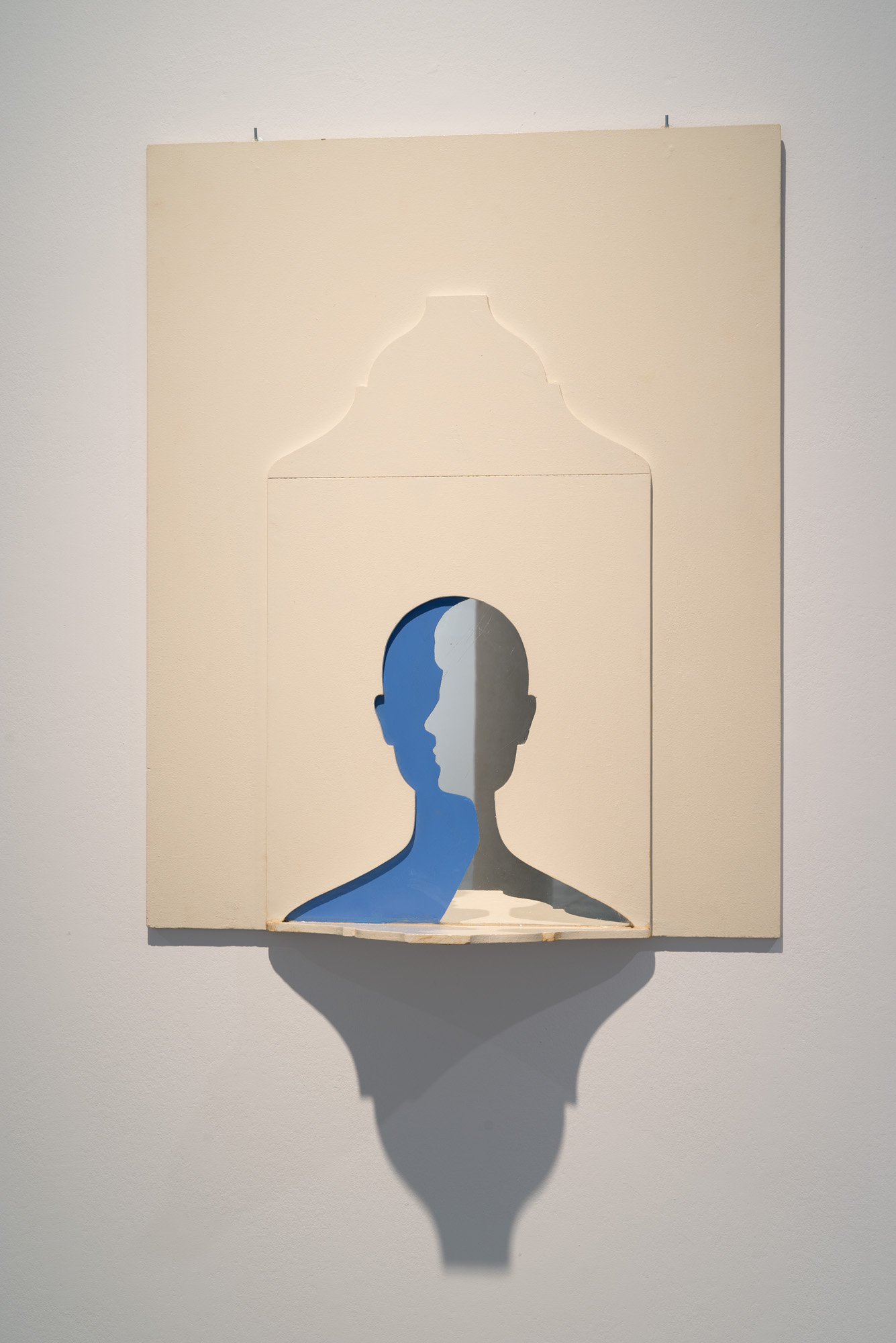
Ana Vieira, A Senhora M.M.T.S., 1967. Wood, mirror, and enamel paint. 100 x 80 x 23 cm. © of the work of art, Ana Vieira State, 2020 © of the photograph, Es Baluard Museu. Photographer: David Bonet
Enquire
Vieira invites the viewer to take part in the dialectic game she proposes with A Senhora M.M.T.S. [The Lady M.M.T.S.] (1967): again, a female silhouette, a mirror; but this time, the mirror is real and awaits the visitor’s reflection. The early two-dimensional fragments, in turn, extend into space and come forward to meet us. The artist’s need to explore artistic media in relation to frames (physical and symbolic), led her to a spatial opening-up of the physical limits. Layers of space framed in wood capture an overexposure: a male silhouette in blue and the female silhouette in the mirror within the first. It is curious that the same blue fills the whole of the body imprinted on the steps of A Passagem da Senhora M.L.T. [The Passage of Lady M.L.T.] (1967). Perhaps the artist project s this body imbued with blue into an unknown, desire space as a rising path to liberty.
Vieira convida o espetador a participar do jogo dialético que ela propõe com A Senhora M.M.T.S. (1967): novamente, uma silhueta feminina, um espelho; mas, desta vez, o espelho é real e aguarda o reflexo do visitante. Os primeiros fragmentos bidimensionais, por sua vez, estendem-se no espaço e avançam para nos encontrar. A necessidade da artista de explorar meios artísticos em relação a molduras (físicas e simbólicas) levou-a a uma abertura espacial dos limites físicos. Camadas de espaço emolduradas em madeira capturam uma superexposição: uma silhueta masculina em azul e a silhueta feminina no espelho dentro da primeira. É curioso que o mesmo azul preencha todo o corpo impresso nos degraus de A Passagem da Senhora M.L.T. (1967). Talvez a artista projete este corpo imbuído de azul num espaço desconhecido e desejado como um caminho ascendente para a liberdade.
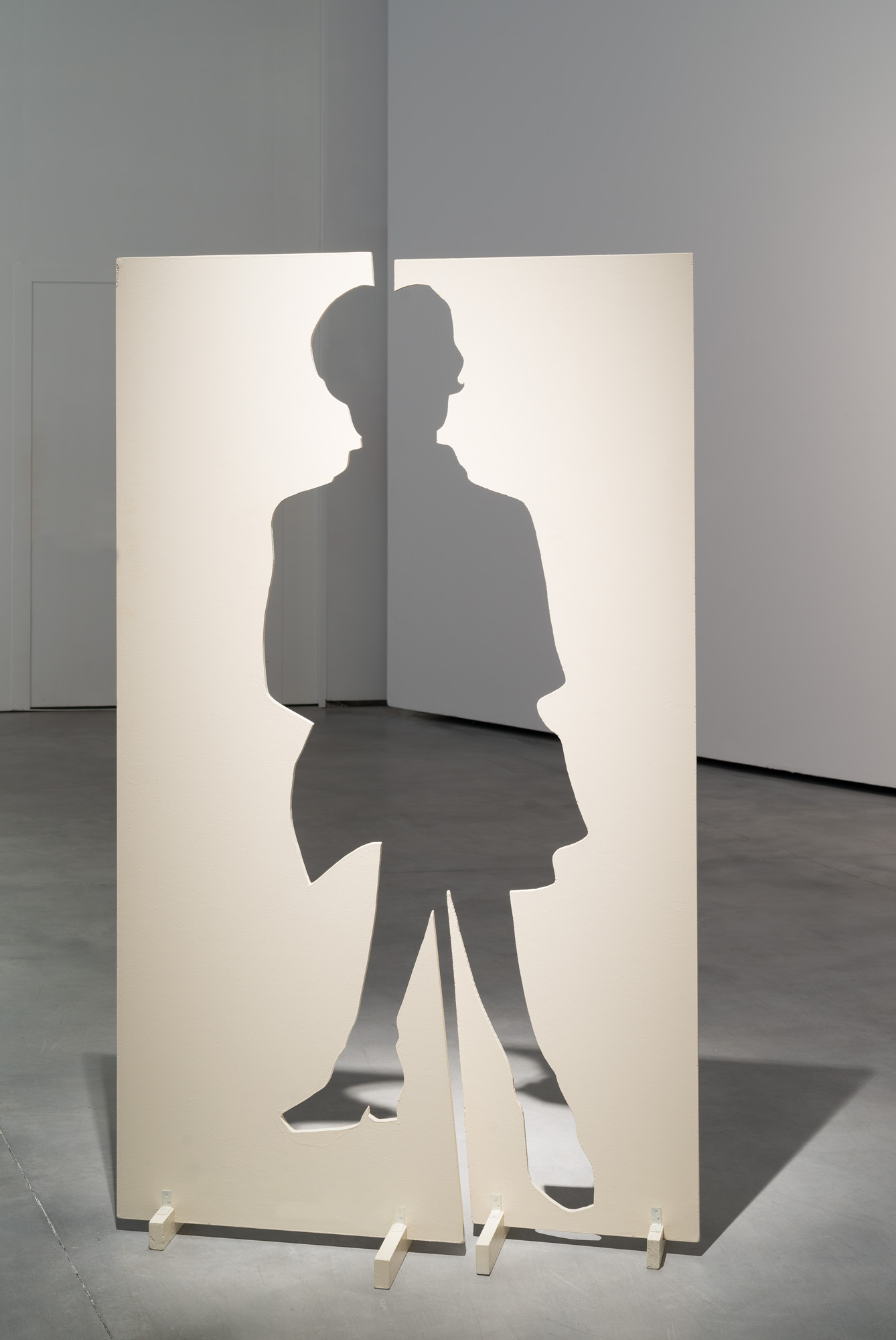
Ana Vieira, Untitled, 1968. Wood and enamel paint. 173 x 100 x 10 cm. © of the work of art, Ana Vieira State, 2020 © of the photograph, Es Baluard Museu. Photographer: David Bonet
Enquire
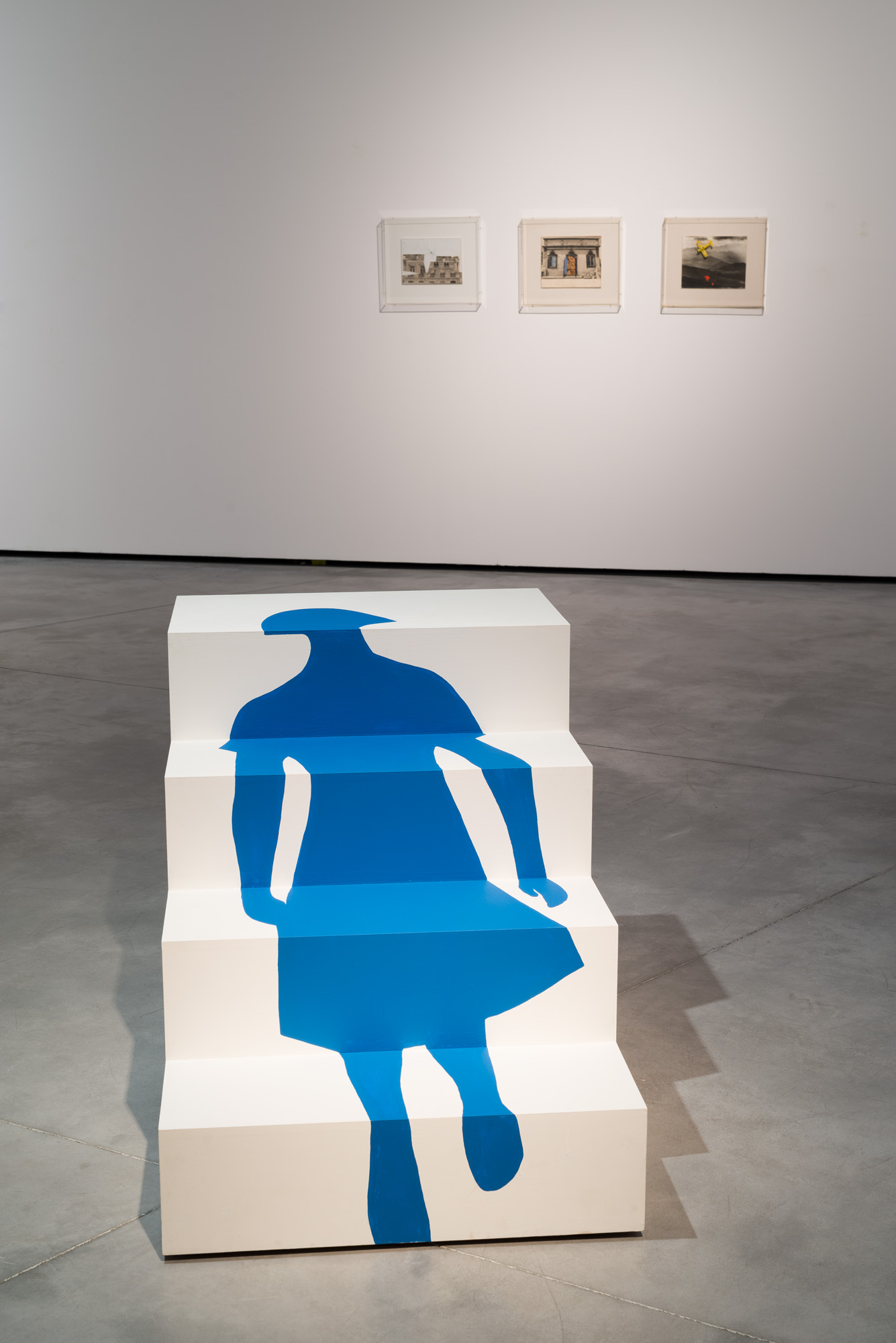
Ana Vieira, A Passagem da Senhora M.L.T., 1967-2007. Wood and acrylic paint. 80 x 116 x 74 cm. Unique. © of the work of art, Ana Vieira State, 2020 © of the photograph, Es Baluard Museu. Photographer: David Bonet
Enquire

Exhibition view: Ana Vieira. El hogar y la huida (Ana Vieira. The Home and the Escape), Es Baluard Museu d’Art Contemporani de Palma, Palma de Mallorca, Spain, 21.02.20-30.08.20 © of the works of art, Ana Vieira State, 2020 © of the photograph, Es Baluard Museu, 2020. Photographer: David Bonet
Enquire
The series of silkscreens done between 1973 and 1976 and some of the intervened photographs (1973-1978) introduce us into a reflection about the domestic sphere, those everyday tasks associated with women and the responsibilities that women acquire for family life to go smoothly. Is it a simple thing? A plate, some silverware, the necessary everyday intimacy; setting the table for the satisfaction of the those to be fed. Vieira introduces the elements, but she also includes the longings, projections of the future. At rain, a ship, a road; signs that materialise the wish to find other ways to live. The blue associated with liberty, from the sea to the sky, frames the furniture.
A série de serigrafias realizada entre 1973 e 1976 e algumas das fotografias intervencionadas (1973-1978) conduzem-nos a uma reflexão sobre a esfera doméstica, as tarefas quotidianas associadas às mulheres e as responsabilidades que estas assumem para que a vida familiar decorra sem problemas. É uma coisa simples? Um prato, alguns talheres, a intimidade quotidiana necessária; pôr a mesa para a satisfação daqueles que vão ser alimentados. Vieira introduz os elementos, mas também inclui os anseios, as projeções do futuro. A chuva, um navio, uma estrada; sinais que materializam o desejo de encontrar outras formas de viver. O azul associado à liberdade, do mar ao céu, emoldura o mobiliário.

Ana Vieira, Sala de Espera – Os Móveis a Afirmarem a sua Inutilidade, 2014. Furniture, molded plaster, paint, square linoleum flooring. 307 x 201 cm. Norlinda and José Lima Collection, on long-term loan at the Centro de Arte Oliva, São João da Madeira © of the photograph, Es Baluard Museu. Photographer: David Bonet
Enquire

Ana Vieira, Close-up 3, Close-up 8 and Close-up 10, 2004. © of the works of art, Ana Vieira State, 2020 © of the photograph, Es Baluard Museu. Photographer: David Bonet
Enquire

Ana Vieira, Close-up 3, 2004 (detail). © of the work of art, Ana Vieira State, 2020 © of the photograph, Es Baluard Museu. Photographer: David Bonet
Enquire
Gradually, the house bursts, scrutinizes itself and shows its guts. Leaving, going out to the exterior, is a must. Vieira oversteps the boundaries of private and public and brings us to the possibility of another reality. Blue tinges black and white photographs in the intrusion of objects and structures that make up a private identity. The stairs, a wall clock, a chair. Of all these, two are surprising. The reflection of a woman projected in a window; it is literal, we do not know if that female silhouette is an object, like the furniture, or a reflection of that projector drawn at the top of the stairs. And the curtains, curtains that insinuate two of the constants the begin to appear in the artist’s references: movement and visibility.


Ana Vieira, Close-up 10, 2004 (detail). © of the work of art, Ana Vieira State, 2020 © of the photograph, Es Baluard Museu. Photographer: David Bonet
Enquire


Ana Vieira, Close-up 8, 2004 (detail). © of the work of art, Ana Vieira State, 2020 © of the photograph, Es Baluard Museu. Photographer: David Bonet
Enquire
Aos poucos, a casa explode, examina-se a si própria e mostra as suas entranhas. Sair, ir para o exterior, é uma necessidade. Vieira ultrapassa as fronteiras do privado e do público e leva-nos à possibilidade de outra realidade. O azul tinge fotografias a preto e branco com a intrusão de objetos e estruturas que compõem uma identidade privada. As escadas, um relógio de parede, uma cadeira. De todos estes, dois são surpreendentes. O reflexo de uma mulher projetado numa janela; é literal, não sabemos se essa silhueta feminina é um objeto, como os móveis, ou um reflexo daquele projetor desenhado no topo das escadas. E as cortinas, cortinas que insinuam duas das constantes que começam a aparecer nas referências do artista: movimento e visibilidade.

Exhibition view: Ana Vieira. El hogar y la huida (Ana Vieira. The Home and the Escape), Es Baluard Museu d’Art Contemporani de Palma, Palma de Mallorca, Spain, 21.02.20-30.08.20 © of the works of art, Ana Vieira State, 2020 © of the photograph, Es Baluard Museu, 2020. Photographer: David Bonet
Enquire
The installation Ocultação/Desocultação [Hiding /Unhiding] (1978-2010) is resolved with a direct gesture, marking the architectural limit s of the home with the habitual construction materials, that is to say, bricks. The definitive feature is the inclusion of language, which leaves no room for doubt. Vieira marks and writes out everything that she would like to do; perhaps surprisingly, even the action of breathing is included.
A instalação Ocultação/Desocultação (1978-2010) é resolvida com um gesto direto, marcando os limites arquitetónicos da casa com os materiais de construção habituais, ou seja, tijolos. A característica definitiva é a inclusão da linguagem, que não deixa margem para dúvidas. Vieira marca e escreve tudo o que gostaria de fazer; talvez surpreendentemente, até mesmo a ação de respirar está incluída.

Ana Vieira, Atravessar o Visível, 2008. Printed text on 11 sheets of A4 paper and magnifying glass. 21 x 30 cm. © of the works of art, Ana Vieira State, 2020 © of the photograph, Es Baluard Museu. Photographer: David Bonet
Enquire
The play and seduction that is inherent in all that is to do with visibility is once again present in the work Atravessar o Visível [Crossing the Visible] (2008): words reduced to their minimum expression hide behind the white of the page. Like a voyeur, the visitor examines them and seeks to read them coming nearer to the work, the paper and the white tinged with inscriptions.
O jogo e a sedução inerentes a tudo o que tem a ver com visibilidade estão novamente presentes na obra Atravessar o Visível (2008): palavras reduzidas à sua expressão mínima escondem-se atrás do branco da página. Como um voyeur, o visitante examina-as e procura lê-las aproximando-se da obra, do papel e do branco tingido com inscrições.
The spectator’s gaze and presence are altered by the challenge posed by Vieira’s work. It is the spectator who decides what to see and what not to see. At the same time, the artist’s interests have been shaped by a constant need to transgress limits, both on the semantic and spatial levels. Since the nineteen-seventies, Vieira is immersed in a series of projects in which she gradually introduces new challenges: the frame or the medium, the object, the perimeter, the volume; invisibility and movement. Travelling on physical and mental paths, the visitor’s perception of and relationship with the work and the space are transformed.
O olhar e a presença do espetador são alterados pelo desafio colocado pela obra de Vieira. É o espetador que decide o que ver e o que não ver. Ao mesmo tempo, os interesses da artista foram moldados por uma necessidade constante de transgredir limites, tanto a nível semântico como espacial. Desde a década de 1970, Vieira está imersa numa série de projetos nos quais introduz gradualmente novos desafios: a moldura ou o meio, o objeto, o perímetro, o volume; invisibilidade e movimento. Viajando por caminhos físicos e mentais, a perceção e a relação do visitante com a obra e o espaço são transformadas.

Ana Vieira, O Desenho da Menina a Fugir do seu Suporte, 2014. Variable dimensions. 250 x 770 x 630 cm. Ed. 3. © of the work of art, Ana Vieira State, 2020 © of the photograph, Es Baluard Museu. Photographer: David Bonet
Enquire

Exhibition view: Ana Vieira. El hogar y la huida (Ana Vieira. The Home and the Escape), Es Baluard Museu d’Art Contemporani de Palma, Palma de Mallorca, Spain, 21.02.20-30.08.20 © of the works of art, Ana Vieira State, 2020 © of the photograph, Es Baluard Museu, 2020. Photographer: David Bonet
Enquire
O Desenho da Menina a Fugir do seu Suporte [Drawing of the Little Girl Running Away from her Medium] introduces the audio-visual language for the first time, and with an absolute simplicity, synthesizes and redefines: the silhouette of a woman who is fleeing, escaping from the structure, this time artistic, architectural and social.
– Imma Prieto
Ana Vieira: The Home and the Escape, Palma de Mallorca, Es Baluard – Museu d’Art Contemporani de Palma, Spain
Exhibition view “Ana Vieira. El hogar y la huida“ (Ana Vieira. The Home and the Escape), Es Baluard Museu d’Art Contemporani de Palma, Palma de Mallorca, Spain, 21.02.20-30.08.20 © of the works of art, Ana Vieira State, 2020 © of the photograph, Es Baluard Museu, 2020. Photographer: David Bonet
O Desenho da Menina a Fugir do seu Suporte introduz pela primeira vez a linguagem audiovisual e, com uma simplicidade absoluta, sintetiza e redefine: a silhueta de uma mulher que foge, escapando da estrutura, desta vez artística, arquitetónica e social.
– Imma Prieto
Ana Vieira: The Home and the Escape, Palma de Maiorca, Es Baluard – Museu d’Art Contemporani de Palma, Palma de Maiorca, Espanha
Exhibition view “Ana Vieira. El hogar y la huida” (Ana Vieira. The Home and the Escape), Es Baluard Museu d’Art Contemporani de Palma, Palma de Mallorca, Spain, 21.02.20-30.08.20 © of the works of art, Ana Vieira State, 2020 © of the photograph, Es Baluard Museu, 2020. Photographer: David Bonet
Ana Vieira was born in Coimbra in 1940, spent her childhood and early years on the island of São Miguel in the Azores, and lived most of her adult life in Lisbon, where she died in 2016. She graduated in Painting from the School of Fine Arts (1966) and was awarded the AICA Prize in 1991.
Ana Vieira started exhibiting her work regularly in the late 1960s and established herself as one of the key figures of Portuguese contemporary art in the decades that followed. Anchored in a critical thinking and an artistic language that explores the limits and the traditional supports of art, particularly painting and sculpture, her practice aligns with the conceptual art movement and is markedly influenced by the exploration of everyday objects, spaces, and situations. Often in the form of installations, Vieira plays with representations of passages, half-spaces and transparencies, creating hybrid territories simultaneously visible and inaccessible, welcoming and hostile. These scenic creations allow for different possibilities for the experiencing of objects, freeing them from their function and inscribing them in a poetic dimension that lies between allegory and simulacrum.
Her work has been the subject of two major retrospective exhibitions, at the Serralves Museum in 1998 and at the Calouste Gulbenkian Foundation’s Modern Art Center in 2011, institutions with significant collections of the artist’s work. In 2017, the Graça Morais Art Center presented a major posthumous solo exhibition, and in 2020, the Es Baluard Museum, in Spain, dedicated an important retrospective exhibition of the artist’s work. More recently, the exhibition “Ana Vieira: Cadernos de Montagem” has brought renewed attention to the work of one of the most iconic artists of the 20th century, studying, documenting, and exhibiting a collection of emblematic works.
Her work has been regularly featured in group exhibitions at national and international institutions, including: MAAT – Museum of Art, Architecture and Technology, and EDP Foundation (Lisbon, PT); MNAC – National Museum of Contemporary Art (Lisbon, PT); José de Guimarães Arts Center (Guimarães, PT); Calouste Gulbenkian Foundation (Lisbon, PT); Serralves Museum (Porto, PT); CAV – Visual Arts Center (Coimbra, PT); Berardo Collection Museum (Lisbon, PT); Culturgest (Lisbon, PT); and also MARCO – Vigo Art Museum (Vigo, ES); SESC Pompeia (São Paulo, BR); National Museum of Women in the Arts (Washington, USA); La Monnaie de Paris (Paris, FR); Afro-Brazil Museum (São Paulo, BR), among others.
Ana Vieira’s work is represented not only in the collections of Calouste Gulbenkian Foundation’s Modern Art Center (CAM), Serralves Museum, Culturgest, State Contemporary Art Collection (CACE), Contemporary Art Museum – Belém Cultural Center (MAC/CCB), but also in the EDP Foundation, Carmona e Costa Foundation, and Musée Cantonal de Beaux-Arts, Switzerland.
The artist’s archival collection is on deposit at the Banco de Arte Contemporânea (BAC).
Ana Vieira nasceu em Coimbra em 1940, passou a infância na ilha de S. Miguel, nos Açores e viveu grande parte da sua vida adulta em Lisboa, onde faleceu em 2016. Concluiu o curso de Pintura na Escola Superior de Belas-Artes (1966) e foi distinguida com o Prémio AICA em 1991.
Começa a expor com regularidade no final dos anos 1960, afirmando-se nas décadas seguintes como uma das figuras incontornáveis da arte contemporânea portuguesa, com um pensamento crítico e uma linguagem artística que explora os limites e suportes das disciplinas, em particular da pintura e da escultura. A sua prática, alinhada com os movimentos da arte concetual, é marcadamente influenciada pela exploração dos objetos comuns, pelos espaços e situações do quotidiano, muitas vezes sob a forma de instalações onde jogos de transparências criam territórios híbridos, simultaneamente visíveis e inacessíveis, acolhedores e hostis. Estas criações cénicas oferecem outras hipóteses para a experiência dos objetos, libertando-os da sua função e inscrevendo-os numa dimensão poética que se insinua entre a alegoria e o simulacro.
O seu trabalho foi objeto de duas grandes exposições antológicas, no Museu de Serralves, em 1998, e no Centro de Arte Moderna da Fundação Calouste Gulbenkian, em 2011, instituições com relevante acervo da artista. Em 2017, o Centro de Arte Graça Morais apresenta uma grande exposição individual póstuma, e, em 2020, o Museu Es Baluard, em Espanha, dedica-lhe uma importante exposição retrospetiva. Mais recentemente, a exposição “Ana Vieira: Cadernos de Montagem”, confere renovada atenção à obra de uma das mais icónicas artistas do século XX, estudando, documentando e expondo um conjunto de obras emblemáticas.
A sua obra vem sendo apresentada regularmente em exposições coletivas, em instituições nacionais e internacionais, de entre as quais se destacam: MAAT – Museu de Arte, Arquitetura e Tecnologia e Fundação EDP (Lisboa, PT); Museu Nacional de Arte Contemporânea (Lisboa, PT); Centro de Artes José de Guimarães (Guimarães, PT); Fundação Calouste Gulbenkian (Lisboa, PT); Museu de Serralves (Porto, PT); CAV – Centro de Artes Visuais (Coimbra, PT); Museu Coleção Berardo (Lisboa, PT); Culturgest (Lisboa, PT); e, ainda, MARCO – Museu de Arte de Vigo (Vigo, ES); SESC Pompeia (São Paulo, BR); National Museum of Women in the Arts (Washington, EUA); La Monnaie de Paris (Paris, FR); Museu Afro-Brasil (São Paulo, BR), entre outros.
O trabalho de Ana Vieira está representado não só nas coleções do Centro de Arte Moderna (CAM) – Fundação Calouste Gulbenkian, do Museu de Serralves, da Culturgest, da Coleção de Arte Contemporânea do Estado (CACE), do Museu de Arte Contemporânea do Centro Cultural de Belém (MAC/CCB), como também da Fundação EDP, da Fundação Carmona e Costa e do Musée Cantonal de Beaux-Arts, na Suíça.
O espólio documental da artista está em depósito no BAC (Banco de Arte Contemporânea).
